Kulasekarapattinam Spaceport To Handle 25 Annual Satellite Launches
Source:The Hindu ↗
Why It Matters
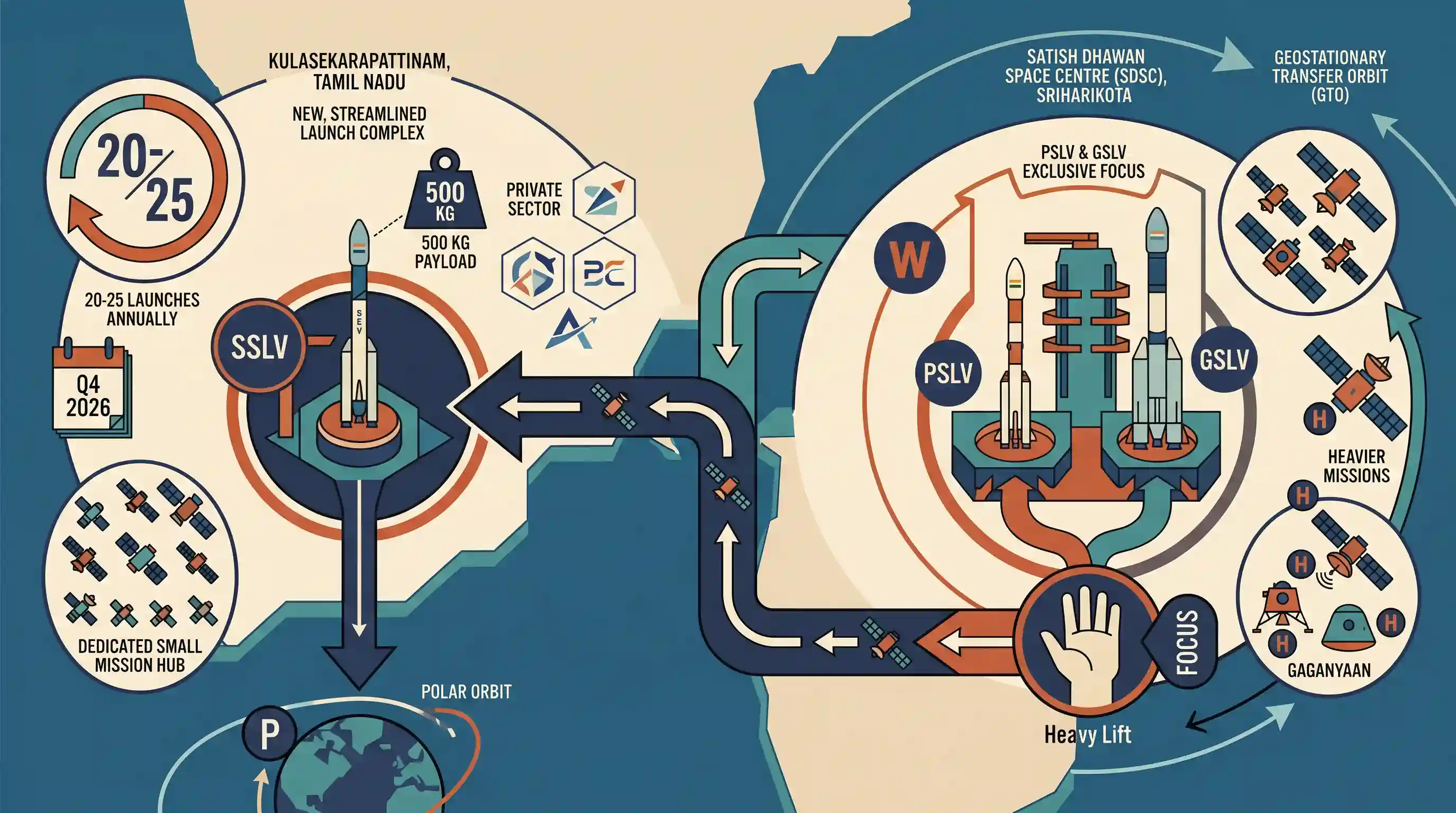
The Kulasekarapattinam spaceport marks a crucial step in commercializing India's space sector, accommodating the rising global demand for small satellite launches and providing dedicated infrastructure for emerging private space startups under India's new space policy.
Summary
ISRO's new rocket launch complex at Kulasekarapattinam, Tamil Nadu, is set to commence commercial operations by the fourth quarter of 2026. Designed specifically for Small Satellite Launch Vehicles (SSLVs) and private sector rockets carrying payloads up to 500 kg, the facility is expected to conduct 20 to 25 launches annually. This development will establish a dedicated hub for small-scale space missions while freeing up the Satish Dhawan Space Centre (SDSC) in Sriharikota to focus exclusively on launching heavier PSLV and GSLV payloads.
Key Points
- ISRO is building its second rocket launch complex at Kulasekarapattinam in Tamil Nadu, designed to become operational by Q4 2026.
- The new facility will be dedicated to launching Small Satellite Launch Vehicles (SSLVs) and private rockets carrying payloads up to 500 kg.
- It is projected to handle 20 to 25 satellite launches annually, catering significantly to the private space sector and small satellite market.
- The primary launchpad at SDSC, Sriharikota, will be exclusively reserved for heavier missions utilizing PSLV and GSLV rockets.
- Land acquisition of 2,233 acres is complete, and preliminary construction operations worth ₹100 crore have commenced.
Important Terms
Small Satellite Launch Vehicle (SSLV)

A three-stage, all-solid propellant rocket developed by ISRO to launch small satellites (up to 500kg) into Low Earth Orbit. It features low cost, rapid turnaround, and minimal infrastructure.
UPSC context
GS-3 (Space Technology); tests understanding of India's commercial space shift and launch-on-demand capabilities.
Polar Satellite Launch Vehicle (PSLV)
India's reliable 'workhorse' launcher using four alternating solid and liquid stages. It is primarily used for placing remote sensing satellites into Sun-Synchronous Polar Orbits and interplanetary missions.
UPSC context
GS-3 (Space Technology); covers the evolution of India’s satellite delivery systems and historical mission successes.
Geosynchronous Satellite Launch Vehicle (GSLV)
A fourth-generation heavy-lift launcher using an indigenous cryogenic upper stage. It is designed to place heavy communication satellites into high-altitude Geosynchronous Transfer Orbits (GTO).
UPSC context
GS-3 (Space Technology); tests knowledge of cryogenic technology and self-reliance in heavy satellite launches.
Satish Dhawan Space Centre (SDSC)
The primary spaceport of India located at Sriharikota, Andhra Pradesh. It provides infrastructure for vehicle assembly, fueling, and launching for PSLV, GSLV, and LVM3 missions.
UPSC context
GS-3 (S&T/Geography); examines strategic infrastructure and the geographical advantages of India's coastal launch sites.
Liquid Propulsion Systems Centre (LPSC)
ISRO’s specialized center for the design and development of liquid propulsion stages, Vikas engines, and cryogenic systems used in launch vehicles and satellite missions.
UPSC context
GS-3 (Space Technology); tests knowledge of ISRO’s organizational structure and core propulsion research centers.
ISRO
The national space agency of India under the Department of Space, responsible for space research, satellite communication, planetary exploration, and indigenous launch vehicle development.
UPSC context
GS-3 (S&T/Governance); foundational for understanding India’s space program, global position, and scientific achievements.
Prelims Trap
Kulasekarapattinam launchport is designed to eventually replace Sriharikota for all future PSLV and GSLV launches.
Kulasekarapattinam is exclusively for Small Satellite Launch Vehicles (SSLVs) and private rockets up to 500 kg. Sriharikota retains all heavier PSLV and GSLV missions.
Static Concepts Connected
Why is Kulasekarapattinam geographically ideal for launching SSLVs?
- Direct southward trajectory: It provides a clear path for straight southward launches into polar orbits without flying over populated landmasses.
- No Dogleg maneuver: Rockets from Sriharikota must curve around Sri Lanka, wasting fuel. Kulasekarapattinam eliminates this fuel-heavy maneuver, maximizing the limited payload capacity of smaller rockets.
What are the defining features of ISRO's Small Satellite Launch Vehicle (SSLV)?
- Payload capacity: Designed specifically to carry smaller payloads of up to 500 kg to Low Earth Orbit (LEO), catering to the microsatellite boom.
- Quick turnaround: Can be integrated and launched in under a week by a small team, enabling low-cost, launch-on-demand commercial services.
- Propulsion stages: Utilizes three solid-propulsion stages alongside a liquid-fueled Velocity Trimming Module (VTM) for precise terminal orbit insertion.
Cross-Topic Patterns
Indian Space Policy 2023 alignment
The new spaceport enables the policy's goal of empowering Non-Governmental Entities (NGEs) by providing dedicated infrastructure for high-frequency private rocket launches.
Geographic determinism in spaceports
Highlights physical geography principles: east coast sites leverage Earth's rotation for equatorial orbits, while southern peninsular tips optimize polar trajectories.

Expect a 2026 question merging SSLV technical features with the geographic necessity of avoiding the dogleg maneuver over Sri Lanka.
Linked PYQs · 2
Linked PYQs · 2
- 2018PrelimsGS1
With reference to India's satellite launch vehicles, consider the following statements: 1. PSLVs launch the satellites useful for Earth resources monitoring whereas GSLVs are designed mainly to launch communication satellites. 2. Satellites launched by PSLV appear to remain permanently fixed in the same position in the sky, as viewed from a particular location on Earth. 3. GSLV Mk III is a four-staged launch vehicle with the first and third stages using solid rocket motors; and the second and fourth stages using liquid rocket engines. Which of the statements given above is/are correct?
- 2016MainsGS3
Discuss India's achievements in the field of Space Science and Technology. How the application of this technology has helped India in its socio-economic development?
