Kuki-Zo State Reorganization Demands and Federal Challenges in Manipur
Source:Indian Express ↗
Why It Matters
The demand for a separate Union Territory in Manipur is a prime case study for UPSC aspirants on how ethnic conflicts stress India's federal framework. It connects constitutional concepts of state reorganization and tribal autonomy with real-world internal security challenges and border management issues in the Northeast.
Summary
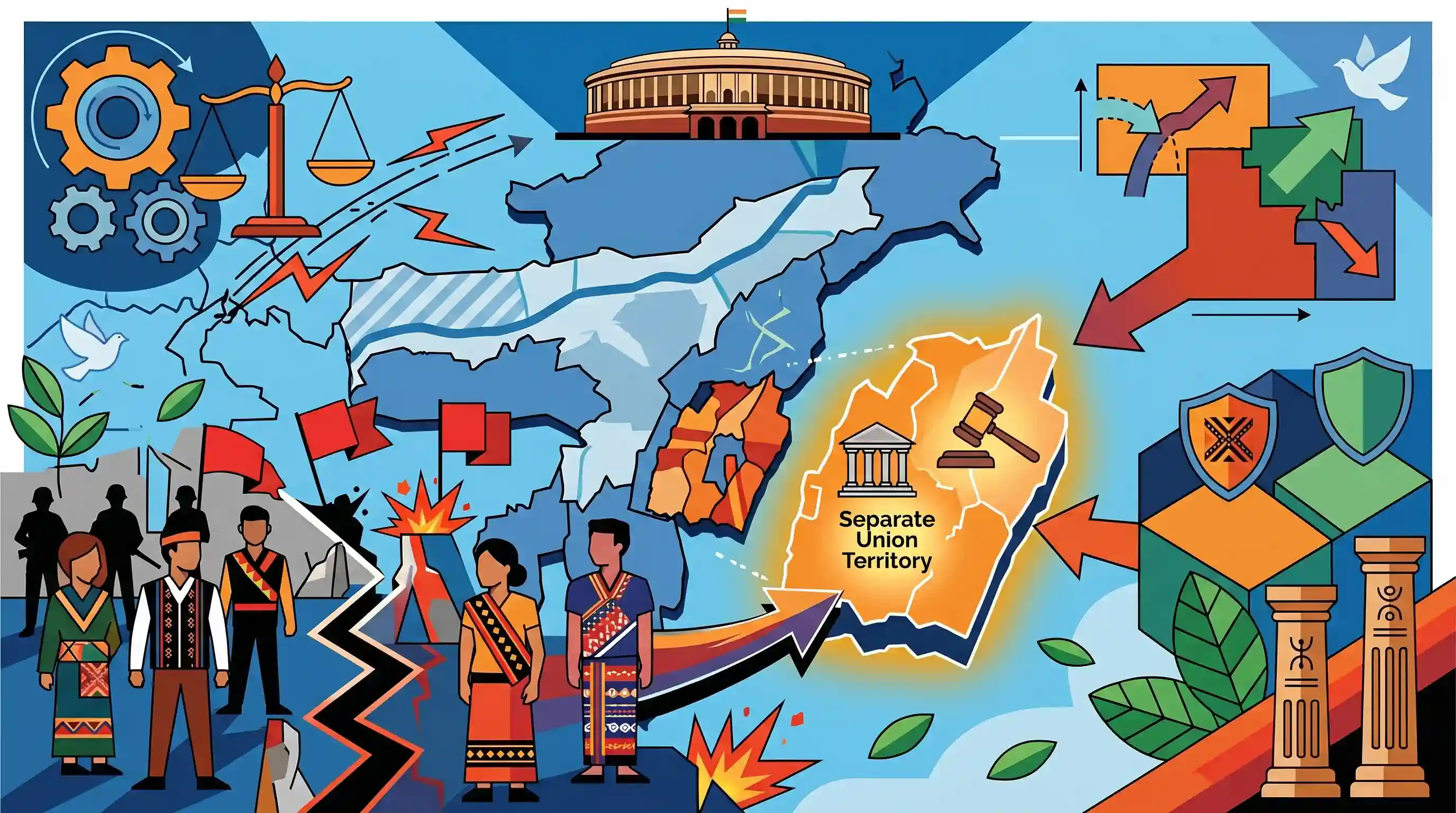
The Kuki-Zo Council (KZC) in Manipur is advocating for a separate Union Territory with its own legislature as the definitive political solution to the ongoing ethnic conflict with the Meitei community. This demand highlights severe internal security challenges and ethnic fractures in Northeast India, bringing to the forefront constitutional debates regarding state reorganization (Article 3), the mechanisms for tribal autonomy (such as the Sixth Schedule), and the limits of asymmetric federalism.
Key Points
- The Kuki-Zo community, represented by the Kuki-Zo Council (KZC), is firmly demanding a separate administration in the form of a Union Territory with a legislature as a political solution to the ethnic conflict in Manipur.
- The demand reflects the deepening ethnic divide and the community's assertion that co-existence with the Meitei majority under the current state administration is no longer viable.
- Constitutionally, the creation of a new Union Territory or State falls under Article 3, while a UT with a legislature is governed by provisions like Article 239A, raising debates around federalism and territorial reorganization.
- The prolonged conflict and demands for separation exacerbate internal security challenges in the strategically sensitive Northeast region, which shares porous borders with Myanmar.
Important Terms
Article 3 of the Indian Constitution

Empowers Parliament to form new States or Union Territories, and alter the areas, boundaries, or names of existing States by a simple majority without a formal constitutional amendment.
UPSC context
GS Paper II: Essential for topics on Federalism and State Reorganization; tests understanding of India's 'indestructible Union of destructible states'.
Article 239A of the Indian Constitution
A constitutional provision that enables Parliament to create a local legislature, a Council of Ministers, or both for certain Union Territories (currently Puducherry).
UPSC context
GS Paper II: Relevant for debates on 'Separate Administration' and asymmetric federalism in conflict-prone Union Territories.
Sixth Schedule
Provides for the administration of tribal areas in Assam, Meghalaya, Tripura, and Mizoram through Autonomous District Councils (ADCs) with legislative, executive, and judicial powers.
UPSC context
GS Paper II & III: Critical for tribal autonomy, decentralization, and internal security challenges in Northeast India.
Kuki-Zo Council (KZC)
The apex representative body of the Kuki-Zo tribes in Manipur, spearheading the demand for a separate Union Territory with a legislature to resolve ethnic conflict.
UPSC context
GS Paper III: Relevant for internal security, ethnic conflicts, and peacebuilding processes in Northeast India.
Prelims Trap
Creating a Union Territory with a legislature requires a Constitutional Amendment Act under Article 368.
Under Article 239A and Article 4, Parliament can create a legislature for a UT or alter state boundaries via an ordinary law. It does not require an Article 368 amendment.
Static Concepts Connected
How does Parliament alter boundaries or create a new UT?
- Article 3: Parliament can form new states/UTs by separating territory from any State via an ordinary majority.
- Prior Recommendation: A bill for this purpose requires the prior recommendation of the President.
- State Legislature Views: The President must refer the bill to the concerned State Legislature for its views, though these views are not binding on Parliament.
- Article 4 Exemption: Laws made under Article 3 are explicitly exempt from being considered constitutional amendments under Article 368.
What are the special constitutional safeguards for Manipur?
- Article 371C: The President can create a committee of MLAs elected from the Hill Areas of Manipur to protect tribal interests.
- Governor's Responsibility: The Governor has special responsibility to ensure the proper functioning of this Hill Areas Committee and submits an annual report to the President.
- Union Executive Power: The executive power of the Union extends to giving directions to the State as to the administration of these Hill Areas.
Cross-Topic Patterns
Border Management + Golden Triangle
The Manipur conflict is compounded by the porous Myanmar border, linking ethnic insurgencies and the Free Movement Regime (FMR) debate with transnational drug trafficking from the Golden Triangle.
Asymmetric Federalism + Tribal Autonomy
The Kuki-Zo demand underscores the perceived failure of Article 371C (Hill Areas Committee) compared to the robust executive and legislative autonomy granted by the Sixth Schedule in other Northeast states.

Expect a 2026 multi-statement question interlinking Art 3 (state reorganization), Art 371C (Manipur Hill Areas), and Art 239A (UTs).
Linked PYQs · 4
Linked PYQs · 4
- 2017MainsGS3
The North-East region of India has been infested with insurgency for a very long time. Analyze the major reasons for the survival of armed insurgency in this region.
- 2019MainsGS3
Cross-border movement of insurgents is only one of the several security challenges facing the policing of the border in North-East India. Examine the various challenges currently emanating across the India-Myanmar border. Also, discuss the steps to counter the challenges.
- 2022MainsGS2
“While the national political parties in India favour centralisation, the regional parties are in favour of State autonomy.” Comment.
- 2015PrelimsGS1
The provisions in Fifth Schedule and Sixth Schedule in the Constitution of India are made in order to
