Kuki Zo Council Demand for Separate Union Territory
Source:Indian Express ↗
Why It Matters
The ongoing crisis in Manipur underscores the complexities of ethnic divides, internal security, and borderland governance. Demands for a separate UT invoke crucial UPSC themes such as the reorganization of states (Article 3), the efficacy of existing autonomous frameworks, and the Union's role in conflict resolution.
Summary
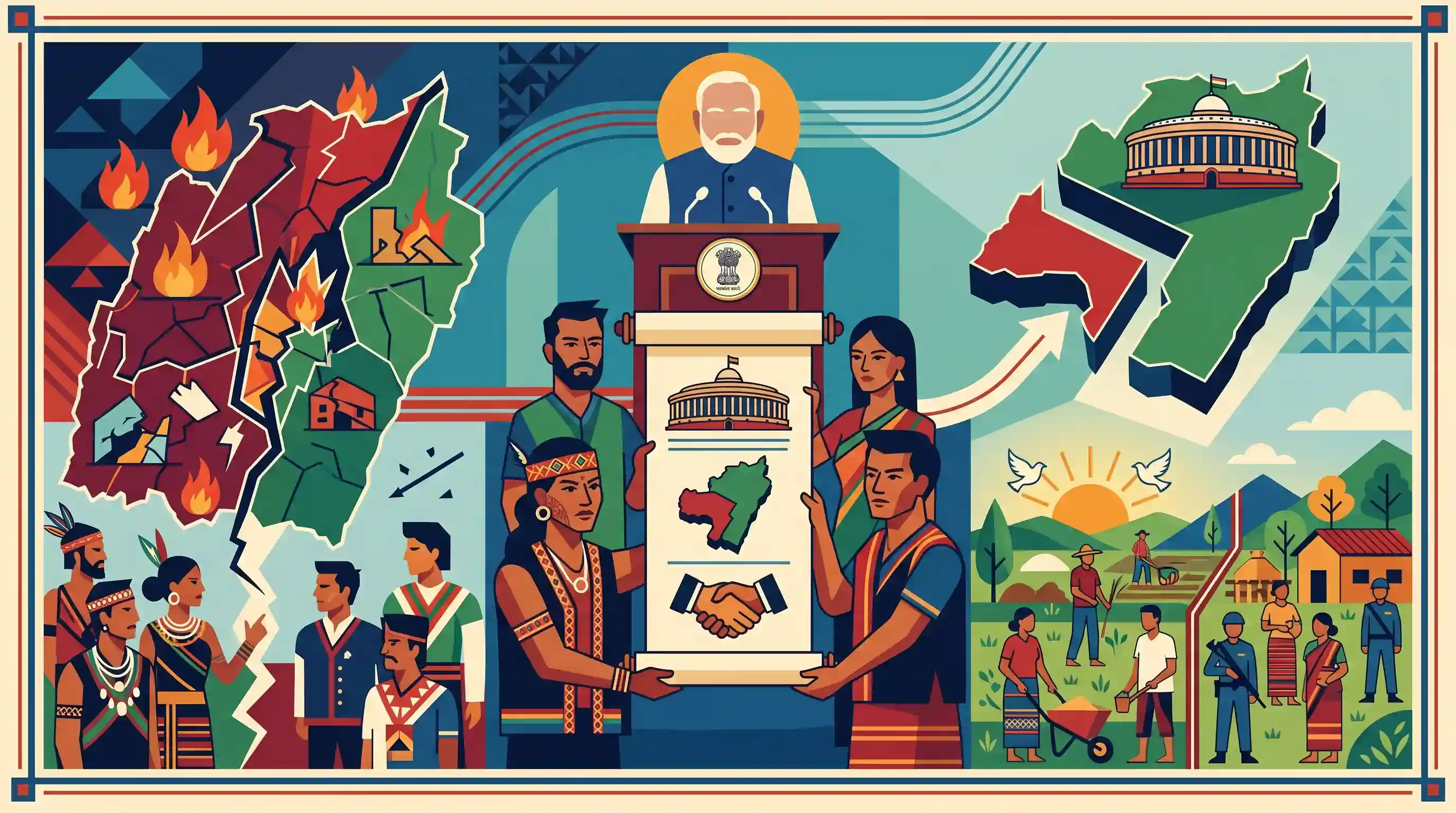
The Kuki-Zo Council has formally requested Prime Minister Narendra Modi to create a separate Union Territory with a legislature for the Kuki-Zo communities in Manipur. Emphasizing the deep fractures caused by the ongoing ethnic conflict with the Meiteis, the Council argued that shared administration is no longer viable. This demand for political and territorial reorganization is being pushed as the essential precondition for restoring lasting peace and security in the state.
Key Points
- The Kuki-Zo Council submitted a memorandum to PM Modi demanding a separate Union Territory with a legislative assembly for the Kuki-Zomi-Hmar communities.
- The Council maintained that co-existence with the Meitei community is impossible following the prolonged ethnic violence in Manipur.
- They framed this administrative and territorial reorganization as an absolute prerequisite for any lasting peace settlement.
- This demand invokes constitutional debates around state reorganization (Article 3), asymmetric federalism, and the administration of tribal areas in the North East.
Important Terms
Article 3 of the Constitution

Empowers Parliament to create new States or Union Territories and alter boundaries, areas, or names of existing States by a simple majority, following a Presidential recommendation and state legislature consultation.
UPSC context
GS Paper-II: Indian Polity and Constitution. Crucial for questions on federalism, state reorganization, and the Union's power over state boundaries.
Sixth Schedule
Provides for the administration of tribal areas in Assam, Meghalaya, Tripura, and Mizoram through Autonomous District Councils (ADCs) with legislative, executive, and judicial powers to protect tribal identity.
UPSC context
GS Paper-II/III: Tribal governance and Northeast security. Tests understanding of asymmetric federalism and institutional safeguards for indigenous communities.
Article 371C
A special constitutional provision for Manipur that empowers the President to constitute a committee of the State Legislative Assembly consisting of members from the Hill Areas to safeguard tribal interests.
UPSC context
GS Paper-II: Special provisions for states. Important for analyzing governance failures and ethnic tensions in Manipur.
Kuki-Zo Council (KZC)
An umbrella socio-political organization formed in 2024 to represent Kuki-Zo tribal communities in Manipur, advocating for a separate Union Territory with a legislature due to ethnic conflict.
UPSC context
GS Paper-III: Internal Security. Represents key stakeholders in Northeast ethnic conflicts and negotiations for political settlements.
Hill Areas Committee (HAC)
A constitutional body in Manipur formed under Article 371C, comprising MLAs from hill districts, meant to monitor and advise on administration and development in tribal areas.
UPSC context
GS Paper-II: Federalism and regional autonomy. Tests knowledge of state-specific institutional mechanisms for protecting minority rights.
Suspension of Operations (SoO) Pact
A tripartite ceasefire agreement signed in 2008 between the Centre, Manipur government, and Kuki-Zo insurgent groups (KNO and UPF) to halt hostilities and initiate political dialogue.
UPSC context
GS Paper-III: Internal Security. Critical for understanding peace processes and the role of non-state actors in Northeast insurgencies.
Prelims Trap
"Manipur's tribal hill areas are administered under the Sixth Schedule of the Indian Constitution."
Manipur is NOT a Sixth Schedule state (which only covers Assam, Meghalaya, Tripura, Mizoram). Instead, Article 371C provides for a distinct Hill Areas Committee for Manipur.
Static Concepts Connected
How does Parliament create a new State or UT under Article 3?
- Simple Majority: Parliament can form new states or UTs by a simple majority; it does not require a constitutional amendment under Article 368.
- Presidential Recommendation: A bill for state reorganization requires the prior recommendation of the President before introduction in Parliament.
- Non-binding Consultation: The President must refer the bill to the concerned State Legislature for its views, but these views are not binding on Parliament.
What is the special provision for Manipur under Article 371C?
- Hill Areas Committee: The President is authorized to provide for the creation of a committee of the Manipur Legislative Assembly consisting of members elected from the Hill Areas.
- Governor's Responsibility: The Governor has a special responsibility to ensure the proper functioning of this committee and must submit an annual report to the President.
- Union Executive Power: The executive power of the Union extends to giving directions to the State regarding the administration of these Hill Areas.
Cross-Topic Patterns
Topography dictating internal security
The Imphal Valley vs. Hill Districts demographic divide acts as a force multiplier for ethnic insurgencies, heavily complicating border management with Myanmar and the debate over AFSPA applicability.
Asymmetric federalism and UT legislatures
The demand invokes Article 239A. Currently, only Delhi, Puducherry, and J&K have constitutional provisions for legislatures, representing a unique hybrid model of federalism with overarching central control.

Expect a tricky match-the-following Prelims question blending Article 371C, Inner Line Permit (ILP), and the 6th Schedule for Manipur.
Linked PYQs · 4
Linked PYQs · 4
- 2025MainsGS3
What are the major challenges to internal security and peace process in the North-Eastern States? Map the various peace accords and agreements initiated by the government in the past decade.
- 2017MainsGS3
The North-East region of India has been infested with insurgency for a very long time. Analyze the major reasons for the survival of armed insurgency in this region.
- 2024MainsGS2
What changes has the Union Government recently introduced in the domain of Centre-State relations ? Suggest measures to be adopted to build the trust between the Centre and the States and for strengthening federalism.
- 2015PrelimsGS1
The provisions in Fifth Schedule and Sixth Schedule in the Constitution of India are made in order to
