Delimitation Based Solely on Population Faces Southern Pushback
Source:The Hindu ↗
Why It Matters
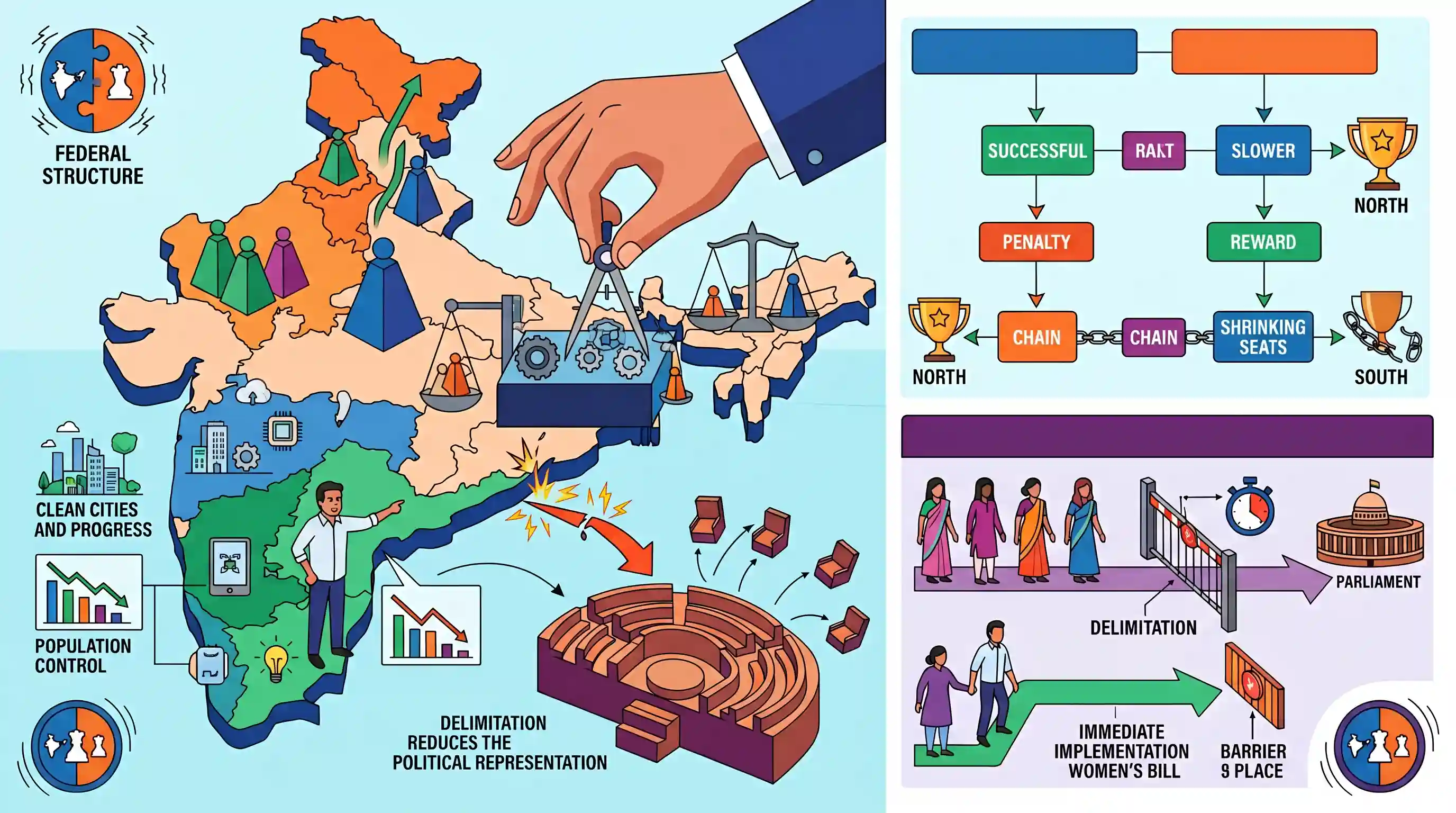
This article brings out a crucial conflict in Indian federalism: the tension between democratic representation (which favours higher population) and progressive demographic performance (where southern states have excelled). It is a classic GS2 Centre-State relation debate encompassing the constitutional freeze on delimitation and the implementation mechanics of the Women's Reservation Bill.
Summary
Bharat Rashtra Samithi (BRS) working president K.T. Rama Rao has strongly objected to the Centre's proposed delimitation exercise, warning that making population the sole basis for redrawing parliamentary constituencies would severely penalise southern States. Highlighting that southern States successfully implemented national population control policies, he argued that reducing their political representation in the Lok Sabha would trigger a massive 'North versus South' agitation. Additionally, he criticized the linking of the Women's Reservation Bill to the delimitation process, demanding its independent and immediate implementation. The issue strikes at the core of India's federal structure and demographic transitions.
Key Points
- BRS working president K.T. Rama Rao cautioned the Centre against proceeding with the delimitation of parliamentary constituencies solely on population criteria.
- He argued that penalising southern States for successfully controlling their populations would spark a severe North-South divide and lead to massive public agitation.
- Southern India accounts for approximately 24% of the Lok Sabha's representation, and its political voice must not be diluted given its disproportionate contribution to the national economy.
- KTR also strongly objected to linking the implementation of the Women's Reservation Bill with the delimitation exercise, calling for immediate 33% reservation for women.
Important Terms
Delimitation Commission

An independent, high-powered statutory body chaired by a retired Supreme Court judge, tasked with redrawing the boundaries of Lok Sabha and State Assembly constituencies based on recent census data.
UPSC context
GS Paper II: Important for Electoral Reforms and the principle of 'one vote, one value' in a representative democracy.
Nari Shakti Vandan Adhiniyam
The 106th Constitutional Amendment Act (2023) providing 33% reservation for women in the Lok Sabha and State Assemblies, currently linked to the completion of the next census and delimitation exercise.
UPSC context
GS Paper II: Focuses on Women’s Empowerment, social justice, and legislative representation.
Article 82
A constitutional mandate requiring Parliament to enact a Delimitation Act after every census to readjust the allocation of seats and territorial constituencies in the Lok Sabha.
UPSC context
GS Paper II: Tests knowledge of constitutional provisions governing the Indian electoral system and parliamentary composition.
84th Amendment Act, 2001
Legislation that froze the total number of seats in the Lok Sabha and State Assemblies until the first census after 2026 to incentivize states to implement population control policies.
UPSC context
GS Paper II: Crucial for understanding the 'freeze' on seats and its impact on demographic representation and federalism.
Demographic Penalty
A term describing the political and fiscal loss suffered by states (primarily in the South) that successfully reduced population growth, only to face reduced representation and central funding.
UPSC context
GS Paper II/III: Relevant for Centre-State relations, cooperative federalism, and the 15th Finance Commission's devolution formula.
Federalism
The constitutional division of powers between the Union and States, currently strained by the 'North-South' divide regarding political leverage and proportional representation in Parliament.
UPSC context
GS Paper II: A 'Basic Structure' concept tested through Centre-State conflicts, fiscal federalism, and regional representation issues.
Prelims Trap
The Nari Shakti Vandan Adhiniyam (106th CAA) mandates immediate implementation of 33% women's reservation.
Under Article 334A, the 33% reservation is constitutionally contingent upon the publication of the first post-enactment Census and the completion of the subsequent delimitation exercise. It is not immediate.
Static Concepts Connected
What are the core constitutional provisions regarding the Delimitation Commission?
- Article 82: Mandates Parliament to enact a Delimitation Act after every Census to readjust the allocation of seats and territorial constituencies.
- Finality of Orders: Delimitation orders have the force of law and cannot be questioned in any court to avoid election delays.
- Composition: Appointed by the President; usually comprises a retired Supreme Court judge, the CEC, and respective State Election Commissioners.
How has the Constitution balanced Population Control vs Political Representation?
- 42nd Amendment (1976): Froze Lok Sabha seat allocation based on the 1971 Census to ensure states effectively implementing family planning were not politically penalized.
- 84th Amendment (2001): Extended the freeze on the total number of Lok Sabha seats per state until the first Census published after the year 2026.
- 15th Finance Commission: Introduced a 12.5% weightage for Demographic Performance, financially rewarding states (mostly southern) that successfully reduced their Total Fertility Rates.
Cross-Topic Patterns
Financial Devolution vs Political Representation
The 15th FC rewarded Southern states with "Demographic Performance" weightage, contrasting sharply with the political penalty they might face in post-2026 parliamentary delimitation.
106th CAA linked to Federal Friction
Making women's reservation contingent on delimitation creates an intersectional friction, where gender justice is delayed by federal disputes over population-based seat allocation.

Post-2026 delimitation and the 106th CAA's dependency on it will likely form a complex multi-statement Polity question in Prelims 2026.
Linked PYQs · 4
Linked PYQs · 4
- 2024PrelimsGS1
How many Delimitation Commissions have been constituted by the Government of India till December 2023?
- 2023MainsGS2
Discuss the contribution of civil society groups for women's effective and meaningful participation and representation in state legislatures in India.
- 2019MainsGS2
“The reservation of seats for women in the institutions of local self-government has had a limited impact on the patriarchal character of the Indian Political Process.” Comment.
- 2023PrelimsGS1
Consider the following: 1. Demographic performance 2. Forest and ecology 3. Governance reforms 4. Stable government 5. Tax and fiscal efforts For the horizontal tax devolution, the Fifteenth Finance Commission used how many of the above as criteria other than population area and income distance?
