KSPCA recommends workplace welfare measures for women police
Source:The Hindu ↗
Why It Matters
Highlights the pressing need for gender-sensitive workplace policies, particularly in demanding sectors like law enforcement. It serves as an important case study for GS-1 and GS-2 topics involving gender equity, women's empowerment, and administrative reforms for occupational safety and health.
Summary
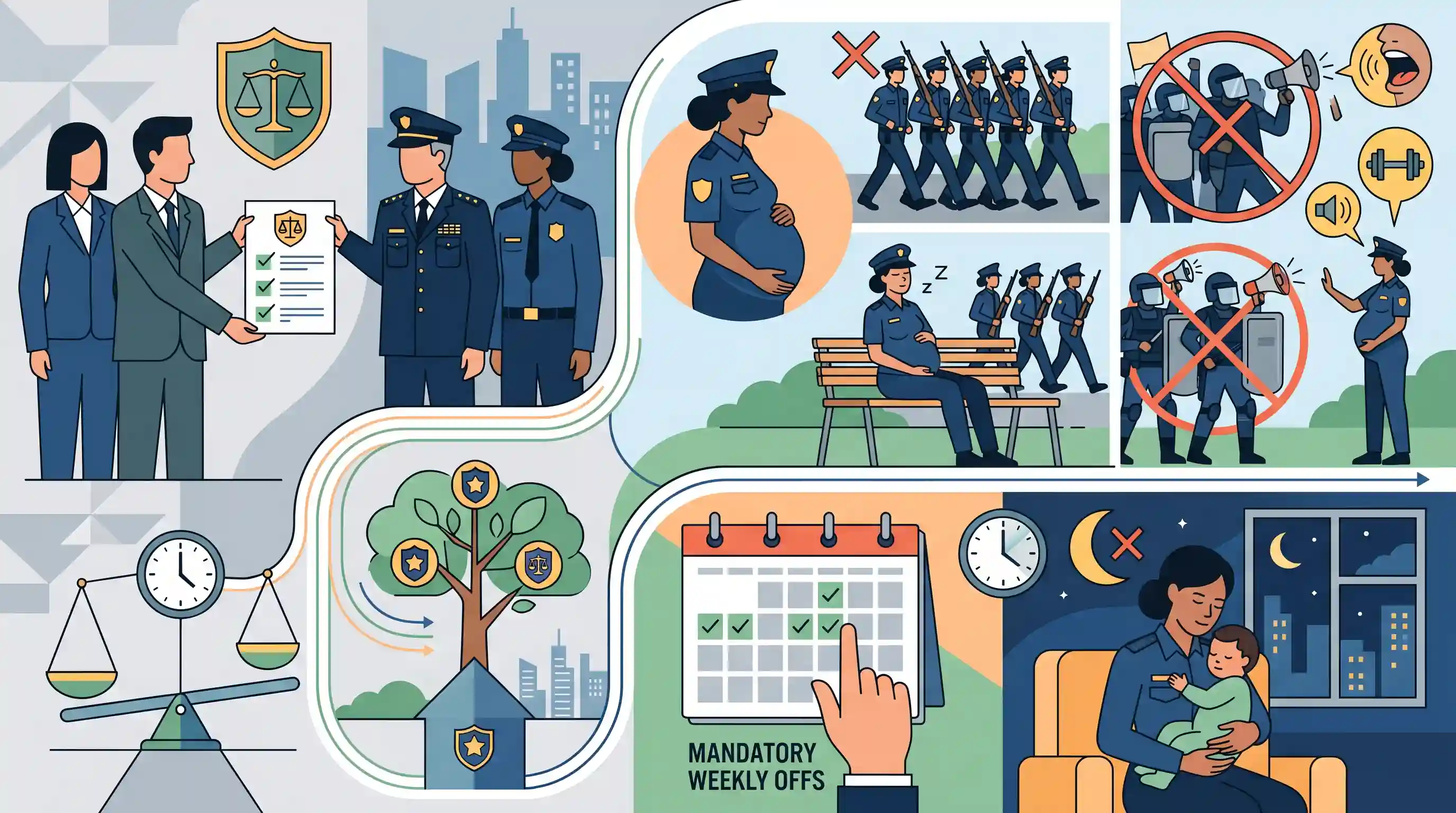
The Karnataka State Police Complaints Authority (KSPCA) has urged the State police chief to introduce specific welfare measures for pregnant women and mothers in the police force. Aiming to improve occupational health and work-life balance, the recommendations include exempting pregnant personnel from weekly parades and strenuous assignments like rallies, protests, and high-noise environments. Furthermore, it advocates for mandatory weekly offs and restricting night shift duties for women whose children are under three years old, citing the successful implementation of similar measures by the Chandigarh Police.
Key Points
- The Karnataka State Police Complaints Authority (KSPCA) has proposed special welfare measures to protect the health and well-being of pregnant women police personnel and those with young children.
- Proposed measures include exemptions from physically demanding tasks such as weekly parades, rallies, protests, and weapon-related duties.
- The proposal suggests ensuring mandatory weekly offs for pregnant women and preventing women with children under three years old from being assigned night shifts.
- The recommendations, if implemented by the State DGP, would mirror welfare steps previously undertaken by the Chandigarh Police to provide a safer, more equitable workplace for women in law enforcement.
Important Terms
Police Complaints Authority (PCA)

An independent oversight body mandated by the Supreme Court to investigate public grievances concerning "serious misconduct" by police, such as custodial death, rape, or extortion.
UPSC context
GS Paper II (Governance); central to accountability mechanisms under the 2006 Supreme Court directives on police reforms.
Karnataka State Police Complaints Authority (KSPCA)
A statutory body established under the Karnataka Police (Amendment) Act, 2012, to inquire into allegations of misconduct against the state's police personnel.
UPSC context
GS Paper II (State-level Statutory Bodies); illustrates the localized implementation of judicial mandates for police transparency.
Prakash Singh Case (2006)
The 2006 Supreme Court ruling that issued seven binding directives to transform the police from a colonial-era force into a democratic service-oriented institution.
UPSC context
GS Paper II (Judiciary/Governance); the landmark judgment that necessitated the creation of PCAs and State Security Commissions.
Police Reforms
Structural and operational changes aimed at ensuring functional autonomy, merit-based appointments, and sensitivity in law enforcement, moving away from the 1861 colonial framework.
UPSC context
GS Paper II & III (Internal Security/Governance); tests knowledge of committees (e.g., Malimath, Ribeiro) and modernization challenges.
Women in Policing
The thematic focus on increasing female representation (currently ~11.7% in India) and improving their working conditions to ensure gender-sensitive policing and maternal welfare.
UPSC context
GS Paper I (Social Issues) & II (Governance); concerns issues like reservation, crèches, and special welfare measures for pregnant personnel.
Chandigarh Police Model
Mentioned in the article as a benchmark for implementing welfare policies like night-shift exemptions for mothers of young children and weekly offs for pregnant personnel.
UPSC context
GS Paper II (Governance/Best Practices); useful as a case study for administrative innovations in personnel welfare and gender inclusivity.
Prelims Trap
The OSH Code, 2020 absolutely prohibits women from working night shifts to ensure their occupational safety.
False. The OSH Code 2020 shifted to a 'rights-plus-safeguards' approach, legally permitting women to work night shifts with their consent and employer-provided safety measures.
Static Concepts Connected
What are the key directives of the Supreme Court's Prakash Singh judgement (2006)?
- State Security Commission: To ensure the state government does not exercise unwarranted influence or pressure on the state police force.
- Police Complaints Authority: To inquire into public complaints against police officers for serious misconduct, ensuring departmental accountability.
- Police Establishment Board: To independently decide transfers, postings, and promotions for officers below the rank of Deputy Superintendent of Police.
- Fixed Tenure: Mandating a minimum two-year tenure for the DGP, IG, and other key operational officers to prevent politically motivated transfers.
How does the Indian Constitution balance equality with workplace affirmative action for women?
- Article 14 & 15(1): Guarantees equality before the law and expressly prohibits state discrimination strictly on the grounds of sex.
- Article 15(3): Empowers the State to make special provisions for women and children, enabling substantive equality (e.g., maternity benefits and workplace exemptions).
- Article 42 (DPSP): Directs the State to make provisions for securing just and humane conditions of work and for maternity relief.
Cross-Topic Patterns
Gender parity in law enforcement
India's low female police representation (~12%) weakens ground-level intelligence gathering and limits sensitivity in handling gender-based violence, making structural workplace reforms a core internal security mandate.
OSH Code 2020 and maternal welfare
Labor codes shifted India from protecting women via outright restrictions (like banning night shifts) to enabling workforce participation via safety guardrails, reflecting the evolution toward substantive gender equity.

Mains GS-2 will likely link low female police representation (under 12%) with the lack of institutional welfare and Prakash Singh reforms.
Linked PYQs · 3
Linked PYQs · 3
- 2024MainsGS1
Distinguish between gender equality, gender equity and women's empowerment. Why is it important to take gender concerns into account in programme design and implementation?
- 2020MainsGS2
In order to enhance the prospects of social development, sound and adequate health care policies are needed particularly in the fields of geriatric and maternal health care. Discuss.
- 2023MainsGS2
Explain the constitutional perspectives of Gender Justice with the help of relevant Constitutional Provisions and case laws.
