Kerala State Biodiversity Board Proposes Model Conservation Villages
Source:The Hindu ↗
Why It Matters
This provides a strong case study of decentralized biodiversity conservation (linking GS3 Environment with GS2 Panchayati Raj). The implementation of global targets (Kunming-Montreal Framework) and statutory bodies (Biodiversity Management Committees) through local villages is a recurrent theme in UPSC Mains and Prelims.
Summary
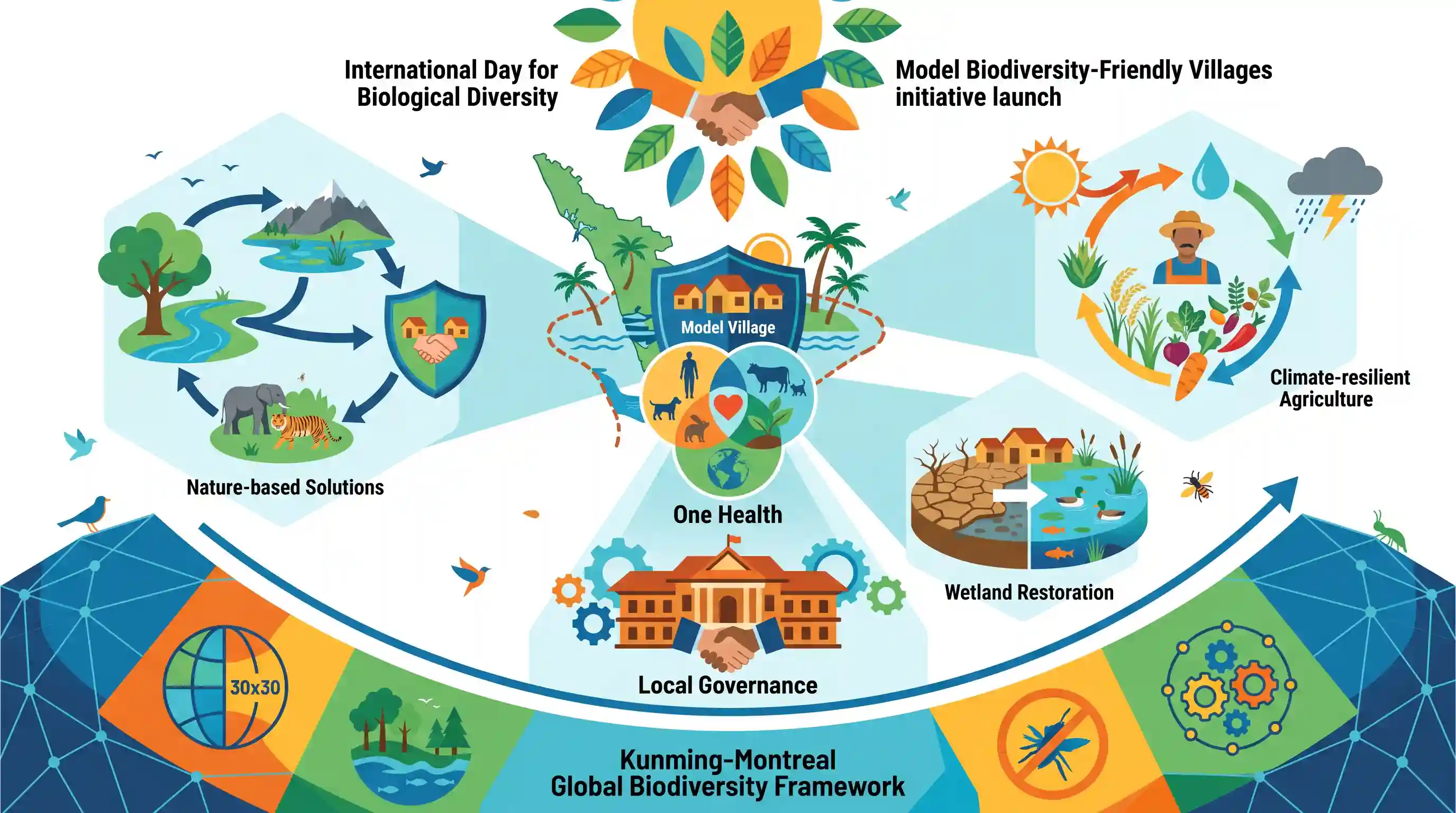
The Kerala State Biodiversity Board (KSBB) has introduced the 'Model Biodiversity-Friendly Villages' initiative to promote grassroots conservation. Launched around the International Day for Biological Diversity, the project aims to implement nature-based solutions, climate-resilient agriculture, and wetland restoration at the village level. By leveraging Local Self-Government Institutions, it aligns local actions with the Kunming-Montreal Global Biodiversity Framework and the 'One Health' approach, integrating human, animal, and ecosystem well-being.
Key Points
- The Kerala State Biodiversity Board (KSBB) has mooted a 'Model Biodiversity-Friendly Villages' initiative to decentralize conservation efforts.
- The initiative emphasizes climate-resilient agricultural biodiversity, wetland restoration, and nature-based solutions.
- It adopts a 'One Health' approach, acknowledging the interconnectedness of human, animal, and environmental health.
- The project positions Local Self-Government Institutions (LSGIs) as central to implementing the Kunming-Montreal Global Biodiversity Framework at the grassroots level.
Important Terms
Model Biodiversity-Friendly Villages initiative

A project by the Kerala State Biodiversity Board to implement nature-based solutions, climate-resilient agriculture, and wetland restoration through Local Self-Government Institutions.
UPSC context
GS III: Environment. Tests knowledge of decentralized environmental management and community-led conservation models in India.
Kunming-Montreal Global Biodiversity Framework
A landmark global agreement adopted at COP15 in 2022, featuring 23 targets for 2030 (like 30x30) to halt and reverse biodiversity loss.
UPSC context
GS III: Biodiversity. High relevance for international conventions and India’s commitment to global environmental targets.
National Biodiversity Strategy and Action Plan (NBSAP)
India’s strategic policy document for implementing the Convention on Biological Diversity, recently updated (2024-2030) to align with global biodiversity goals.
UPSC context
GS III: Environment. Crucial for understanding national legal frameworks and policy alignment with global standards.
Kerala State Biodiversity Strategy and Action Plan 2025-35
Kerala’s long-term roadmap (2025-2035) aiming for ecological sustainability through agrobiodiversity, native breed conservation, and decentralized management.
UPSC context
GS III: Conservation. Example of state-level policy innovation and federalism in environmental governance.
One Health approach
An integrated, collaborative approach recognizing that the health of humans, animals, and ecosystems are closely linked and interdependent.
UPSC context
GS II/III: Health & Environment. Tests understanding of zoonotic disease prevention and holistic ecosystem management.
Kerala State Biodiversity Board (KSBB)
A statutory body established under the Biological Diversity Act, 2002, to advise the state government and manage local Biodiversity Management Committees (BMCs).
UPSC context
GS II/III: Governance & Environment. Representative of institutional frameworks for biodiversity at the state level.
Prelims Trap
The Kunming-Montreal Global Biodiversity Framework establishes legally binding country-specific targets to halt biodiversity loss.
The GBF is not a legally binding treaty. It is a global framework where implementation relies on voluntary national commitments via updated National Biodiversity Strategies and Action Plans (NBSAPs).
Static Concepts Connected
How does the Biological Diversity Act (2002) decentralize conservation?
- Statutory BMCs: The Act mandates the creation of BMCs at local body levels (Panchayats/Municipalities) to promote conservation and sustainable use.
- People's Biodiversity Registers: BMCs are responsible for preparing PBRs, which comprehensively document local biodiversity, habitats, and traditional knowledge.
- Benefit Sharing: BMCs play a crucial role in deciding Access and Benefit Sharing (ABS) and can levy collection fees on biological resources.
What are the core targets of the Kunming-Montreal GBF?
- 30x30 Target: A commitment to conserve at least 30% of the world's lands, inland waters, coastal areas, and oceans by 2030.
- Financial Mobilization: To mobilize at least $200 billion per year in domestic and international biodiversity-related funding by 2030.
- Harmful Subsidies: Identify and phase out or reform subsidies harmful to biodiversity by at least $500 billion per year by 2030.
Cross-Topic Patterns
PRI devolution & environmental mandates
Statutory bodies like Biodiversity Management Committees parallel Forest Rights Committees under the FRA, reflecting a distinct UPSC pattern linking decentralized governance (GS2) with ecological conservation (GS3).
One Health & zoonotic spillovers
Integrating ecosystem restoration with public health addresses the 'One Health' mandate, a concept frequently tested alongside Antimicrobial Resistance (AMR) and zoonotic spillovers like Nipah.

Expect a multi-statement Prelims question interlinking the 30x30 Kunming-Montreal targets with the statutory powers of local BMCs.
Linked PYQs · 3
Linked PYQs · 3
- 2023PrelimsGS1
Consider the following statements: 1. In India, the Biodiversity Management Committees are key to the realization of the objectives of the Nagoya Protocol. 2. The Biodiversity Management Committees have important functions in determining access and benefit sharing, including the power to levy collection fees on the access of biological resources within its jurisdiction. Which of the statements given above is/are correct?
- 2024MainsGS2
Analyse the role of local bodies in providing good governance at local level and bring out the pros and cons merging the rural local bodies with the urban local bodies.
- 2019MainsGS3
Define the concept of carrying capacity of an ecosystem as relevant to an environment. Explain how understanding this concept is vital while planning for sustainable development of a region.
