Krushi Road Map Aims for Fifteen Percent Agriculture GVA Growth in AP
Source:The Hindu ↗
Why It Matters
It serves as an excellent state-level case study for GS3 Agriculture answers, illustrating practical interventions for crop diversification (shifting from paddy to millets/horticulture), improving water-use efficiency (micro-irrigation), and boosting farmers' income via FPOs and value addition.
Summary
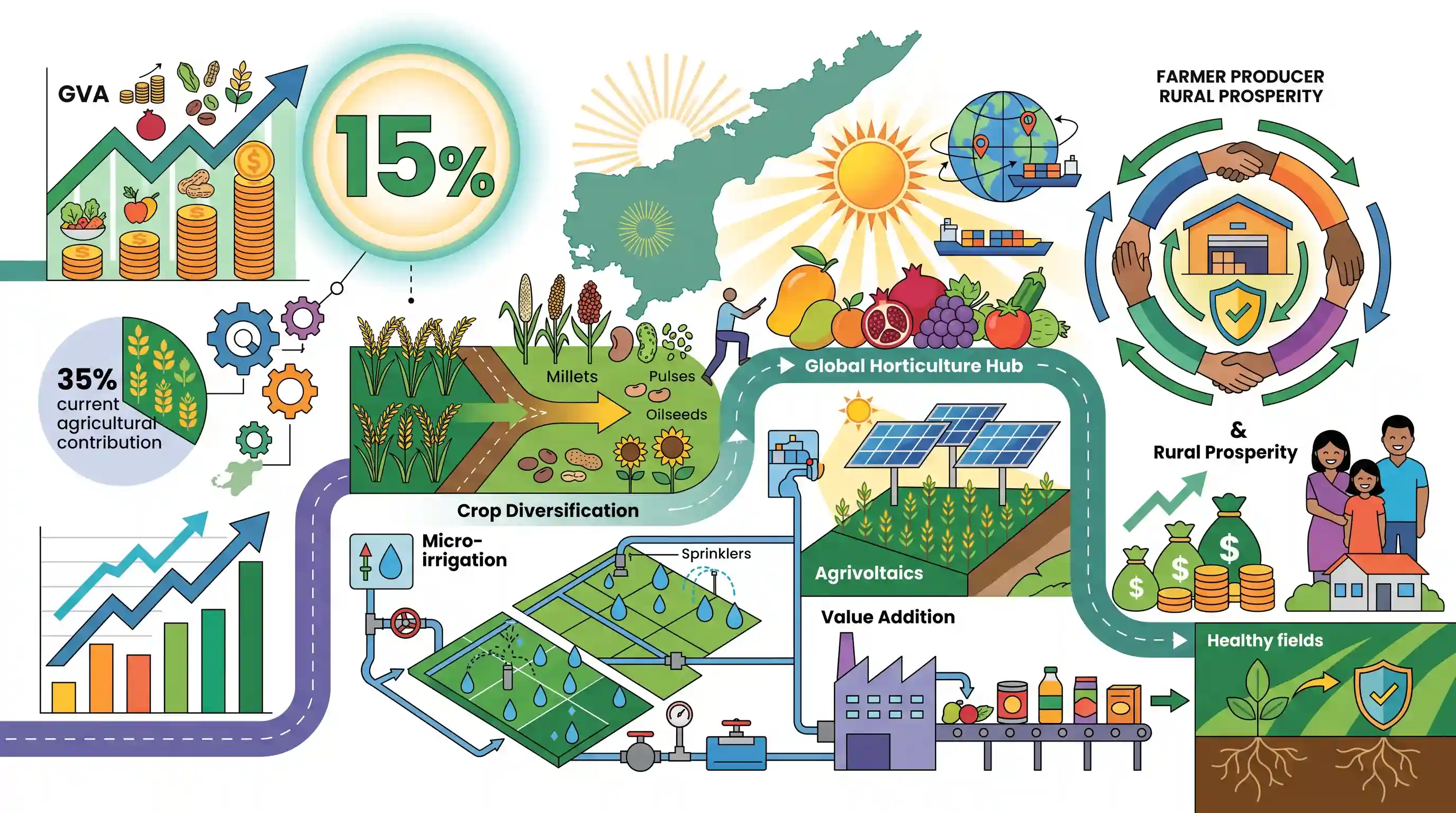
The Andhra Pradesh government, in collaboration with the Union Ministry of Agriculture, is drafting a comprehensive 'Krushi Road Map' to achieve a 15% Gross Value Added (GVA) growth rate in the primary sector over five years. Aligned with the 'Swarna Andhra @2047' vision, the strategy addresses the state's reliance on agriculture, which currently contributes 35% to its GSDP. The roadmap prioritizes crop diversification—moving from traditional paddy to millets, pulses, and oilseeds—and targets establishing Rayalaseema as a Global Horticulture Hub. Furthermore, it outlines systemic improvements through micro-irrigation, agrivoltaics, value addition, and the strengthening of Farmer Producer Organizations (FPOs) to boost rural incomes and climate resilience.
Key Points
- The Andhra Pradesh government is finalizing the 'Krushi Road Map' to achieve an ambitious 15% growth rate in agriculture Gross Value Added (GVA) over the next five years.
- The agriculture sector is crucial to AP, contributing 35% of the state's GSDP and providing livelihood to 62% of the rural population.
- The plan emphasizes strategic crop diversification, aiming to shift farmers away from water-intensive paddy toward millets, pulses, oilseeds, and oil palm.
- A major focus is on transforming the drought-prone Rayalaseema region into a Global Horticulture Hub.
- Key interventions include strengthening Farmer Producer Organizations (FPOs), cultivating fallow lands, implementing micro-irrigation, drone technology, rainwater harvesting, and agrivoltaics.
- The roadmap focuses heavily on post-harvest value addition, branding, and ensuring fair remuneration for farmers.
Important Terms
Farmer Producer Organizations (FPOs)

Legally constituted bodies of small/marginal farmers uniting to improve bargaining power, market access, and production efficiency through collective action and economies of scale.
UPSC context
GS Paper III (Agriculture); tests understanding of institutional reforms for farmer empowerment and rural income enhancement.
Gross Value Added (GVA)
A measure of the value created by a specific sector or industry, calculated as the value of total output minus intermediate consumption used in production.
UPSC context
GS Paper III (Indian Economy); tests knowledge of supply-side economic performance and sectoral contribution to GDP.
Agrivoltaics
The simultaneous use of land for both agricultural production and solar energy generation, enhancing land-use efficiency and providing crops with protection from extreme weather.
UPSC context
GS Paper III (S&T/Environment); tests awareness of sustainable technologies and renewable energy integration in farming.
Swarna Andhra @2047
Andhra Pradesh's long-term vision document aiming to transform the state into a developed economy by 2047, aligning with the national 'Viksit Bharat' objective.
UPSC context
GS Paper III (Economic Development); tests knowledge of state-level planning and long-term socio-economic targets.
Krushi Road Map
A strategic policy framework designed to achieve 15% growth in Andhra Pradesh's primary sector through crop diversification, value addition, and technology-driven infrastructure.
UPSC context
GS Paper III (Agriculture); tests understanding of targeted policy interventions for structural agricultural transformation.
Crop Diversification
The shifting of agricultural production from monoculture (e.g., paddy) to a diverse range of crops like millets and oilseeds to improve soil health and income.
UPSC context
GS Paper III (Major Crops); tests knowledge of sustainable farming practices and climate-resilient agriculture.
Prelims Trap
The 'Krushi Road Map' is a Centrally Sponsored Scheme to increase India's overall agricultural GVA by 15%.
While it involves the Union Ministry, 'Krushi Road Map' is a state-specific vision for Andhra Pradesh, not a nationwide CSS. UPSC often swaps state schemes with central ones.
Static Concepts Connected
How is Agricultural GVA conceptually distinct from Agricultural GDP?
- Core Definition: GVA measures the value of goods and services produced in a sector, calculated as total output minus intermediate consumption (input costs).
- Basic Prices: GVA at basic prices includes production subsidies but strictly excludes production taxes, reflecting the true producer-side income.
- GDP Linkage: GDP is calculated from GVA by adding product taxes and subtracting product subsidies. GVA remains the superior metric for sectoral performance.
What is the legal and operational structure of Farmer Producer Organizations (FPOs)?
- Legal Status: FPOs can be registered under various frameworks: the Companies Act, Cooperative Societies Act, or State-specific Trust Acts.
- Ownership & Purpose: They are entirely owned and governed by farmer-members, designed to aggregate produce and achieve economies of scale in inputs and marketing.
- Central Support: Under the central scheme for 10,000 FPOs, the government provides equity grants and credit guarantee coverage to make them financially viable.
Cross-Topic Patterns
Agrivoltaics + PM-KUSUM scheme
The push for 'agrivoltaics' in state agricultural roadmaps directly links to PM-KUSUM, allowing farmers to boost income by setting up grid-connected solar power plants on barren or fallow lands.
Water stress & regional crop shifts
Transforming drought-prone Rayalaseema into a horticulture hub mirrors national policy priorities seen in Vidarbha and Bundelkhand—shifting from water-guzzling paddy/sugarcane to climate-resilient dryland crops.

Expect a 2026 Prelims question linking FPO legal structures with post-harvest value addition and agricultural GVA calculation.
Linked PYQs · 5
Linked PYQs · 5
- 2024MainsGS3
Explain the role of millets for ensuring health and nutritional security in India.
- 2023MainsGS3
Explain the changes in cropping pattern in India in the context of changes in consumption pattern and marketing conditions.
- 2025MainsGS3
Explain the factors influencing the decision of the farmers on the selection of high value crops in India.
- 2016MainsGS3
What is water-use efficiency? Describe the role of micro-irrigation in increasing the water-use efficiency.
- 2020MainsGS3
Suggest measures to improve water storage and irrigation system to make its judicious use under depleting scenario.
