Kremlin warns of global risks as New START nuclear treaty expires
Source:The Hindu ↗
Why It Matters
The expiration of the New START treaty removes mutual caps on the nuclear arsenals of the U.S. and Russia, sparking risks of a renewed arms race. For UPSC aspirants, understanding bilateral arms control mechanisms is crucial for analyzing shifting global security paradigms and great power competition.
Summary
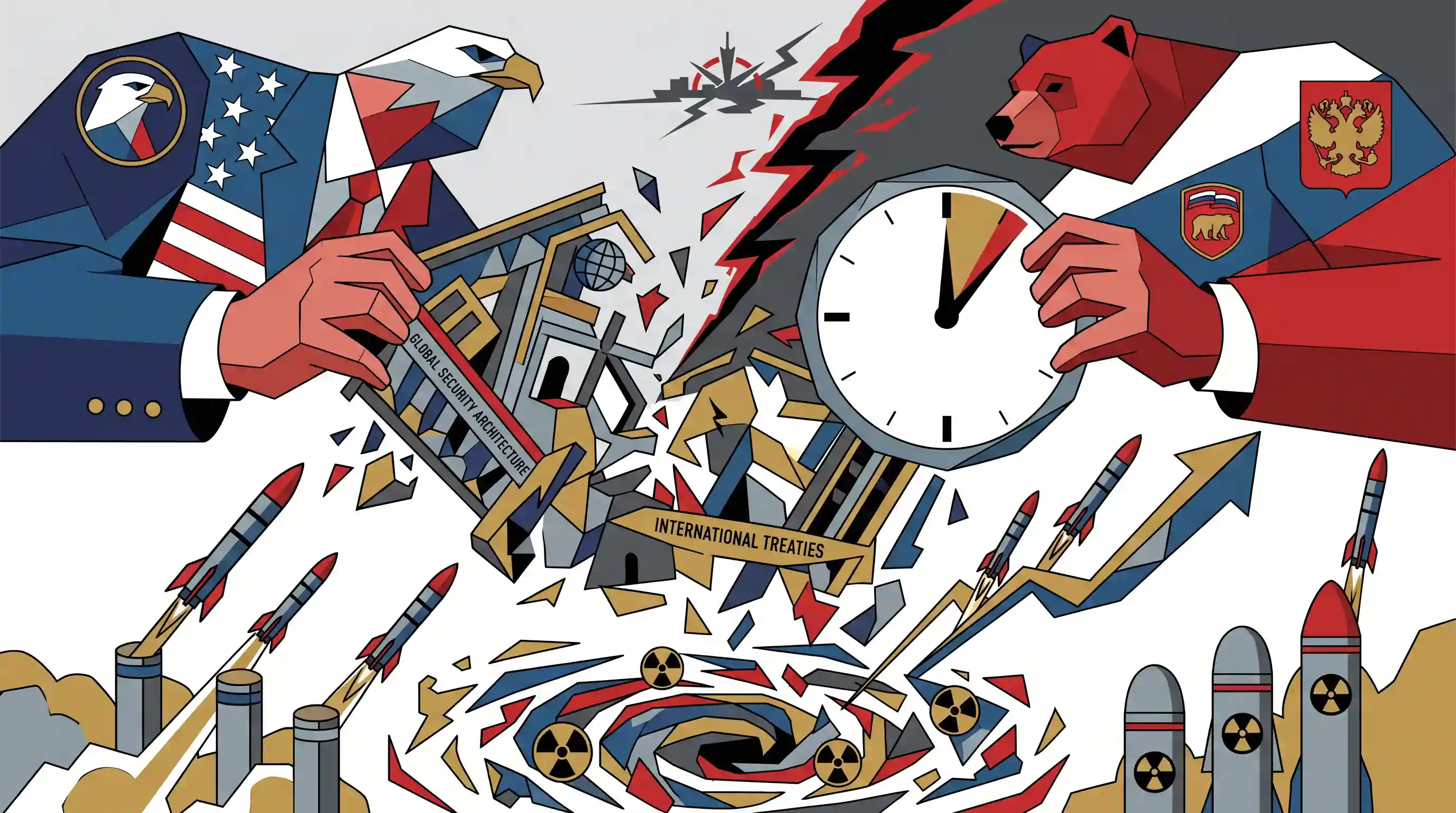
The New START treaty, the final remaining bilateral nuclear arms control agreement between the United States and Russia, is scheduled to expire on February 5, 2026. The Kremlin has warned that the lapse of this agreement will create a highly "dangerous" scenario, leaving the two major nuclear powers without a fundamental regulatory framework to limit their arsenals. Signed in 2010, the treaty faced severe strain after bilateral dialogue broke down due to tensions over the Ukraine conflict, leading Russia to freeze its participation in 2023. The absence of an extension or replacement threatens to trigger a new arms race and undermine the global non-proliferation architecture.
Key Points
- The New START treaty, the last remaining nuclear arms control pact between the U.S. and Russia, is set to expire on February 5, 2026.
- The Kremlin warned that the impending lapse will result in a "dangerous moment" for global stability, leaving the world's top two nuclear powers without mutual arsenal constraints.
- Signed in 2010 by Barack Obama and Dmitry Medvedev, the treaty capped deployed strategic nuclear warheads and delivery systems.
- Negotiations to extend or replace the treaty broke down due to soaring tensions over the Ukraine conflict, culminating in Russia freezing its active participation in 2023.
Important Terms
New START Treaty

A bilateral nuclear arms reduction treaty between the U.S. and Russia. It capped deployed strategic warheads at 1,550 and launchers at 700. It officially expired on February 5, 2026.
UPSC context
GS Paper II: International Relations. Tests knowledge of bilateral treaties, disarmament efforts, and the shift from Cold War-era arms control.
Global Non-Proliferation Architecture
The collection of international treaties (like NPT), organizations (IAEA), and norms designed to prevent the spread of nuclear weapons and promote disarmament.
UPSC context
GS Paper II: International Relations. Crucial for understanding global security, IAEA's role, and India’s 'Nuclear Haves vs Have-nots' stance.
Strategic Stability
A condition where nuclear-armed states have no incentive to launch a first strike, typically maintained through transparency, communication, and balanced nuclear arsenals.
UPSC context
GS Paper III: Internal Security/Defense. Tests understanding of deterrence, nuclear doctrine, and prevention of unintended escalations.
Vertical Proliferation
The quantitative increase or qualitative improvement of nuclear weapons and delivery systems within a state's existing arsenal.
UPSC context
GS Paper II: International Relations. Distinguishes between states acquiring weapons (horizontal) vs. expanding existing stockpiles (vertical).
Kremlin
A metonym referring to the executive branch of the Russian government or the office of the President, headquartered in Moscow's historic fortified complex.
UPSC context
GS Paper II: International Relations. Understanding diplomatic terminology and official state actors in global geopolitics.
Nuclear Non-Proliferation Treaty (NPT)
The primary international treaty (1970) aimed at preventing the spread of nuclear weapons, based on three pillars: non-proliferation, disarmament, and peaceful use.
UPSC context
GS Paper II: International Relations. Core topic regarding India’s non-signatory status and global nuclear governance.
Prelims Trap
"Russia formally withdrew from the New START Treaty in 2023, terminating the agreement."
Russia only suspended its participation in 2023, halting inspections and data sharing, but did not legally withdraw. The treaty legally remained in force until its natural expiration in 2026.
Static Concepts Connected
What are the three core pillars of the Nuclear Non-Proliferation Treaty (NPT)?
- Non-proliferation: Nuclear-weapon states agree not to transfer weapons; non-nuclear states agree not to acquire or manufacture them.
- Disarmament: All parties commit to pursue negotiations in good faith toward eventual total nuclear disarmament (under Article VI).
- Peaceful Use: Guarantees the inalienable right of all parties to research, develop, and use nuclear energy for peaceful civilian purposes.
How do Strategic and Tactical nuclear weapons differ in doctrine?
- Strategic: High-yield weapons (like ICBMs) designed to strike deep into enemy territory, destroying cities or mass infrastructure to deter war.
- Tactical: Lower-yield, short-range weapons intended for battlefield use to achieve specific, immediate military objectives.
- Treaty focus: Major US-Russia arms control pacts (like New START) historically cap only deployed strategic arsenals, leaving tactical weapons largely unregulated.
Cross-Topic Patterns
Bilateral collapse meets multipolar reality
The demise of US-Russia bilateral treaties shifts focus to China's rapidly expanding, unregulated nuclear arsenal, forcing global security debates to transition from Cold War bilateralism to trilateral or multipolar arms control.
Proxy conflicts fracturing global architecture
The spillover of the Ukraine conflict into nuclear non-proliferation demonstrates how modern geopolitical proxy wars are directly dismantling decades-old, legally binding global governance and security architectures.

Expect a chronological sequencing question on defunct nuclear pacts (ABM, INF, New START) or a Mains Q on multipolar arms race in 2026.
Linked PYQs · 4
Linked PYQs · 4
- 2011PrelimsGS1
The "New START" treaty was in the news. What is this treaty?
- 2025MainsGS2
"The reform process in the United Nations remains unresolved, because of the delicate imbalance of East and West and entanglement of the USA vs. Russo-Chinese alliance.” Examine and critically evaluate the East-West policy confrontations in this regard.
- 2023MainsGS2
‘The expansion and strengthening of NATO and a stronger US-Europe strategic partnership works well for India.’ What is your opinion about this statement ? Give reasons and examples to support your answer.
- 2021MainsGS2
“The USA is facing an existential threat in the form of a China, that is much more challenging than the erstwhile Soviet Union.” Explain.
