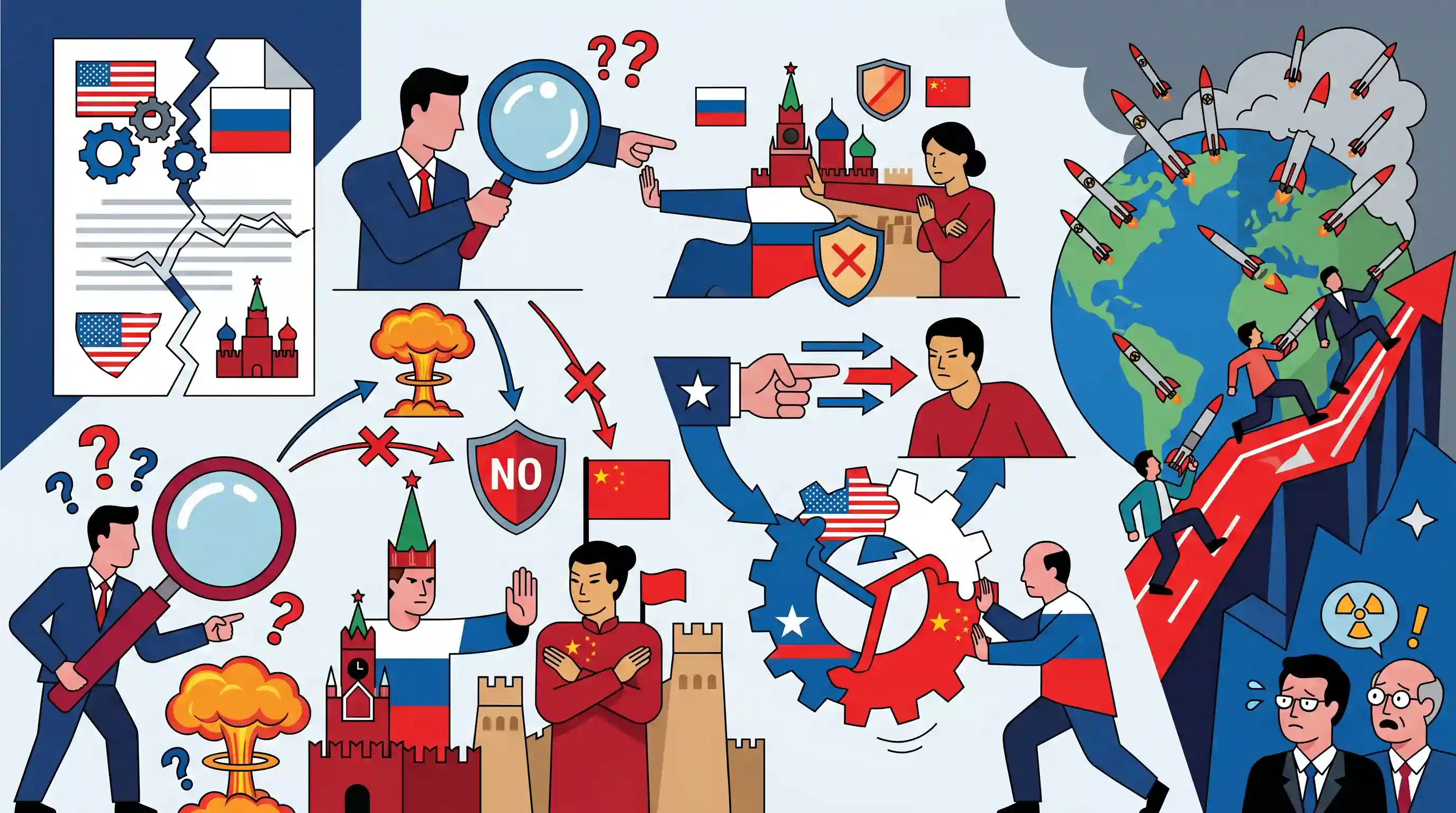
Kremlin denies US allegations of secret nuclear testing by Russia
Source:The Hindu ↗
Why It Matters
The erosion of legacy bilateral nuclear arms control frameworks (like New START) and the shift towards a multipolar nuclear dynamic involving China significantly impacts global security architecture. It is highly relevant for GS-2 (International Relations) questions examining the evolving geopolitical rivalry between the US, Russia, and China.
Summary
The Kremlin has categorically denied US allegations that Russia and China have conducted secret nuclear tests. The US recently accused China of carrying out a covert test in 2020 and is actively pressuring Beijing to participate in a broader trilateral nuclear arms control treaty with Washington and Moscow. This diplomatic push follows the expiration of the bilateral New START agreement, sparking fears among international security experts of an impending global nuclear arms race.
Key Points
- Russia dismissed US claims that either Moscow or Beijing have engaged in secret nuclear testing.
- The US administration aims to bring China into a new, broader trilateral nuclear arms control framework alongside Russia.
- The diplomatic push to include China follows the recent expiration of the bilateral New START treaty, amplifying global concerns about an unconstrained nuclear arms race among major powers.
Important Terms
New START

A 2010 US-Russia treaty capping deployed strategic nuclear warheads at 1,550. It officially expired on February 5, 2026, after extensions failed, leaving no legally binding limits on the world's largest nuclear arsenals.
UPSC context
GS Paper II (IR) and III (Security). Significant for understanding the breakdown of the post-Cold War strategic stability and disarmament framework.
Comprehensive Nuclear-Test-Ban Treaty (CTBT)
A 1996 multilateral treaty banning all nuclear explosions for military or civilian purposes. While not formally 'in force' globally, its norms are maintained through voluntary testing moratoriums by major powers.
UPSC context
GS Paper II. Focuses on India’s non-signatory status and the global verification regime managed by the CTBTO.
Trilateral Arms Control
A proposed 21st-century arms control framework seeking to include the US, Russia, and China. Washington advocates this to address China’s nuclear expansion, though Beijing maintains its arsenal is too small for parity-based limits.
UPSC context
GS Paper II (Global Groupings). Represents the shift from bipolar to tripolar nuclear diplomacy and the challenges of achieving multination strategic restraint.
Nuclear Moratorium
A voluntary, non-binding suspension of nuclear testing observed by major nuclear powers. Accusations of "yield-producing" tests, as recently leveled by the US against China, threaten this fragile international norm.
UPSC context
GS Paper III (Internal Security/Tech). Relevant for discussions on the 'qualitative' arms race and the technical distinctions between sub-critical and yield-producing tests.
Nuclear Non-Proliferation Treaty (NPT)
A 1970 landmark treaty to prevent nuclear weapon spread and promote disarmament. It divides states into Nuclear Weapon States and Non-Nuclear Weapon States, a distinction India has historically criticized as discriminatory.
UPSC context
GS Paper II. Fundamental to India’s foreign policy and its historical 'no-first-use' and 'credible minimum deterrence' doctrines.
Kremlin
The administrative center of the Russian government in Moscow. In international relations, the term is used metonymically to represent the executive branch and strategic decision-making authority of the Russian Federation.
UPSC context
GS Paper II (IR). Essential for identifying the primary actor in Eurasian security and Russian strategic communications regarding arms control disputes.
Prelims Trap
"China was bound by the New START limits before its expiration."
New START was strictly bilateral between the USA and Russia. China’s historical exclusion from such limits is precisely why the US is now demanding a trilateral framework.
Static Concepts Connected
What are the core mandates of NPT, CTBT, and New START treaties?
- NPT (1968): Prevents nuclear weapons spread. Recognizes exactly five official Nuclear-Weapon States (US, Russia, UK, France, China). India remains a non-signatory.
- CTBT (1996): Bans all nuclear explosions globally. It is not yet in force because key Annex II countries (including the US and China) have not ratified it.
- New START (2010): Bilateral US-Russia treaty limiting deployed strategic nuclear warheads and delivery systems. Its expiration has prompted debates for a new trilateral framework.
Why has India historically refused to sign both the NPT and CTBT?
- Discriminatory nature: India views the NPT as fundamentally flawed for creating an arbitrary divide of nuclear 'haves' and 'have-nots' based on a 1967 cut-off date.
- Lack of disarmament: India argues the CTBT merely halts explosive testing but allows sub-critical computer simulations, failing to mandate comprehensive, time-bound global nuclear disarmament.
Cross-Topic Patterns
Nuclear deterrence in the Indo-Pacific
China's expanding, unconstrained arsenal alters the Asian balance of power, forcing India to recalibrate its own nuclear deterrence posture and potentially deepening Quad defense cooperation.
Emerging tech vs old arms treaties
The collapse of legacy bilateral treaties accelerates the unregulated development of dual-use hypersonic glide vehicles and AI-managed nuclear commands, rendering Cold War-era agreements obsolete.

Expect a multi-statement Prelims question contrasting India’s non-signatory NPT/CTBT stance with the new US-Russia-China dynamic.
Linked PYQs · 3
Linked PYQs · 3
- 2021MainsGS2
“The USA is facing an existential threat in the form of a China, that is much more challenging than the erstwhile Soviet Union.” Explain.
- 2025MainsGS2
"The reform process in the United Nations remains unresolved, because of the delicate imbalance of East and West and entanglement of the USA vs. Russo-Chinese alliance.” Examine and critically evaluate the East-West policy confrontations in this regard.
- 2015PrelimsGS1
Consider the following countries: 1. China 2. France 3. India 4. Israel 5. Pakistan Which among the above are Nuclear Weapons States as recognized by the Treaty on the Non-Proliferation of Nuclear Weapons, commonly known as Nuclear Non-Proliferation Treaty (NPT)?
