Russia-Ukraine Conflict: European Arms Supply and Peace Talks
Source:The Hindu ↗
Why It Matters
Highlights the shifting dynamics of the Russia-Ukraine war, detailing the contradictory pressures of simultaneous peace negotiations and continued arms supplies, as well as the evolving diplomatic postures of European powers and the United States in conflict resolution.
Summary
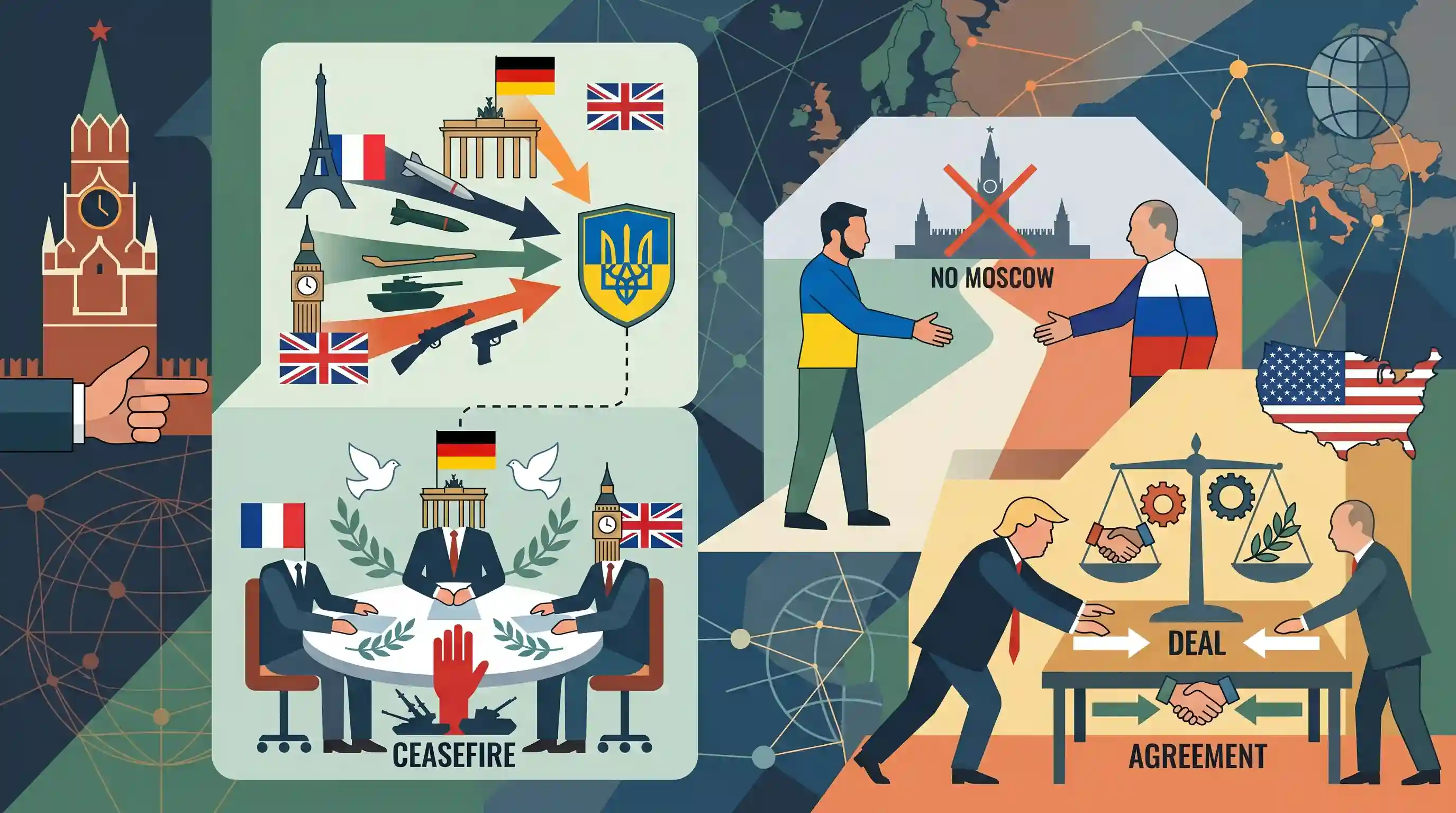
The Kremlin criticized the leaders of France, Germany, and Britain for their seemingly contradictory stance on the Ukraine conflict, pointing out that while they advocate for peace talks between Volodymyr Zelenskyy and Vladimir Putin, they simultaneously continue to arm Ukraine. The European leaders had supported a ceasefire proposal, while Zelenskyy suggested a direct meeting with Putin, excluding Moscow as a venue. Meanwhile, U.S. President Donald Trump continues to urge both sides to compromise and negotiate an end to the war.
Key Points
- The Kremlin accused the leaders of Britain, Germany, and France of inconsistency, noting they talk of peace but continue to supply Kyiv with new weapons.
- Emmanuel Macron, Friedrich Merz, and Keir Starmer expressed support for a proposal aimed at securing a ceasefire through talks between Volodymyr Zelenskyy and Vladimir Putin.
- Zelenskyy proposed a face-to-face meeting with Putin via an open letter, although he preemptively ruled out meeting in Moscow.
- U.S. President Donald Trump has encouraged a face-to-face meeting between the two leaders while pushing both sides to compromise to end the conflict.
Important Terms
Kremlin

The fortified complex in Moscow serving as the official residence of the Russian President; it is used metonymically to refer to the Russian government and its political authority.
UPSC context
GS Paper 2: International Relations. Represents the executive power of a major global actor and its influence on regional and global security.
European Security Architecture
The institutional framework, including organizations like NATO, the EU, and the OSCE, and the norms designed to maintain peace and stability on the European continent.
UPSC context
GS Paper 2: International Relations. Critical for analyzing the impact of global conflicts on regional stability and the shift in post-Cold War power.
Ceasefire
A temporary agreement between warring parties to suspend hostilities, often as a preliminary step toward a permanent peace treaty; it does not legally end the state of war.
UPSC context
GS Paper 2: International Relations. Relevant for understanding conflict resolution mechanisms and the difference between temporary truces and durable peace settlements.
Geopolitics
The study of how geographical factors, such as location and resources, influence political power and international relations between states.
UPSC context
GS Paper 2: International Relations. Tests the ability to link territorial geography with strategic decision-making and global power dynamics.
Strategic Autonomy
The ability of a state or group of states to make independent foreign policy and defense decisions without being constrained by external pressures or alliance obligations.
UPSC context
GS Paper 2: International Relations. Central to analyzing the independent foreign policies of powers like India and the European Union in a multipolar world.
Diplomacy
The profession or activity of managing international relations through representatives to reach agreements and resolve conflicts peacefully through negotiation.
UPSC context
GS Paper 2: International Relations. Evaluates the role of soft power and formal negotiations in settling international disputes.
Prelims Trap
The Normandy Format includes the US and UK alongside European nations.
The Normandy Format (created in 2014) strictly comprises only four nations: France, Germany, Russia, and Ukraine. The US and UK are not formal participants.
Static Concepts Connected
What are the key diplomatic frameworks preceding the current Russia-Ukraine war?
- Normandy Format: Formed in 2014, it includes France, Germany, Russia, and Ukraine, and was originally aimed at resolving the Donbas conflict.
- Minsk Agreements: Ceasefire protocols (2014 and 2015) mediated by France and Germany to halt fighting in Eastern Ukraine, whose failure preceded the 2022 invasion.
How does the OSCE function in European security?
- Primary Mandate: The Organization for Security and Co-operation in Europe handles arms control, human rights, and conflict prevention across the continent.
- Broad Membership: It includes 57 participating states spanning North America, Europe, and Asia, making it a rare forum where both Russia and the US sit together.
Cross-Topic Patterns
Transatlantic rift on European security
Europe's insistence on arming Ukraine for deterrence contrasts sharply with the transactional US push for compromise, highlighting deep fractures in NATO's strategic unity.
India's diplomatic stance vindicated
As Western powers struggle to balance military aid with peace talks, India's consistent multi-aligned stance prioritizing diplomacy and dialogue over military entanglement gains normative traction.

Minsk Agreements and the Normandy Format remain high-probability match-the-following pairs for Prelims 2026 International Relations.
Linked PYQs · 3
Linked PYQs · 3
- 2025MainsGS2
"The reform process in the United Nations remains unresolved, because of the delicate imbalance of East and West and entanglement of the USA vs. Russo-Chinese alliance.” Examine and critically evaluate the East-West policy confrontations in this regard.
- 2023MainsGS2
‘The expansion and strengthening of NATO and a stronger US-Europe strategic partnership works well for India.’ What is your opinion about this statement ? Give reasons and examples to support your answer.
- 2025MainsGS2
"With the waning of globalization, post-Cold War world is becoming a site of sovereign nationalism.” Elucidate.
