Kremlin Awaits Clarity on US Weapons Supply to Ukraine
Source:The Hindu ↗
Why It Matters
Changes in US leadership and foreign policy significantly impact the geopolitical dynamics of the Russia-Ukraine conflict, global energy security, and international trade sanctions, which are vital for understanding shifting global power structures in GS Paper 2.
Summary
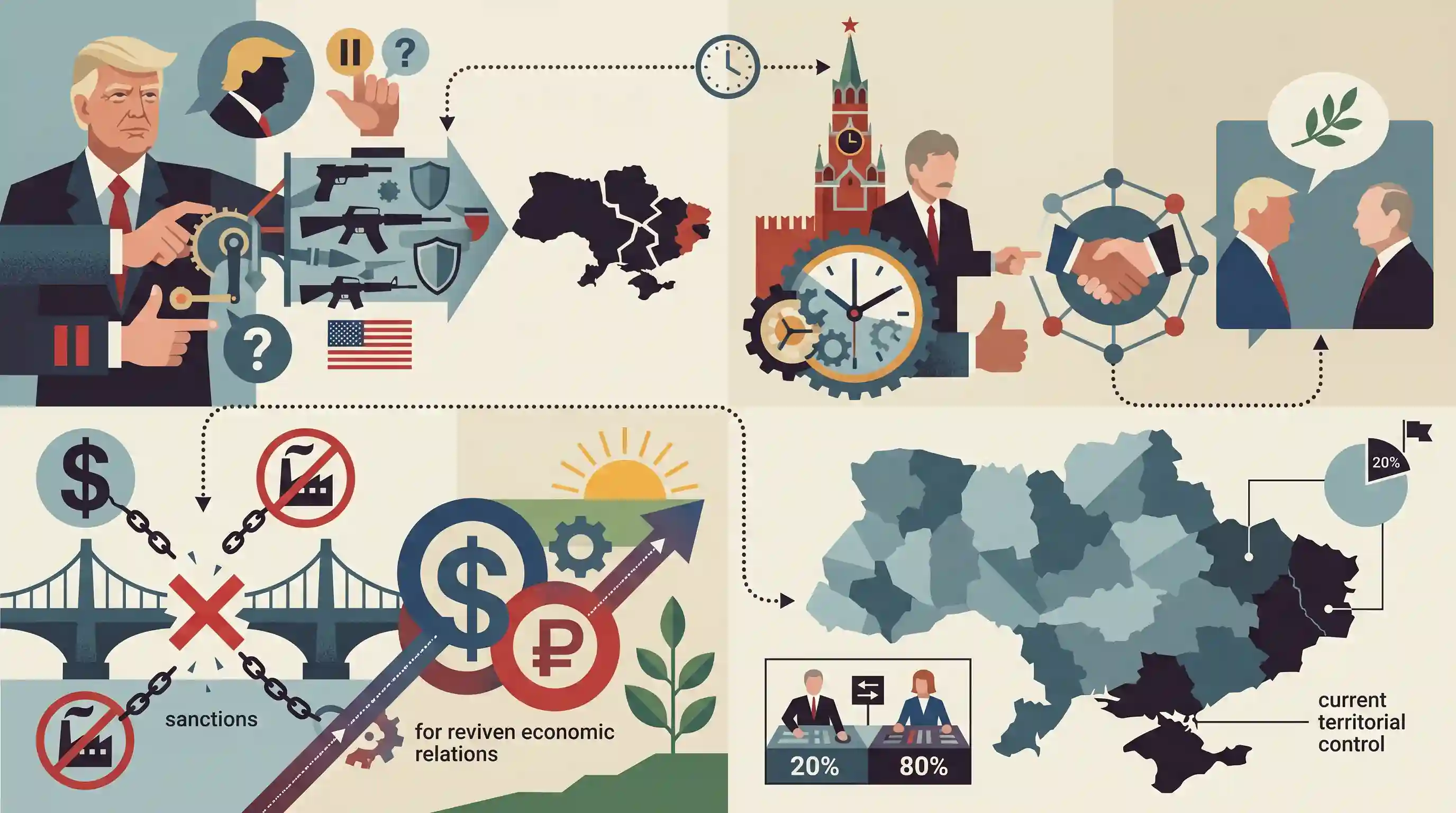
Following remarks by US President-elect Donald Trump regarding military aid to Ukraine, the Kremlin stated it would take time to clarify future US weapons supplies. Russian spokesperson Dmitry Peskov appreciated Trump's push for direct negotiations to resolve the conflict. While criticizing US sanctions as illegal, Russia expressed hope for reviving US-Russia economic relations. The conflict's territorial reality currently sees Russia controlling about 20% of Ukraine, including Crimea and Luhansk.
Key Points
- The Kremlin stated that it will take time to ascertain the specifics of future US weapon supplies to Ukraine, following remarks by US President-elect Donald Trump.
- Kremlin spokesperson Dmitry Peskov welcomed Trump's efforts to initiate direct negotiations between Russia and Ukraine.
- Russia currently controls approximately one-fifth of Ukrainian territory, including the Crimean peninsula and parts of Luhansk.
- Russia criticized existing US sanctions as illegal but noted potential opportunities to restore bilateral trade and economic relations under a new US administration.
Important Terms
Kremlin

The official residence of the Russian President and a metonym for the Russian government's central authority.
UPSC context
GS-II (International Relations); tests understanding of global power structures and decision-making centers.
Geopolitics
The study of how geographical factors, such as location and resources, influence international politics and power dynamics between nations.
UPSC context
GS-II; vital for analyzing regional conflicts and global strategic shifts.
Strategic Autonomy
A country's ability to pursue its national interests and independent foreign policy without being coerced by other states.
UPSC context
GS-II (India's Foreign Policy); core concept for India's balancing act between major powers.
Sanctions
Economic or political penalties imposed by countries to pressure another state to change its behavior or adhere to international law.
UPSC context
GS-II & GS-III; covers economic diplomacy and its impact on global trade.
Bilateral Relations
The strategic, economic, and political interactions between two sovereign nations.
UPSC context
GS-II; a primary syllabus topic focusing on India’s ties with major world powers.
Buffer State
A neutral state located between two larger, potentially hostile powers, serving to reduce the risk of direct conflict.
UPSC context
GS-II; central to understanding Ukraine's historical position between NATO and Russia.
Prelims Trap
US economic sanctions on Russia are legally binding on third-party nations under international law.
Unilateral sanctions are not binding under international law. Only sanctions passed by the UN Security Council under Chapter VII of the UN Charter are mandatory.
Static Concepts Connected
What is the legal standing of international sanctions?
- UNSC Sanctions: These are binding on all member states only when authorized by the UN Security Council under Chapter VII of the UN Charter.
- Unilateral Sanctions: Such as CAATSA, these are domestic laws. They use secondary sanctions to deter third-party nations but hold no legal authority under international law.
Geography of the Eastern European Conflict Zone
- Crimea: A strategically vital peninsula connected to mainland Ukraine by the Isthmus of Perekop, flanked by the Black Sea and the Sea of Azov.
- Donbas: The heavily industrialized eastern region of Ukraine, primarily comprising the Donetsk and Luhansk oblasts, which has been a primary territorial flashpoint.
Cross-Topic Patterns
US-Russia detente & India's strategic autonomy
A thaw in US-Russia relations would reduce Moscow's growing dependence on Beijing, significantly easing India's diplomatic tightrope walk and benefiting New Delhi's strategy in the Indo-Pacific.
Sanctions relief and macroeconomic stability
Any rollback of economic sanctions on Russia could stabilize global energy and fertilizer supply chains, directly easing imported inflation pressures and current account deficit risks for energy-dependent economies like India.

Expect a multi-statement question mapping the Black Sea/Sea of Azov, combined with the legal standing of unilateral vs UNSC sanctions.
Linked PYQs · 4
Linked PYQs · 4
- 2023PrelimsGS1
Consider the following countries: 1. Bulgaria 2. Czech Republic 3. Hungary 4. Latvia 5. Lithuania 6. Romania How many of the above-mentioned countries share a land border with Ukraine?
- 2023PrelimsGS1
Consider the following pairs: Area of conflict mentioned in news Country where it is located 1. Donbas : Syria 2. Kachin : Ethiopia 3. Tigray : North Yemen How many of the above pairs are correctly matched?
- 2025MainsGS2
"The reform process in the United Nations remains unresolved, because of the delicate imbalance of East and West and entanglement of the USA vs. Russo-Chinese alliance.” Examine and critically evaluate the East-West policy confrontations in this regard.
- 2012MainsGS2
How have the US sanctions against Iran affected India's bilateral relations with Iran?
