Moscow rejects European allegations regarding Navalny poisoning
Source:The Hindu ↗
Why It Matters
State-sponsored assassinations using exotic biological toxins or chemical weapons directly relate to the Chemical Weapons Convention (CWC) and global human rights norms. For UPSC aspirants, understanding the geopolitical fallout of such events—and the role of organizations like the OPCW in investigating chemical weapons use—is crucial for GS2 (International Relations) and GS3 (Security).
Summary
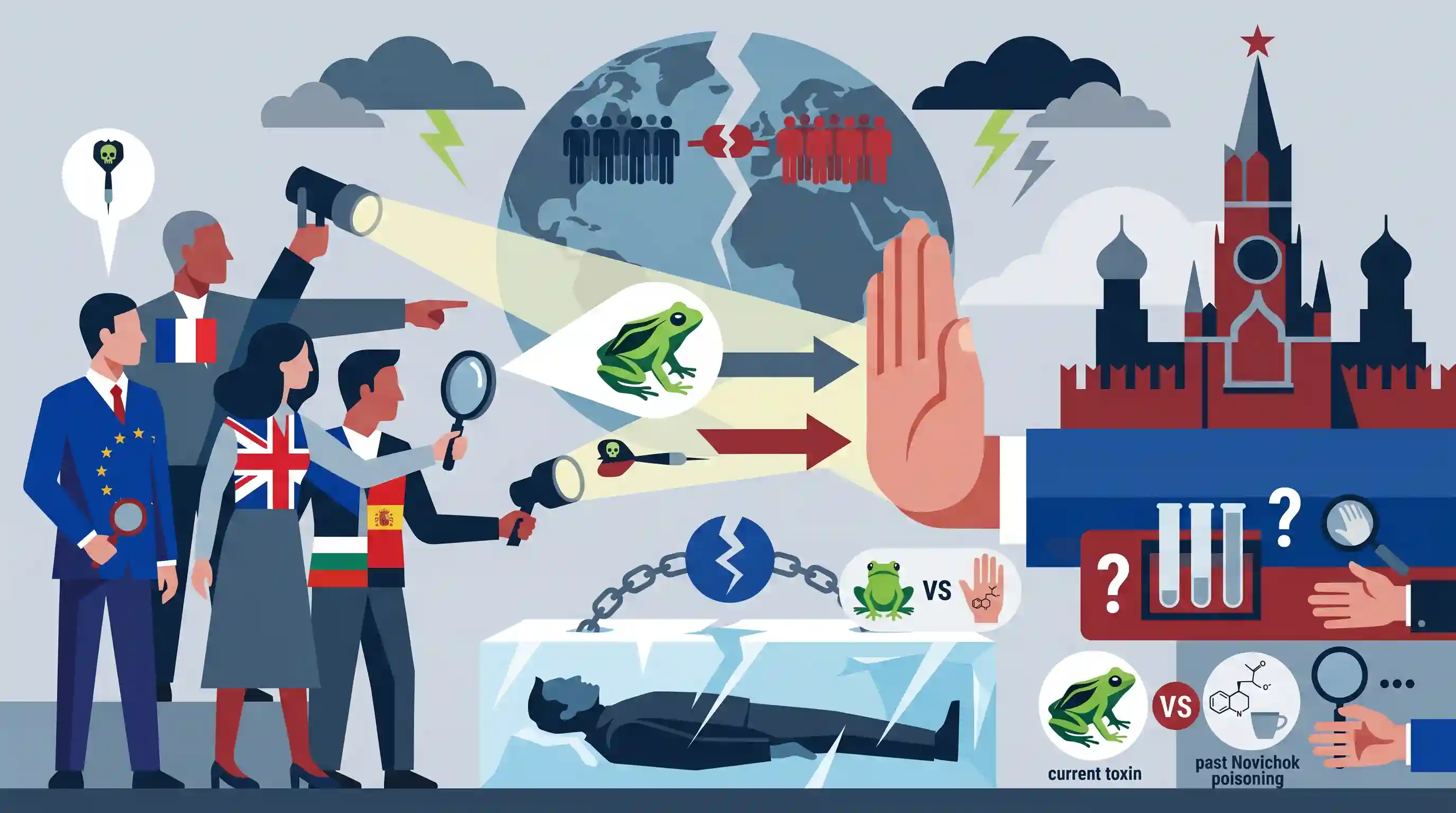
The Kremlin has vehemently denied accusations from five European countries alleging that the Russian state murdered late political opposition leader Alexei Navalny using a poison dart frog toxin. Kremlin spokesperson Dmitry Peskov dismissed the claims as unfounded and biased, arguing that Western countries have failed to provide Russia with laboratory evidence or samples to substantiate the allegations. Navalny, who survived a previous poisoning with a Novichok nerve agent in 2020, died in an Arctic penal colony in 2024. The incident further exacerbates strained diplomatic relations between Russia and the West regarding human rights, political persecution, and the alleged state-sponsored use of unconventional biological/chemical toxins.
Key Points
- Five European countries accused the Russian state of murdering opposition leader Alexei Navalny using a toxin derived from poison dart frogs.
- Kremlin spokesperson Dmitry Peskov strongly rejected the claims, labeling them as unfounded, biased, and based on falsehoods.
- Russia stated that Western nations have repeatedly refused to share laboratory samples and test results that purportedly prove the poisoning.
- Navalny previously survived a 2020 poisoning with a Novichok nerve agent, and later died in an Arctic penal colony in 2024 under suspicious circumstances.
- The use of rare toxins for political assassinations highlights ongoing international tensions and concerns over biological and chemical weapons control.
Important Terms
Chemical Weapons Convention (CWC)

A 1997 multilateral treaty prohibiting the development, production, stockpiling, and use of chemical weapons. It requires states to destroy existing stockpiles and allows for international verification.
UPSC context
GS Paper II (International Relations) and GS Paper III (Security). Tests knowledge of global disarmament regimes and India's obligations.
Organisation for the Prohibition of Chemical Weapons (OPCW)
The Hague-based implementing body of the CWC. It verifies chemical weapons destruction and conducts inspections to ensure treaty compliance. It was awarded the 2013 Nobel Peace Prize.
UPSC context
GS Paper II (Important International Institutions). Relevant for its role in investigating alleged state-sponsored use of chemical agents.
Novichok
A family of highly lethal, fourth-generation nerve agents developed by the Soviet Union. They were added to the CWC’s list of controlled substances in 2019.
UPSC context
GS Paper III (Science & Technology/Security). Tests understanding of chemical warfare agents and their inclusion in international regulatory frameworks.
Biological and Toxin Weapons Convention (BTWC)
A 1975 treaty (opened 1972) that bans the development and stockpiling of biological and toxin weapons. Unlike the CWC, it lacks a formal verification mechanism.
UPSC context
GS Paper II and III. Highlights the regulatory differences between chemical and biological weapons and the challenges of verification.
Batrachotoxin
A potent neurotoxic and cardiotoxic steroidal alkaloid found in certain frogs (e.g., Poison Dart Frogs) and birds. It acts by permanently opening sodium channels, leading to paralysis.
UPSC context
GS Paper III (Science & Technology). Illustrates the overlap between biological toxins and chemical warfare agents in current affairs.
Kremlin
A metonym for the executive branch of the Russian government. Specifically, it refers to the fortified complex in Moscow that is the official residence of the Russian President.
UPSC context
GS Paper II (International Relations). Used to describe Russian state authority and foreign policy decision-making in global disputes.
Prelims Trap
"The Biological Weapons Convention (BWC) is enforced globally through mandatory independent site inspections by a dedicated UN body."
This is a classic trap. Unlike the Chemical Weapons Convention (CWC) which uses the OPCW for site inspections, the BWC notoriously lacks a formal, independent verification and compliance mechanism.
Static Concepts Connected
How do the BWC and CWC differ in scope and verification?
- Scope: BWC bans biological agents and naturally occurring toxins. CWC explicitly bans synthetic chemical weapons and their precursors.
- Verification Mechanism: The CWC utilizes the OPCW for strict, independent global facility inspections. The BWC entirely lacks a formal verification or audit mechanism.
What is the scientific difference between Novichok and Batrachotoxin?
- Novichok: A 4th-generation synthetic nerve agent developed by the Soviets. It fatally inhibits the acetylcholinesterase enzyme, causing continuous muscle stimulation and asphyxiation.
- Batrachotoxin: A naturally occurring, extremely potent steroidal alkaloid neurotoxin secreted by poison dart frogs. Because it is naturally derived, it falls under biological weapon definitions.
Cross-Topic Patterns
Natural toxins and BWC limitations
The use of batrachotoxin highlights a WMD treaty blindspot. As a natural toxin, its regulation falls primarily under the BWC, which lacks the stringent, OPCW-style inspection regime that polices synthetic chemicals.
Extraterritorial hits and international law
State-sponsored poisonings (Navalny, Skripal) parallel recent transnational assassination controversies (e.g., Pannun, Nijjar), deeply testing the frameworks of diplomatic immunity, state sovereignty, and international law enforcement.

Expect a 2026 Prelims question comparing the verification mechanisms of the CWC and BWC, specifically testing the lack of a BWC inspectorate.
Linked PYQs · 3
Linked PYQs · 3
- 2016PrelimsGS1
With reference to 'Organization for the Prohibition of Chemical Weapons (OPCW)', consider the following statements: 1. It is an organization of European Union in working relation with NATO and WHO. 2. It monitors chemical industry to prevent new weapons from emerging. 3. It provides assistance and protection to States (Parties) against chemical weapons threats. Which of the statements given above is/are correct?
- 2024MainsGS2
‘Terrorism has become a significant threat to global peace and security.’ Evaluate the effectiveness of the United Nations Security Council's Counter Terrorism Committee (CTC) and its associated bodies in addressing and mitigating this threat at the international level.
- 2021MainsGS2
Though the Human Rights Commissions have contributed immensely to the protection of human rights in India, yet they have failed to assert themselves against the mighty and powerful. Analyzing their structural and practical limitations, suggest remedial measures.
