US Russia Relations and Sanctions Policy Developments
Source:The Hindu ↗
Why It Matters
Evolving U.S.-Russia relations, potential new sanctions, and NATO's continued arming of Ukraine directly influence global geopolitical stability, energy markets, and defense supply chains. These dynamics compel India to delicately balance its strategic autonomy, maintaining robust ties with the West while navigating its historical and defense dependence on Russia.
Summary
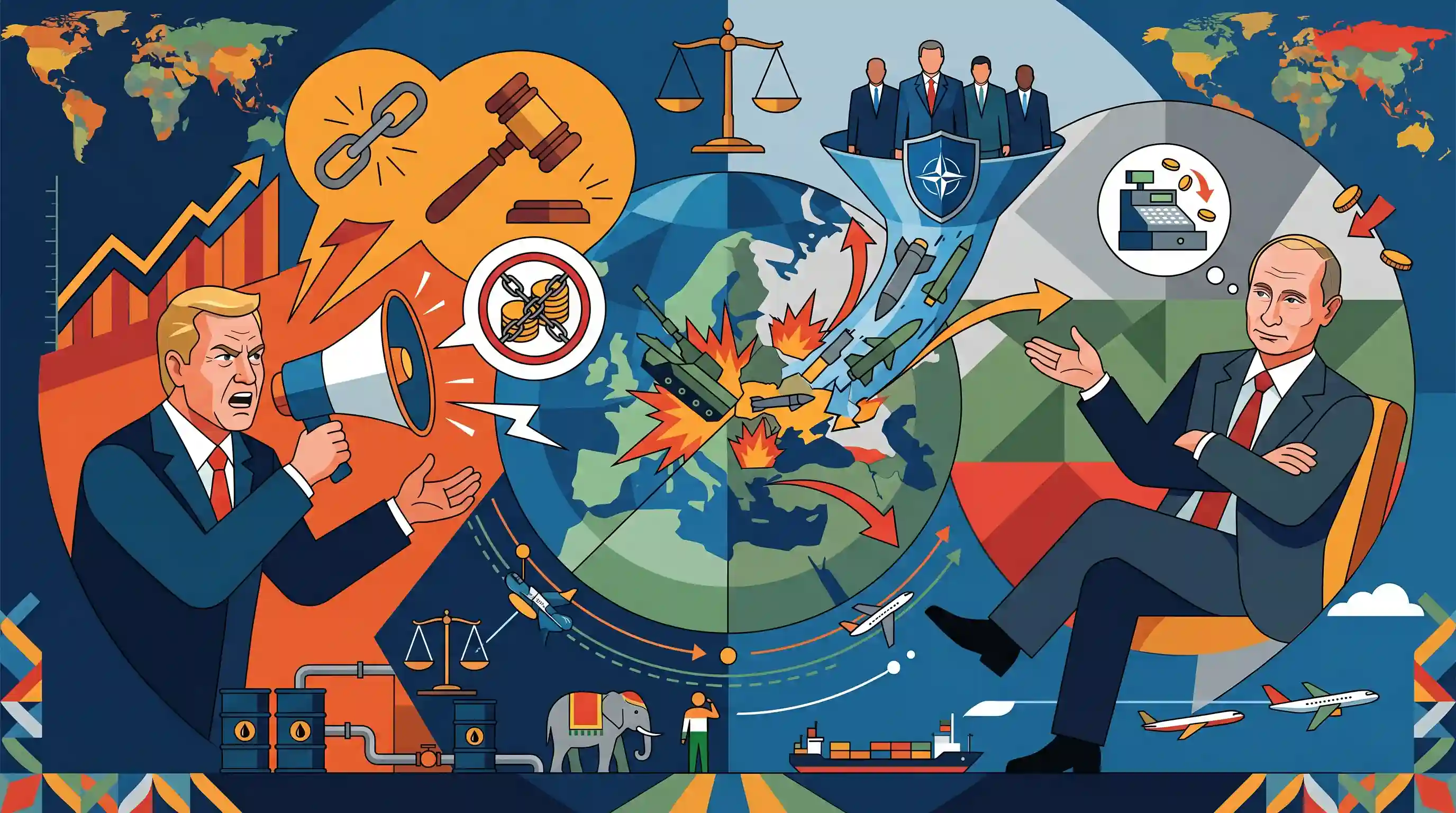
The Kremlin is anticipating a "major statement" from U.S. President Donald Trump, who recently voiced his frustration with Russian President Vladimir Putin concerning the ongoing Russia-Ukraine conflict and hinted at the possibility of new sanctions. Simultaneously, Kremlin spokesperson Dmitry Peskov dismissed concerns over fresh NATO weapons deliveries to Ukraine, referring to the continued arming of Kyiv as "just business."
Key Points
- U.S. President Donald Trump is scheduled to make a 'major statement' regarding Russia amid his expressed frustrations over the Russia-Ukraine conflict.
- Trump is reportedly considering imposing sanctions on Russia due to his dissatisfaction with President Vladimir Putin's actions.
- The Kremlin downplayed the impact of new NATO weapons deliveries to Ukraine, with spokesperson Dmitry Peskov characterizing the ongoing arms supply to Kyiv as 'just business'.
Important Terms
Kremlin

The central fortress in Moscow that serves as the official residence of the Russian President and a metonym for the Russian government's executive authority.
UPSC context
GS Paper II: International Relations. Represents the executive power of a major global power whose policies significantly impact India's strategic interests.
NATO
An intergovernmental military alliance of 32 North American and European countries, established in 1949 to provide collective security against external aggression, primarily through the principle of collective defense.
UPSC context
GS Paper II/III: International Relations and Security. Tests understanding of global security architectures and the influence of western-led alliances on regional conflicts.
International Sanctions
Coercive measures—economic, diplomatic, or military—imposed by countries or international bodies to penalize a state, entity, or individual to influence their behavior or stop illegal actions.
UPSC context
GS Paper II: International Relations. Examines instruments of non-military statecraft and their effectiveness in global governance and conflict resolution.
Geopolitics
The study of how geographical factors like location, natural resources, and topography influence the political power, foreign policy, and international relations of a state.
UPSC context
GS Paper II: International Relations. Core concept for analyzing shifts in global power dynamics and India's strategic positioning in a multipolar world.
Collective Defence
The core principle of NATO (Article 5) stating that an attack against one member is considered an attack against all, requiring a coordinated response from all allies.
UPSC context
GS Paper II: International Relations. Tests knowledge of the legal and strategic foundations of international military alliances and their role in modern warfare.
Bilateral Relations
Strategic interactions and diplomatic ties between two sovereign states, such as the current high-stakes engagement between the United States and Russia regarding global security.
UPSC context
GS Paper II: International Relations. Fundamental to the syllabus section on India’s interests and the effect of policies of developed nations.
Prelims Trap
NATO weapons deliveries to Ukraine trigger Article 5 collective defense obligations.
Ukraine is not a NATO member. Article 5 applies exclusively to member states; weapons deliveries represent external support, not an activation of collective defense.
Static Concepts Connected
How does US domestic law CAATSA impact India's strategic autonomy?
- Secondary Sanctions: Penalizes third-party countries engaging in significant transactions with Russian defense or intelligence sectors.
- S-400 Dilemma: India's procurement of the Russian S-400 missile system risks CAATSA sanctions, persistently testing US-India bilateral ties.
- Waiver Provision: The US President can grant a waiver based on national security interests, though it requires constant diplomatic maneuvering by India.
What is the scope of NATO's Article 5 regarding collective defense?
- Core Principle: An armed attack against one NATO member is considered an attack against all members.
- Geographic Limit: Strictly applies to member states in North America and Europe; it does not legally cover non-member partners like Ukraine.
- Historical Invocation: It has only been invoked once in history—by the United States following the 9/11 terrorist attacks.
Cross-Topic Patterns
Sanctions accelerating Rupee-Rouble mechanisms
Frequent US unilateral sanctions push nations like India and Russia to bypass the SWIFT network, directly accelerating global de-dollarisation and alternative payment systems like the Rupee-Rouble mechanism.
Proxy conflicts and UNSC structural deadlock
Entrenched East-West proxy engagements block consensus at the UN Security Council, halting resolutions on global security and making the case for multilateral reforms increasingly urgent for India.

Expect a multi-statement question linking unilateral US sanctions (CAATSA), SWIFT exclusion, and India's alternative payment mechanisms.
Linked PYQs · 3
Linked PYQs · 3
- 2023MainsGS2
‘The expansion and strengthening of NATO and a stronger US-Europe strategic partnership works well for India.’ What is your opinion about this statement ? Give reasons and examples to support your answer.
- 2012MainsGS2
Does Putin's return as President of Russia mark a shift to a confrontationist stance in international diplomacy towards the West?
- 2020MainsGS2
What is the significance of Indo-US defence deals over Indo-Russian defence deals? Discuss with reference to stability in the Indo-Pacific region.
