Russia Ukraine Peace Talks and European Economic Sanctions
Source:The Hindu ↗
Why It Matters
The article is crucial for understanding the dual-track nature of modern conflicts, where tentative diplomatic peace talks run parallel to aggressive economic warfare (primary and secondary sanctions). The weaponization of trade and energy via sanctions has direct implications for global supply chains and neutral trading partners, analogous to past sanctions regimes that candidates must analyze for GS Paper 2.
Summary
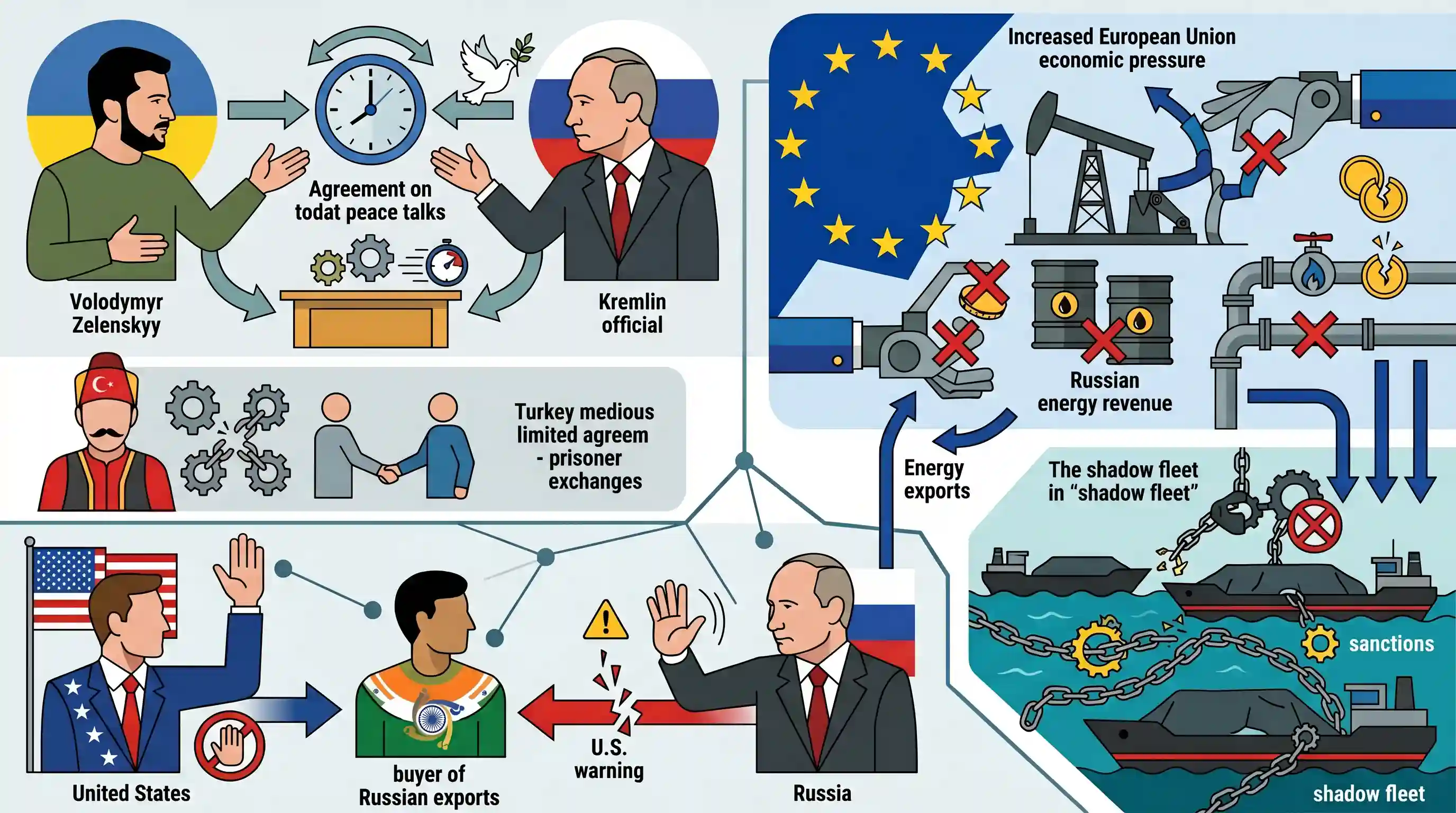
The Kremlin has expressed agreement with Ukrainian President Volodymyr Zelenskyy regarding the necessity to accelerate peace talks, signaling potential openness to diplomacy despite significant disagreements over ceasefire terms. Previous mediation by Turkey has yielded limited agreements, such as prisoner exchanges. Concurrently, the European Union is intensifying economic pressure on Russia by preparing new sanctions aimed at its energy revenue and the "shadow fleet" used to evade trade restrictions. Furthermore, Russia dismissed concerns that U.S. warnings of secondary sanctions on buyers of Russian exports would derail bilateral discussions with Washington.
Key Points
- Russia's Kremlin agreed with Ukrainian President Volodymyr Zelenskyy on the need to increase momentum for peace talks, although no specific dates are set and wide gaps on ceasefire terms remain.
- Previous rounds of negotiations hosted by Turkey successfully resulted in agreements on exchanging prisoners and soldiers' remains.
- The European Union is preparing a new round of sanctions specifically targeting Russia's energy revenues and its "shadow fleet" of vessels used to bypass current restrictions.
- Despite U.S. threats of secondary sanctions on entities buying Russian exports, Russia indicated this would not end its bilateral engagements with Washington.
Important Terms
Secondary Sanctions

Economic penalties imposed by a country on foreign entities to prevent them from trading with a primary sanctioned target, effectively extending the reach of domestic laws to third parties.
UPSC context
GS-II: Effect of policies of developed countries; tests understanding of extraterritorial laws affecting India's trade and strategic autonomy.
Shadow Fleet
A clandestine network of older, under-insured tankers with opaque ownership used by sanctioned nations to export commodities like oil while bypassing international price caps and monitoring.
UPSC context
GS-III: Security/Economy; challenges in global trade transparency, maritime safety, and risks to India's oil supply chain.
European Union (EU)
A unique political and economic union of 27 European states that facilitates free trade, security, and shared legislation through supranational institutions like the European Commission.
UPSC context
GS-II: Regional and Global Groupings; impact of EU's unified foreign and trade policies on India's interests.
Kremlin
The historic fortified complex in Moscow that serves as the official residence of the Russian President and the symbolic seat of the Russian government's executive power.
UPSC context
GS-II: International Relations; understanding centralized government stances and their official positions on global security issues.
Mediation
A diplomatic process where a neutral third party facilitates negotiations between conflicting nations to reach a voluntary agreement and resolve disputes peacefully.
UPSC context
GS-II: Important International institutions and fora; peaceful conflict resolution mechanisms in global diplomacy.
Prelims Trap
The 'Shadow Fleet' refers to stealth naval warships deployed by Russia in the Black Sea.
It actually refers to a network of commercial oil tankers and merchant vessels that use obscured ownership and AIS manipulation to bypass Western economic sanctions.
Static Concepts Connected
What is the difference between Primary and Secondary Sanctions?
- Primary Sanctions: Restrict the imposing country's own citizens and companies from doing business with the targeted nation.
- Secondary Sanctions: Extraterritorial measures targeting third-country entities, threatening to cut them off from the imposing country's financial system (e.g., US markets).
- UN Sanctions: Multilateral and legally binding on all UN member states, unlike unilateral secondary sanctions imposed by individual nations.
How do vessels in the "Shadow Fleet" evade maritime tracking?
- AIS Disabling: Ships intentionally turn off their Automatic Identification System transponders to go 'dark' and avoid detection.
- GNSS Spoofing: Broadcasting fake GPS coordinates to mask the ship's actual physical location from monitoring systems.
- Flags of Convenience: Registering ships in countries with lax maritime regulations to deliberately obscure true ownership and avoid scrutiny.
- Ship-to-Ship Transfers: Moving cargo (like oil) between vessels in mid-ocean to disguise the origin of the sanctioned goods.
Cross-Topic Patterns
Shadow Fleet & Maritime Law (UNCLOS)
Evasion tactics like disabling AIS and mid-sea transfers intersect with UNCLOS regulations, raising significant environmental and maritime safety concerns in international waters.
Sanctions & Rupee Internationalization
Western secondary sanctions on Russian energy accelerate India's push for Rupee-Ruble trade mechanisms, Special Rupee Vostro Accounts (SRVA), and broader currency internationalization efforts.

The mechanics of secondary sanctions and 'Shadow Fleet' AIS evasion tactics are prime targets for a 2026 Prelims multi-statement question.
Linked PYQs · 2
Linked PYQs · 2
- 2025MainsGS2
"The reform process in the United Nations remains unresolved, because of the delicate imbalance of East and West and entanglement of the USA vs. Russo-Chinese alliance.” Examine and critically evaluate the East-West policy confrontations in this regard.
- 2012MainsGS2
How have the US sanctions against Iran affected India's bilateral relations with Iran?
