Kota Medical Negligence Victims Demand Kidney Transplants
Source:The Hindu ↗
Why It Matters
This article touches upon three major RPSC RAS Prelims topics: 1. Constitutional Law & Fundamental Rights (Article 21): The petition for euthanasia directly links to the judicial evolution of Article 21, specifically the 'Right to Live with Dignity' and the legalization of passive euthanasia in the landmark Common Cause v. Union of India case, which is a frequent theme in RPSC exams (e.g., Maneka Gandhi case, Article 21 interpretations). 2. Science & Human Physiology: It highlights clinical differences between Acute Renal Failure (ARF) and End-Stage Renal Disease (ESRD), the mechanism of dialysis, and legal regulations surrounding organ transplantation in India (THOTA). 3. Public Health and Drug Safety Administration in Rajasthan: It raises critical administrative aspects regarding maternal mortality, quality control in government drug supplies under state initiatives like Mukhyamantri Nishulk Dawa Yojana, and the role of oversight authorities.
Summary
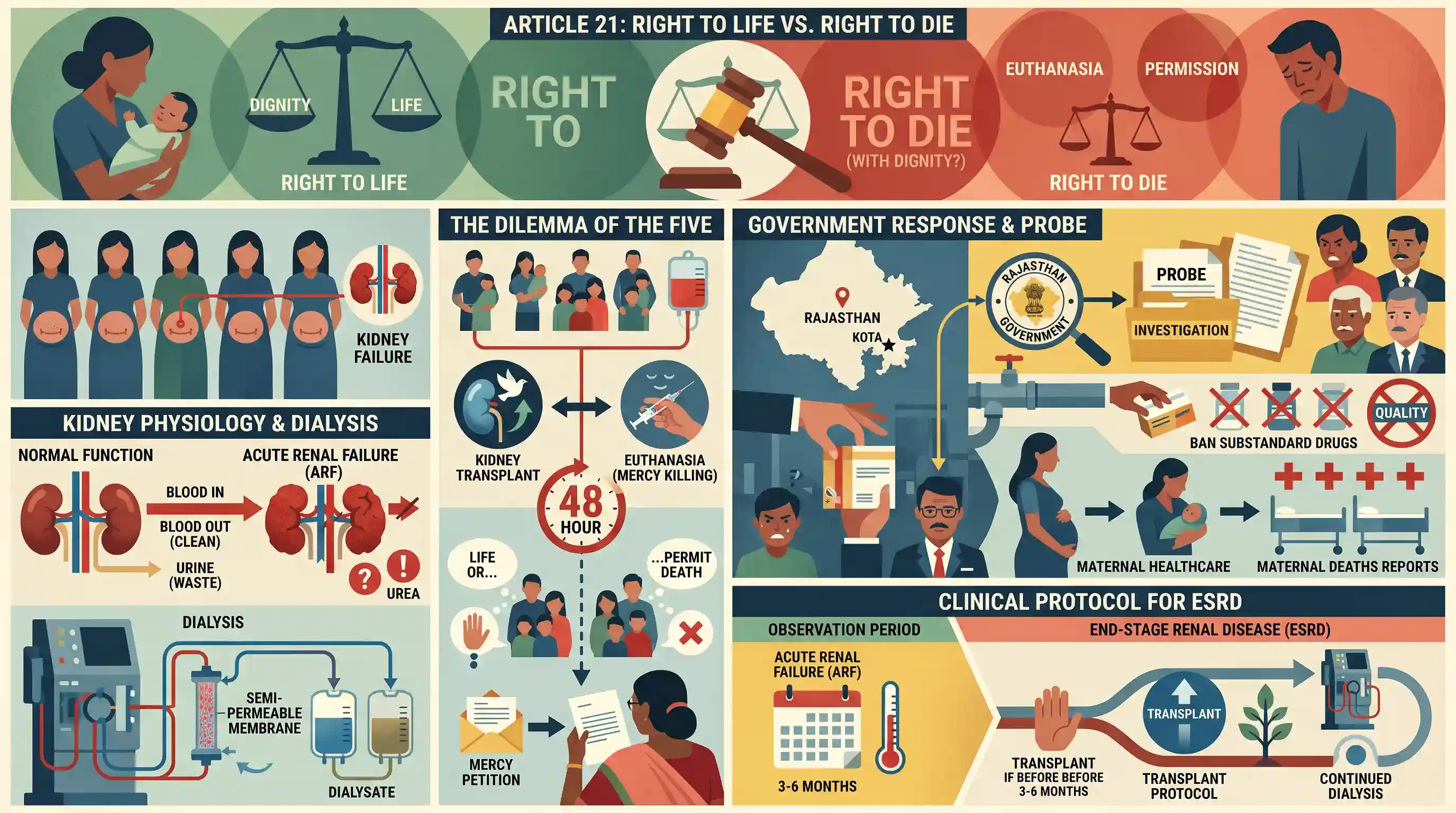
The families of five women who developed acute renal failure (ARF) after undergoing Caesarean sections at government hospitals in Kota, Rajasthan, have written to President Droupadi Murmu demanding kidney transplants within 48 hours or permission for euthanasia (mercy killing). Amid reports of maternal deaths in the same hospitals, the Rajasthan government has ordered a probe and banned the supply of substandard drugs. While families demand immediate transplants, medical experts state that 3-6 months of clinical observation are needed before classifying the condition as End-Stage Renal Disease (ESRD) to initiate transplant protocols.
Key Points
- Five women in Kota, Rajasthan, suffered acute renal failure (ARF) requiring multiple rounds of dialysis after undergoing C-section deliveries at NMCH and JK Lone Hospital. Five other women died of post-delivery complications.
- The victims' families wrote to the President of India, Droupadi Murmu, seeking permission for euthanasia (mercy killing) if they do not receive a kidney transplant within 48 hours, highlighting extreme financial and psychological distress.
- Hospital authorities stated that talk of kidney transplantation is premature, as patients with acute renal failure must be observed for 3 to 6 months before being categorized under End-Stage Renal Disease (ESRD) to determine if the kidney damage is irreversible.
- The Rajasthan state government ordered a probe into the cases and banned substandard drug supplies suspected to have caused the infections and complications.
- Similar maternal deaths and healthcare complications have also been reported from other districts, including Bikaner, Bhilwara, and Banswara, raising systemic concerns over maternal healthcare quality and drug supply chains.
Important Terms
Article 21 of the Constitution

A fundamental constitutional right guaranteeing the protection of life and personal liberty, interpreted by the judiciary to include the right to healthcare, bodily integrity, and to die with dignity (passive euthanasia).
UPSC context
GS Paper II (Polity). Tests understanding of fundamental rights, judicial activism, and the legal evolution of the right to die.
Transplantation of Human Organs and Tissues Act (THOTA)
A 1994 Indian law regulating the removal, storage, and transplantation of human organs and tissues for therapeutic purposes, aiming to prevent commercial dealings and illegal organ trade.
UPSC context
GS Paper II (Governance) & GS Paper III (Science). Tests knowledge of medical ethics, regulatory frameworks, and public health governance.
Mukhyamantri Nishulk Dawa Yojana (MNDY)
A flagship public health initiative launched by Rajasthan in 2011 to provide free essential medicines, surgical items, and sutures to all patients visiting government healthcare facilities.
UPSC context
GS Paper II (Welfare Schemes). Evaluates healthcare accessibility, universal health coverage models, and public sector medicine procurement challenges.
Prelims Trap
The President of India can grant executive permission for euthanasia or mercy killing under the pardoning powers of Article 72.
Article 72 applies strictly to pardoning judicial sentences of convicted offenders. It cannot authorize active euthanasia, which is classified as culpable homicide under criminal law.
Static Concepts Connected
What is India's legal position on Euthanasia?
- Judicial recognition: The Supreme Court in Common Cause (2018) recognized the Right to Die with Dignity as a fundamental right under Article 21.
- Passive versus Active: Passive euthanasia (withholding life-sustaining treatment) is legally permitted under strict guidelines, whereas active euthanasia remains a criminal offense in India.
- Living wills: An individual can execute an Advance Medical Directive (living will) to detail preferred medical decisions if they become mentally incompetent.
How is drug safety regulated in India?
- Central regulatory role: The CDSCO (led by DCGI) regulates new drug approvals, clinical trials, and standards for imported pharmaceutical goods.
- State licensing role: State Licensing Authorities (SLAs) handle licensing for local drug manufacturing, sales, distribution, and general market surveillance.
- Joint jurisdiction: Both CDSCO and state regulators jointly license highly critical medical supplies, including vaccines, sera, and large-volume parenterals.
Cross-Topic Patterns
Article 72 limits vs Article 21
Petitions for mercy killing test constitutional boundaries, as executive pardons under Article 72 cannot authorize active euthanasia, which remains a criminal offense.
Drug regulatory federalism and safety
Substandard drug supply in public hospitals highlights the structural challenges of split federal oversight between CDSCO and state licensing agencies over crucial parenterals.

Constitutional limits of Article 72 vs. Article 21 passive euthanasia guidelines are highly likely to be tested in Prelims 2026.
Linked PYQs · 1
Linked PYQs · 1
- 2023RPSC_PRELIMSGS1
Identify the incorrect statement regarding the Menaka Gandhi case, 1978, concerning the judicial interpretation of Article 21.
