Koracha community opposes Karnataka internal reservation matrix
Source:The Hindu ↗
Why It Matters
This issue highlights the complex challenges of implementing internal reservation (sub-categorisation) within Scheduled Castes. It underscores the ongoing struggle of highly marginalized nomadic tribes who fail to benefit from broad reservations when grouped with relatively dominant castes. The topic is crucial for UPSC as it touches upon recent Supreme Court judgments on sub-classification and the constitutional mandate for equitable distribution of affirmative action benefits based on empirical data.
Summary
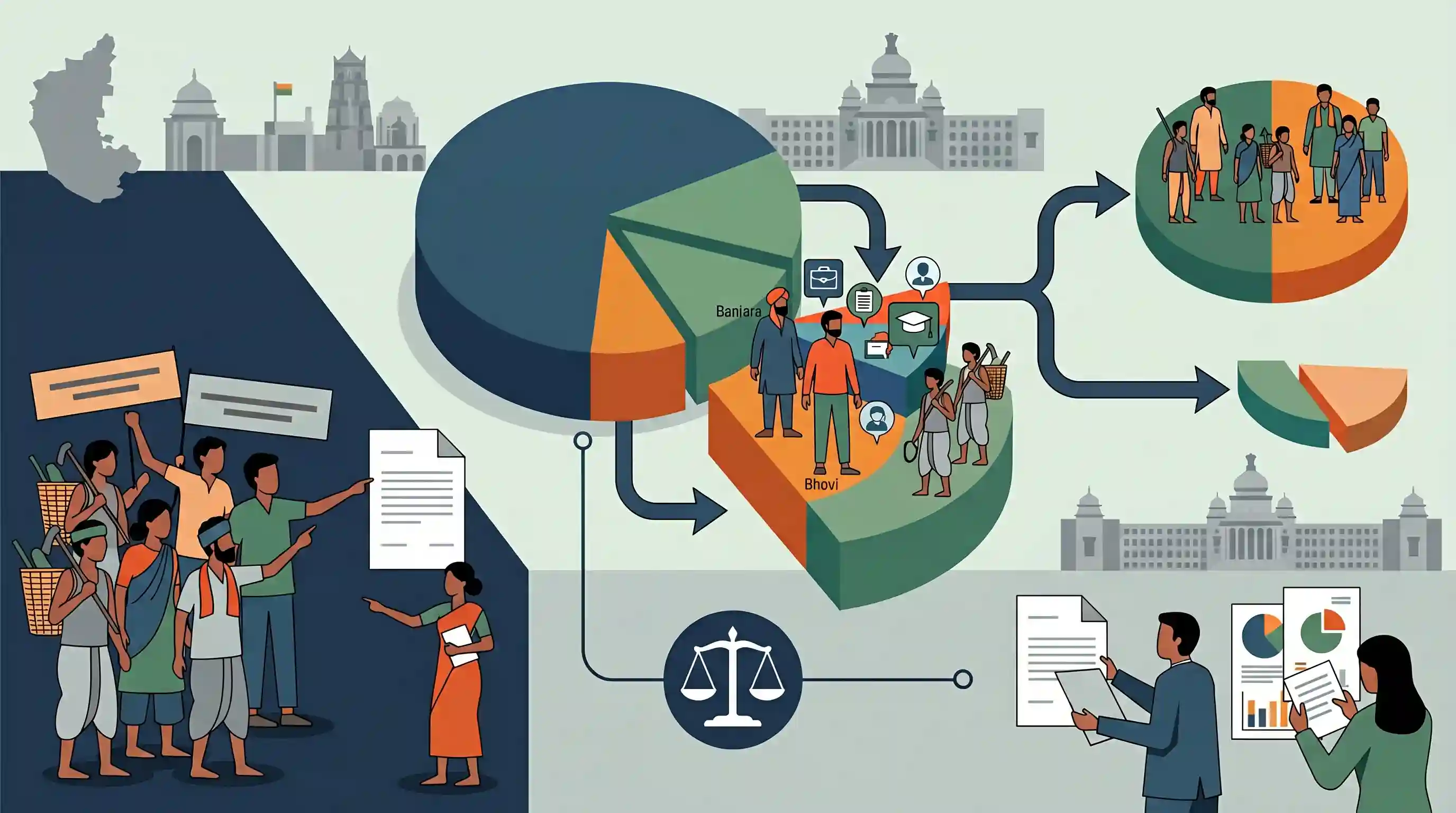
The Koracha community, a nomadic group in Karnataka, is protesting the state government's finalized internal reservation matrix for Scheduled Castes. Categorized under a 5% quota block alongside larger communities like the Banjara and Bhovi, the Korachas argue they cannot effectively compete and thus face continued marginalization. Citing discrepancies between the 2011 census and the Justice H.N. Nagamohan Das commission data, the community demands either inclusion with the 'Right' or 'Left' caste groups or a separate 2% internal reservation specifically for nomadic castes with populations under one lakh. Their opposition emphasizes the need for empirical evaluation of socio-economic and educational backwardness, as mandated by the Supreme Court for valid internal sub-categorization of reserved categories.
Key Points
- The Koracha community in Karnataka opposes the state government's finalized internal reservation matrix for Scheduled Castes.
- Currently grouped in the C-category with a 5% quota alongside larger communities like the Banjara and Bhovi, the Korachas argue they cannot compete fairly.
- They demand a separate 2% internal reservation specifically for nomadic castes with a population under one lakh, or inclusion with the 'Right' or 'Left' caste categories.
- The community highlights discrepancies in population data, criticizing the reliance on the Justice H.N. Nagamohan Das commission over the 2011 census.
- They argue the state cabinet's decision ignores Supreme Court guidelines requiring internal reservation to be based on empirical data regarding socio-economic and educational backwardness.
Important Terms
Justice H.N. Nagamohan Das commission

A retired judge-led panel that recommended increasing Karnataka's SC/ST reservation and proposed a scientific sub-categorisation matrix for the state's 101 Scheduled Caste communities based on socio-educational backwardness.
UPSC context
GS Paper II (Social Justice/Polity); relevant for state-level initiatives in affirmative action and data-driven policy making.
Supreme Court Sub-categorisation Ruling
A landmark 2024 ruling (6:1 majority) that allowed states to create sub-groups within SC/ST categories to provide preferential treatment to the most backward, overturning the 2004 E.V. Chinnaiah precedent.
UPSC context
GS Paper II (Judiciary/Polity); tests understanding of Article 14, Article 341, and the 'creamy layer' concept in SC reservations.
Koracha community
A nomadic Scheduled Caste community in Karnataka traditionally involved in handicrafts; they are currently protesting their grouping with more advanced SC sub-groups in the state’s internal reservation matrix.
UPSC context
GS Paper II (Welfare Schemes for Vulnerable Sections); serves as a case study for the challenges of 'most-backward' groups within reserved categories.
Internal Reservation Matrix
A framework dividing the total SC quota into blocks (e.g., Left, Right, Touchable, and Nomadic) to ensure equitable benefit distribution among sub-castes with varying levels of historical deprivation.
UPSC context
GS Paper II (Social Justice); critical for understanding administrative mechanisms used to achieve substantive equality in reservations.
Nomadic Tribes
Communities that move from place to place rather than living in one settlement; in Karnataka's reservation context, they often demand separate sub-quotas due to extreme marginalization compared to settled castes.
UPSC context
GS Paper II (Social Justice); pertains to the specific developmental and representational needs of highly vulnerable and mobile populations.
Article 341
The constitutional provision empowering the President to specify castes as 'Scheduled Castes' for a state; it is central to debates on whether states can sub-classify these lists.
UPSC context
GS Paper II (Constitutional Provisions); vital for questions on federalism and the division of power between Parliament and State Legislatures.
Prelims Trap
States have the constitutional power to amend the Scheduled Castes list to create sub-categories.
The 2024 SC ruling allows states to sub-classify the existing list for quotas, but only Parliament (Article 341) can add or remove communities from the official SC list.
Static Concepts Connected
Who holds the power to notify and modify the Scheduled Castes list under Article 341?
- Presidential Notification: The President first notifies the SC list for a specific state or union territory after consulting the Governor.
- Parliamentary Power: Once notified, only Parliament can enact a law to include or exclude any caste, race, or tribe from the Presidential list.
- State Limitations: State legislatures cannot modify the central list; they can only sub-classify existing entries for targeted reservation benefits.
What criteria did the Supreme Court mandate for SC sub-categorisation in 2024?
- Empirical Data: Sub-classification must be based on quantifiable, empirical data demonstrating socio-economic and educational backwardness. It cannot be arbitrary or based on political whims.
- Creamy Layer Extension: States must extend the creamy layer exclusion to SCs and STs to ensure reservation benefits reach the most marginalized within these groups.
- Intra-group Disparities: The Court recognized that SCs are not a homogenous class, and intra-group disparities justify internal quotas for weaker sub-groups.
Cross-Topic Patterns
Caste Census vs. Commission Data
The Korachas' reliance on the 2011 census over state commissions mirrors national debates on the necessity of a socio-economic caste census to justify equitable sub-quotas without data discrepancies.
Mainstreaming Nomadic Tribes
Often clubbed under SC/ST/OBC without separate recognition, Denotified and Nomadic Tribes (like Korachas) face intra-category marginalization, echoing the Idate Commission's push for dedicated welfare boards.

Expect a tricky prelims statement contrasting Article 341 (Parliament's power to amend SC lists) with the State's power to sub-classify.
Linked PYQs · 3
Linked PYQs · 3
- 2011MainsGS1
Discuss the problems specific to the denotified and nomadic tribes in India.
- 2024PrelimsGS1
Consider the following statements : 1. It is the Governor of the State who recognizes and declares any community of that State as a Scheduled Tribe. 2. A community declared as a Scheduled Tribe in a State need not be so in another State. Which of the statements given above is/are correct?
- 2018MainsGS2
Whether National Commission for Scheduled Castes (NCSC) can enforce the implementation of constitutional reservation for the Scheduled Castes in the religious minority institutions? Examine.
