Kondakarla Ava Set to Become First State Conservation Reserve
Source:morning-standard ↗
Why It Matters
APPSC Group 1 Prelims heavily tests state-specific geographical locations (matching sanctuaries/wetlands to districts) and the statutory frameworks that govern environmental protection. The designation of Andhra Pradesh's *first* conservation reserve is a prime candidate for both current affairs and geography questions.
Summary
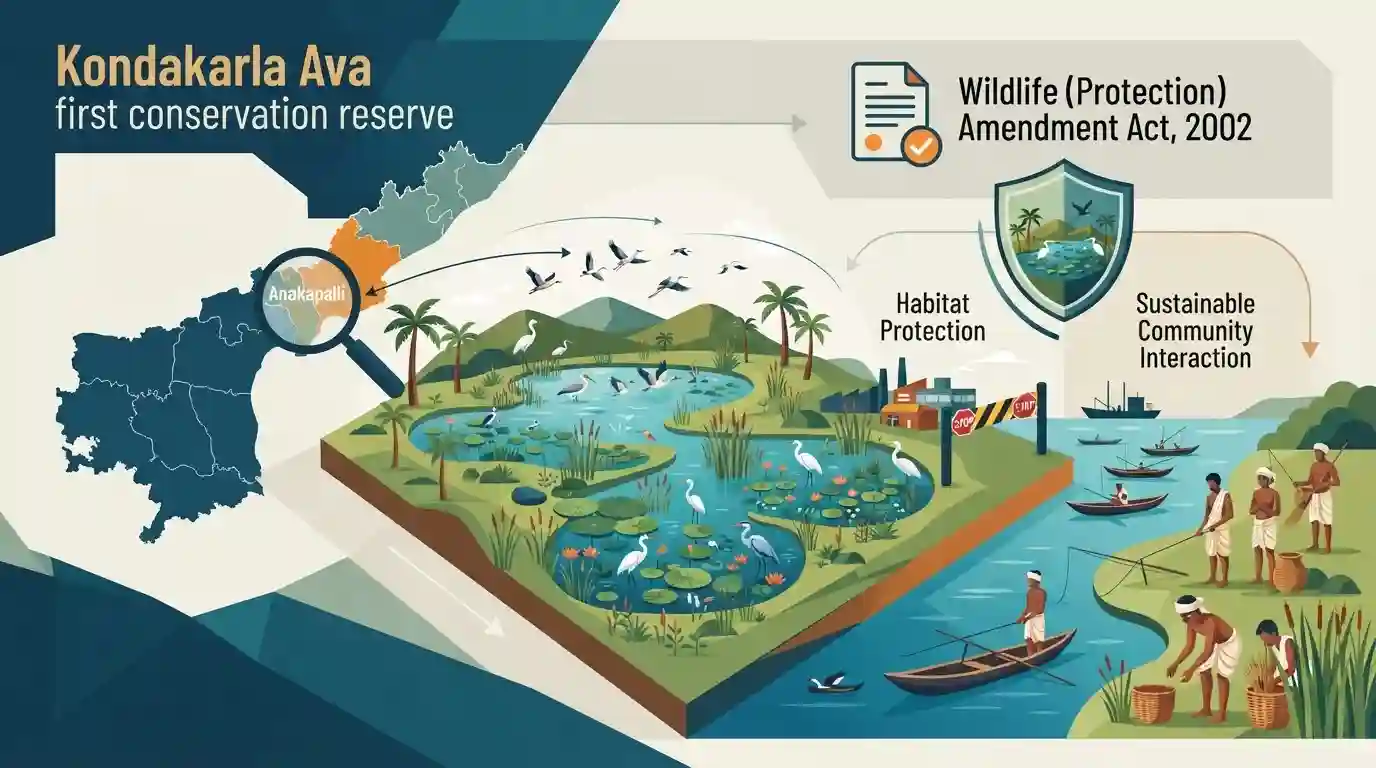
The Kondakarla Ava wetland in the Anakapalli district is poised to be declared Andhra Pradesh's first conservation reserve. As a significant freshwater ecosystem and avian habitat, the conservation reserve tag under the Wildlife (Protection) Amendment Act, 2002, will ensure habitat protection from disruptive commercial exploitation while allowing sustainable community interaction.
Key Points
- Kondakarla Ava wetland, the second largest freshwater lake in Andhra Pradesh located in Anakapalli district, is slated to become the state's first 'conservation reserve'.
- The declaration of a conservation reserve is authorized under the Wildlife (Protection) Amendment Act of 2002 and acts to protect landscapes, seascapes, and habitat of fauna and flora.
- This protected area category will act as a buffer zone and migratory corridor without completely barring local community access, compared to the strict regulations of National Parks.
- Kondakarla Ava is a critical habitat for numerous migratory birds and indigenous flora, making its formal protection crucial for local biodiversity.
Important Terms
Kondakarla Ava

A major natural freshwater lake and wetland in Anakapalli district, Andhra Pradesh. Fed by the Sarada river, this biodiversity-rich habitat for migratory birds is poised to become the state's first Conservation Reserve.
UPSC context
Highly relevant for Prelims (Environment/Geography) testing knowledge of key Indian wetlands, lake locations, and new protected areas.
Conservation Reserve
A protected area category located on government-owned land, often acting as a buffer or ecological corridor between national parks or sanctuaries. It protects landscapes while involving local communities in management.
UPSC context
Essential for GS-3 (Environment) to distinguish between National Parks, Sanctuaries, and community-participatory protected area frameworks.
Wildlife (Protection) Amendment Act, 2002
An amendment to India's foundational 1972 wildlife legislation that officially introduced the concepts of Conservation Reserves and Community Reserves, aiming to balance ecological protection with local community needs.
UPSC context
Crucial for GS-3 (Environment) and Prelims, testing statutory frameworks for wildlife protection, ecological corridors, and participatory conservation.
Prelims Trap
Conservation Reserves possess high statutory protection that strictly prohibits local community access and livestock grazing.
Unlike National Parks, Conservation Reserves do not completely bar access. They allow sustainable community interaction and are designed as flexible buffer zones on government land.
Static Concepts Connected
How do Conservation Reserves differ from Community Reserves?
- Land Ownership: Conservation Reserves are declared on government-owned land, whereas Community Reserves are typically declared on private or community land.
- Core Objective: Both act as buffers and corridors, but Community Reserves require the community to voluntarily offer their land for wildlife protection.
- Management Structure: Both are governed by local, decentralized management committees (like the CRMC) rather than strictly centralized authorities.
What are the prominent freshwater lake ecosystems of Andhra Pradesh?
- Kolleru Lake: The state's largest freshwater lake, situated between the Krishna and Godavari deltas, recognized as an international Ramsar site.
- Kondakarla Ava: The second largest freshwater lake in AP, located in the Eastern Ghats foothills, acting as a crucial wintering ground for migratory birds.
Cross-Topic Patterns
Decentralized Biodiversity Governance
Management via Conservation Reserve Management Committees (CRMC) links to the broader UPSC theme of decentralized biodiversity governance, mirroring the philosophy of the Forest Rights Act and PESA.
Buffer Zones and Migration Corridors
The designation emphasizes a shift in India's conservation strategy from isolated Protected Areas to interconnected landscape management, securing migration corridors for avian and terrestrial species.

Expect a Prelims question comparing land ownership and community access rights in Conservation Reserves versus Community Reserves in 2026.
Linked PYQs · 2
Linked PYQs · 2
- 2024APPSC_PRELIMSGS1
Match the following : | List-I (Wildlife Sanctuary in Andhra Pradesh) | List-II (Region) | |---|---| | A. Coringa | I. Kurnool | | B. Gundla Brahmeswaram | II. Kadapa | | C. Rollapadu | III. East Godavari | | D. Sri Lankamalleswara | IV. Kurnool and Prakasam | Choose the correct answer using the codes given below : Code: A B C D
- 2023APPSC_PRELIMSGS1
According to the Indian Forest Act, 1927, which of the following is the most appropriate sequence which shows the degree of protection between different forest types ?
