Kondakarla Ava Approved as State Conservation Reserve
Source:deccanchronicle ↗
ఇది ఎందుకు ముఖ్యం
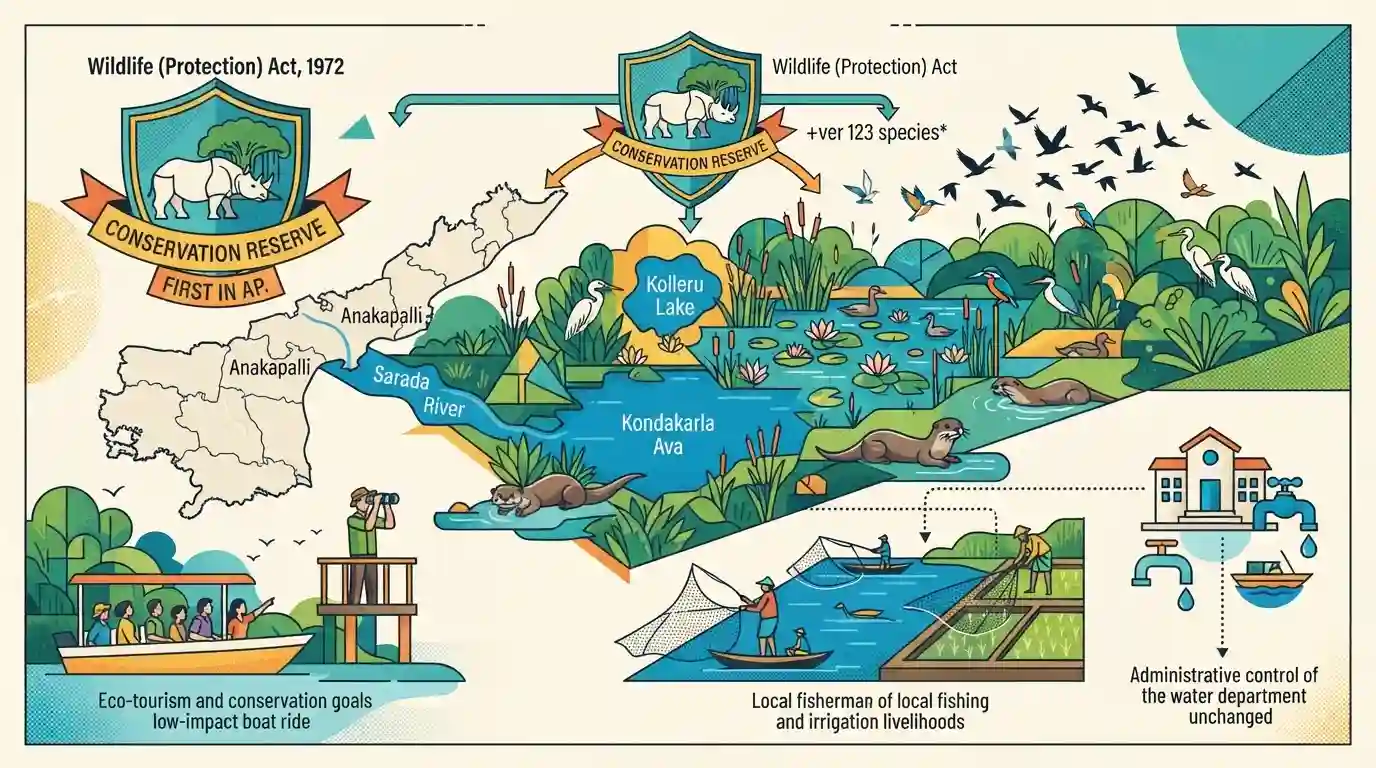
This development represents a major step in Andhra Pradesh's ecological governance, establishing its first-ever Conservation Reserve. It connects key environmental laws (WPA 1972) with regional geography (Sarada river, Kolleru comparison) and local livelihoods, making it highly testable for APPSC Group 1 Prelims.
సారాంశం
The Andhra Pradesh government has approved a proposal to declare the Kondakarla Ava Wetland in Anakapalli district as the state's first Conservation Reserve under the Wildlife (Protection) Act, 1972. Positioned as AP's second-largest natural freshwater lake after Kolleru, this ecologically fragile wetland is fed by the Sarada River and provides sanctuary to over 123 bird species and the vulnerable smooth-coated otter. The notification balances conservation and eco-tourism goals with local irrigation and fishing livelihoods without altering the administrative control of the water department.
ముఖ్య అంశాలు
- Kondakarla Ava Wetland in Anakapalli district has been approved to be notified as Andhra Pradesh's first Conservation Reserve under the Wildlife (Protection) Act, 1972.
- It is the second-largest natural freshwater lake in Andhra Pradesh, second only to Kolleru Lake.
- The wetland is situated 50 km southwest of Visakhapatnam and is fed by the Sarada River and Anakapalle Ava.
- It supports rich biodiversity, hosting over 123 bird species (migratory waterfowl), 24 aquatic plant species, over 20 fish species, and the vulnerable smooth-coated otter.
- Livelihoods of more than 100 local fishing households utilizing traditional palm boats, along with irrigation facilities, are protected under the balanced administrative framework.
- The water department retains administrative ownership over the reservoir structures, while the forest department will oversee wildlife conservation and eco-tourism.
ముఖ్యమైన పదాలు
Wildlife (Protection) Act, 1972

India's primary environmental legislation safeguarding flora and fauna. It establishes protected areas, like National Parks and Conservation Reserves, and classifies species into Schedules for varying degrees of legal protection and trade regulation.
UPSC context
Fundamental for GS-3 Environment and Prelims (Environmental Legislation, Biodiversity frameworks).
Kondakarla Ava Wetland
Andhra Pradesh's second-largest natural freshwater lake, located in Anakapalli district. Fed by the Sarada River, it hosts over 123 bird species and the vulnerable smooth-coated otter. It is set to become AP's first Conservation Reserve.
UPSC context
Important for GS-3 Environment (Wetland ecosystems) and Prelims (Geography/Places in News).
Conservation Reserve
A protected area category introduced in the Wildlife Protection Amendment Act, 2002. These act as buffer zones or corridors connecting established protected areas, managed entirely on government-owned land in consultation with local communities.
UPSC context
Crucial for GS-3 Environment (Protected Area Networks) and Prelims (WPA provisions).
Smooth-coated otter
The largest otter in Southeast Asia, found in freshwater wetlands. Characterized by smooth fur, it is an apex aquatic predator. It is listed as Vulnerable on the IUCN Red List and protected under Indian law.
UPSC context
Relevant for Prelims (Species in News, IUCN statuses) and GS-3 Environment.
Sarada River
A medium-sized east-flowing river originating in the Eastern Ghats. It flows through Andhra Pradesh's Visakhapatnam region, feeds the Kondakarla Ava wetland, and empties into the Bay of Bengal.
UPSC context
Important for Prelims (Indian Geography, East-flowing rivers).
Andhra Pradesh Water Department
The state agency managing irrigation and water supply. At Kondakarla Ava, it retains administrative control over hydraulic structures and canals while accommodating the Forest Department's wildlife conservation and eco-tourism efforts.
UPSC context
Illustrates inter-departmental coordination in wetland management (GS-2/GS-3).
Andhra Pradesh Forest Department
The state authority responsible for wildlife protection, forest conservation, and managing protected areas like the newly approved Kondakarla Ava Conservation Reserve in coordination with other state administrative bodies.
UPSC context
Relevant for GS-2 (State governance) and GS-3 (Environmental conservation administration).
Andhra Pradesh Revenue Department
The state administrative body handling land administration, surveys, and ownership records. At Kondakarla Ava, it conducts joint surveys prior to formally transferring boundary lands for conservation management.
UPSC context
Highlights the role of land administration in formalizing protected areas (GS-2/GS-3).
ప్రిలిమ్స్ ఉచ్చు
Conservation Reserves can be declared on private or community-owned land if local communities agree to conserve wildlife.
Under WPA 1972, Conservation Reserves are declared exclusively on Government-owned land. It is Community Reserves (Section 36C) that are established on private or community lands.
అనుసంధానమైన స్థిర భావనలు
What is a Conservation Reserve under the Wildlife (Protection) Act, 1972?
- Land ownership: Declared by state governments on government-owned land adjacent to national parks/sanctuaries or corridors link.
- Legal basis: Established under Section 36A after consulting local communities; aims to protect landscapes, seascapes, flora, fauna, and habitats.
- Livelihood protection: Local rights like fishing, grazing, and agriculture are protected and not barred, unlike in strict National Parks.
What are the ecological and legal profiles of the Smooth-coated Otter?
- Habitat preference: Constructs territories in major river systems, freshwater wetlands, lakes, and mangrove estuaries.
- IUCN status: Classified as Vulnerable on the IUCN Red List due to habitat loss, pollution, and poaching.
- Legal protection: Placed under Schedule I of India's Wildlife (Protection) Act and Appendix I of CITES.
అంతర-అంశ నమూనాలు
WPA categories and land-tenure rights
Linking conservation zoning under the Wildlife Protection Act to the preservation of traditional community livelihoods, specifically fishing and grazing rights on government-owned wetlands.
Eastern Ghats hydrology and microclimates
Connecting micro-hydrological networks of minor east-flowing rivers (like Sarada) with the survival of endangered, isolated wet-evergreen forest patches within dry-deciduous zones.

2026 Prelims may test the distinction between Conservation and Community Reserves under WPA 1972, using Kondakarla Ava as a base.
అనుసంధాన PYQలు · 2
అనుసంధాన PYQలు · 2
- 2024APPSC_PRELIMSGS1
Match the following : | List-I (Wildlife Sanctuary in Andhra Pradesh) | List-II (Region) | |---|---| | A. Coringa | I. Kurnool | | B. Gundla Brahmeswaram | II. Kadapa | | C. Rollapadu | III. East Godavari | | D. Sri Lankamalleswara | IV. Kurnool and Prakasam | Choose the correct answer using the codes given below : Code: A B C D
- 2019APPSC_PRELIMSGS1
Which one of the following pairs is not correctly matched ? Dam/Lake / River
