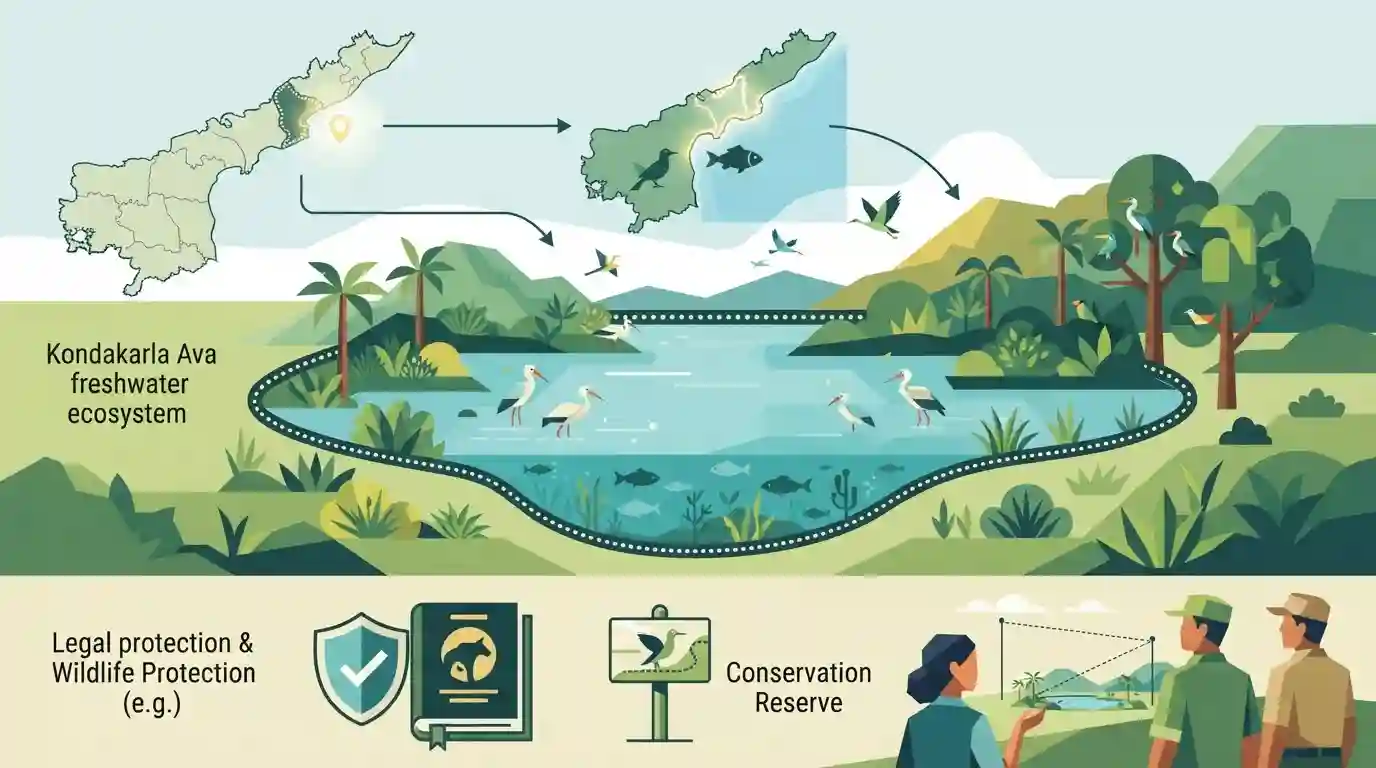
Kondakarla Ava: Andhra Pradesh First Conservation Reserve
Source:newindianexpress ↗
Why It Matters
Important for APPSC Group 1 aspirants tracking state-specific environmental milestones, wildlife protection categories, and geographical landmarks in Andhra Pradesh.
Summary
Kondakarla Ava in Visakhapatnam is designated as Andhra Pradesh's first conservation reserve, providing legal protection to its freshwater ecosystem and rich avian biodiversity under the Wildlife Protection Act.
Key Points
- Kondakarla Ava is set to become Andhra Pradesh's first conservation reserve, enhancing the protection of its unique wetland and biodiversity.
- Located in Visakhapatnam district, Kondakarla Ava is a prominent freshwater lake and an important habitat for resident and migratory birds.
- Conservation reserves are protected areas under the Wildlife (Protection) Act, 1972, which typically act as buffer zones or connectors between established national parks and wildlife sanctuaries.
Important Terms
Wildlife Protection Act 1972

An essential central statute enacted in 1972 that provides the legal framework for the protection of wildlife, flora, and fauna, including provisions under Section 36A for establishing conservation and community reserves.
UPSC context
Important for APPSC/UPSC Environment & Ecology (Paper III / Paper I); tests knowledge of protected area categories and wildlife conservation laws.
Andhra Pradesh Forest Department
The state government agency headed by the Principal Chief Conservator of Forests responsible for managing, protecting, and conserving forests, wildlife, and ecosystems across Andhra Pradesh.
UPSC context
Relevant for APPSC Group-1 & 2 Geography/Environment sections; tests institutional mechanisms of state forest and wildlife management.
Prelims Trap
Conservation reserves are established exclusively on government-owned forest land with no rights allowed to local communities.
Aspirants often confuse Conservation Reserves with National Parks, missing that Conservation Reserves allow for community participation and private land use under Section 36A.
Static Concepts Connected
What are the key protected area categories under the Wildlife (Protection) Act, 1972?
- Statutory Foundation: Statutory basis: Created under specific sections of the WLPA 1972, including National Parks, Sanctuaries, Conservation Reserves, and Community Reserves.
- Section 36A: Conservation reserves: Established under Section 36A, usually on government lands adjacent to sanctuaries/national parks in consultation with local communities.
- Section 36B: Community reserves: Established under Section 36B on private or community-owned lands when communities volunteer to conserve wildlife.
Cross-Topic Patterns
Wetland Conservation Meets AP Geography and Drainage
Wetland conservation under the Wildlife Protection Act intersects with AP geography questions on river basins like the Sarada River and Eastern Ghats ecology.
Statutory Protected Areas and Decentralized Forest Governance
Designation of state-level conservation reserves connects decentralized forest governance with central environmental statutes under Wildlife Protection Act amendments.

APPSC frequently tests first-of-its-kind state assets; expect direct matching or statements on AP's first conservation reserve.
Linked PYQs · 2
Linked PYQs · 2
- 2024APPSC_PRELIMSGS1
Match the following : | List-I (Wildlife Sanctuary in Andhra Pradesh) | List-II (Region) | |---|---| | A. Coringa | I. Kurnool | | B. Gundla Brahmeswaram | II. Kadapa | | C. Rollapadu | III. East Godavari | | D. Sri Lankamalleswara | IV. Kurnool and Prakasam | Choose the correct answer using the codes given below : Code: A B C D
- 2023APPSC_PRELIMSGS1
According to the Indian Forest Act, 1927, which of the following is the most appropriate sequence which shows the degree of protection between different forest types ?
