Kolkata Prepares for Landmark India-Russia Bilateral Conclave
Source:thestatesman ↗
Why It Matters
This article highlights West Bengal's central role in hosting high-level international diplomatic events (such as SAMPARK) and covers crucial environment and biodiversity conservation topics (like the International Big Cat Alliance and snow leopard tracking methods) highly relevant for the WBCS Prelims exam.
Summary
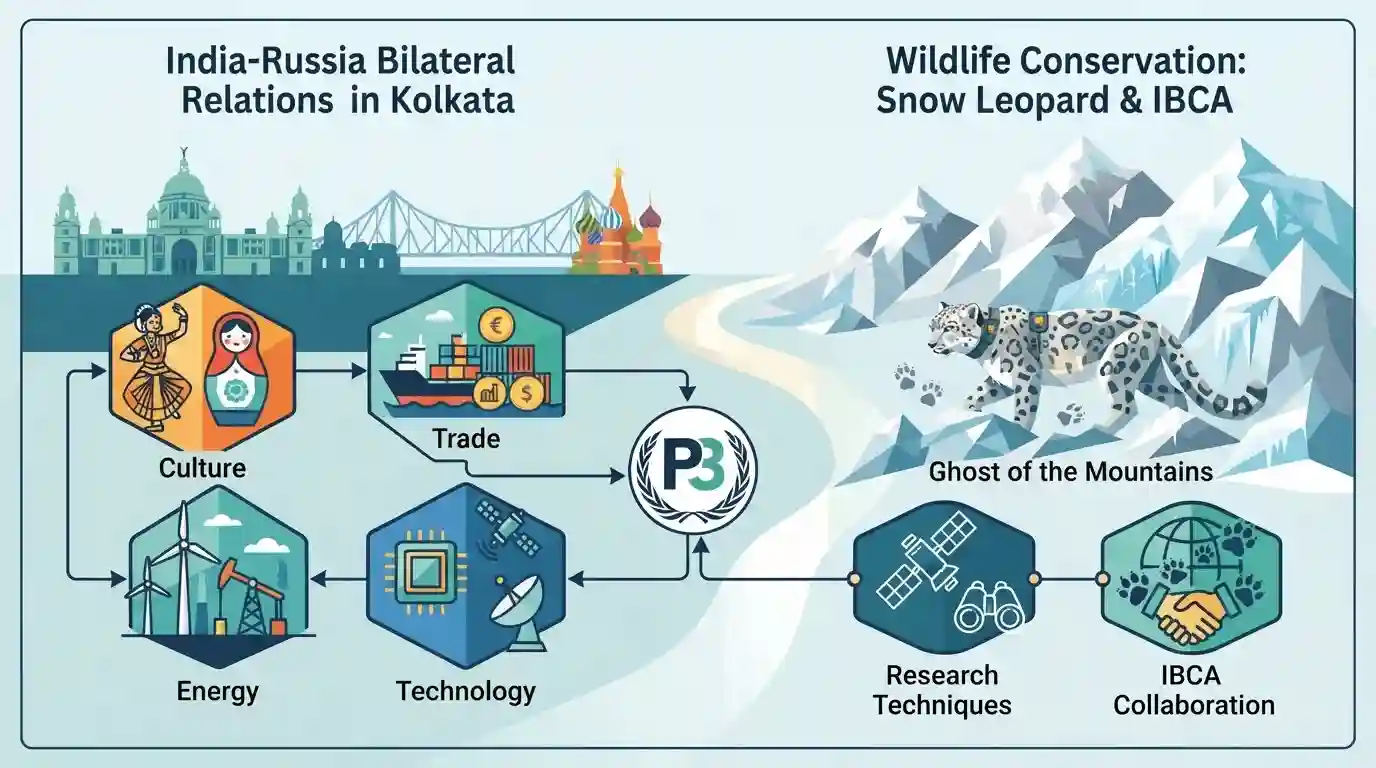
Kolkata is set to host Eastern India's first high-level India-Russia Bilateral Conclave (SAMPARK) organized by Kolkata-based think tank P3. The event targets four core areas of bilateral cooperation: Culture, Trade, Energy, and Technology. Concurrently, under the International Big Cat Alliance (IBCA), India and Russia engaged in bilateral conservation talks in Moscow focused on protecting the endangered snow leopard ('Ghost of the Mountains'), emphasizing research techniques developed by the Wildlife Institute of India (WII).
Key Points
- Kolkata is hosting Eastern India’s first high-level India-Russia Bilateral Conclave, named SAMPARK, at the Bengal Convention Centre, organized by the strategic think tank P3 (People. Policy. Polity.).
- The conclave focuses on four major areas: Culture, Strategic Trade and Investment, Energy Dynamics, and Technology & emerging strategic sectors (including MSMEs, agriculture, textiles, AI, and digital innovation).
- A special 'Corridor of Excellence' will showcase the historical and cultural ties between India and Russia during the conclave.
- As a significant prelude, India and Russia held talks on snow leopard conservation in Moscow under the aegis of the International Big Cat Alliance (IBCA) at the Russian Academy of Sciences.
- Snow leopards, known as the 'Ghost of the Mountains' due to their elusive nature, are monitored using innovative scientific methods by the Wildlife Institute of India (WII), including genetic analysis, radio telemetry, camera traps (covering over 8,500 sq km), and indirect indicators like footprint and scratch marks.
Important Terms
International Big Cat Alliance (IBCA)

An India-led global intergovernmental alliance launched to conserve seven major big cat species—tiger, lion, leopard, snow leopard, cheetah, jaguar, and puma—and their habitats across range countries.
UPSC context
WBCS Paper IV (Environment): Evaluates understanding of global conservation initiatives and India's leadership in environmental diplomacy.
SAMPARK Bilateral Conclave
Eastern India's first high-level India-Russia bilateral conclave, held in Kolkata in August 2026, focusing on strengthening regional cooperation in Culture, Trade, Energy, and Technology.
UPSC context
WBCS Paper III (Current Affairs): Tests awareness of bilateral relations, sub-national diplomacy, and West Bengal's strategic regional role.
Wildlife Institute of India (WII)
An autonomous institution established in 1982 in Dehradun under the Ministry of Environment, Forest and Climate Change, specializing in wildlife research, census, and training.
UPSC context
WBCS Paper IV (Environment/Geography): Tests knowledge of premier national conservation institutes, census methods, and ecological scientific research.
P3 (People. Policy. Polity.)
A Kolkata-based strategic think tank and political advisory organization that conceptualized and organized the SAMPARK conclave to promote regional sub-national involvement in diplomacy.
UPSC context
WBCS Paper III (Current Affairs): Examines the role of regional think tanks, policy formulation, and sub-national diplomatic efforts within West Bengal.
Prelims Trap
India's only captive conservation breeding programme for the Snow Leopard is located in the Union Territory of Ladakh.
Aspirants often assume Snow Leopard conservation or breeding programs are exclusively located in high-altitude Himalayan UTs/States like Ladakh or Himachal Pradesh, overlooking Darjeeling's PNHZP.
Static Concepts Connected
What is the International Big Cat Alliance (IBCA) and its scope?
- Origin & Status: Launched by India in 2023; officially transitioned into a treaty-based intergovernmental organization in January 2025.
- Target Species: Secures global cooperation to protect seven major big cats: Tiger, Lion, Leopard, Snow Leopard, Cheetah, Jaguar, and Puma.
- Geographical Scope: While Jaguar and Puma are not native to India, they are included to foster global range-country partnerships.
What is the status of Snow Leopard conservation in India?
- Conservation Status: Classified as 'Vulnerable' on the IUCN Red List and protected under Schedule I of the Wildlife (Protection) Act, 1972.
- Project Snow Leopard: Launched in 2009 to safeguard high-altitude Himalayan wildlife populations and their habitats across five Himalayan states/UTs.
- West Bengal Link: Darjeeling's Padmaja Naidu Himalayan Zoological Park runs India's and South-East Asia's only successful captive breeding programme.
Cross-Topic Patterns
Kolkata as a sub-regional diplomatic hub
The SAMPARK Conclave highlights West Bengal's potential to transition from a cultural capital to a crucial sub-regional diplomatic hub for Eastern India's trade, energy, and technology.
Eco-diplomacy in strategic alliances
Coupling strategic economic talks with wildlife initiatives (IBCA) shows how bilateral relations leverage soft-power ecological diplomacy to strengthen traditional geopolitical partnerships.

WBCS may link the treaty-based IBCA with West Bengal's exclusive role in Snow Leopard captive breeding at Darjeeling.
Linked PYQs · 4
Linked PYQs · 4
- 2024WBCS_PRELIMSGS1
Which has become the first country to recognize the Taliban Government in Afghanistan?
- 2023WBCS_PRELIMSGS1
Which among the following country is associated with the 'Terminator Tank Support System — the BMPT'?
- 2024WBCS_PRELIMSGS1
What is the Full Form of BRICS? How many Members are there in BRICS?
- 2023WBCS_PRELIMSGS1
Forests having no free entry by people in India —
