Kolkata Metro Upgrades Blue Line with Aluminium Third Rail
Source:Indian Express ↗
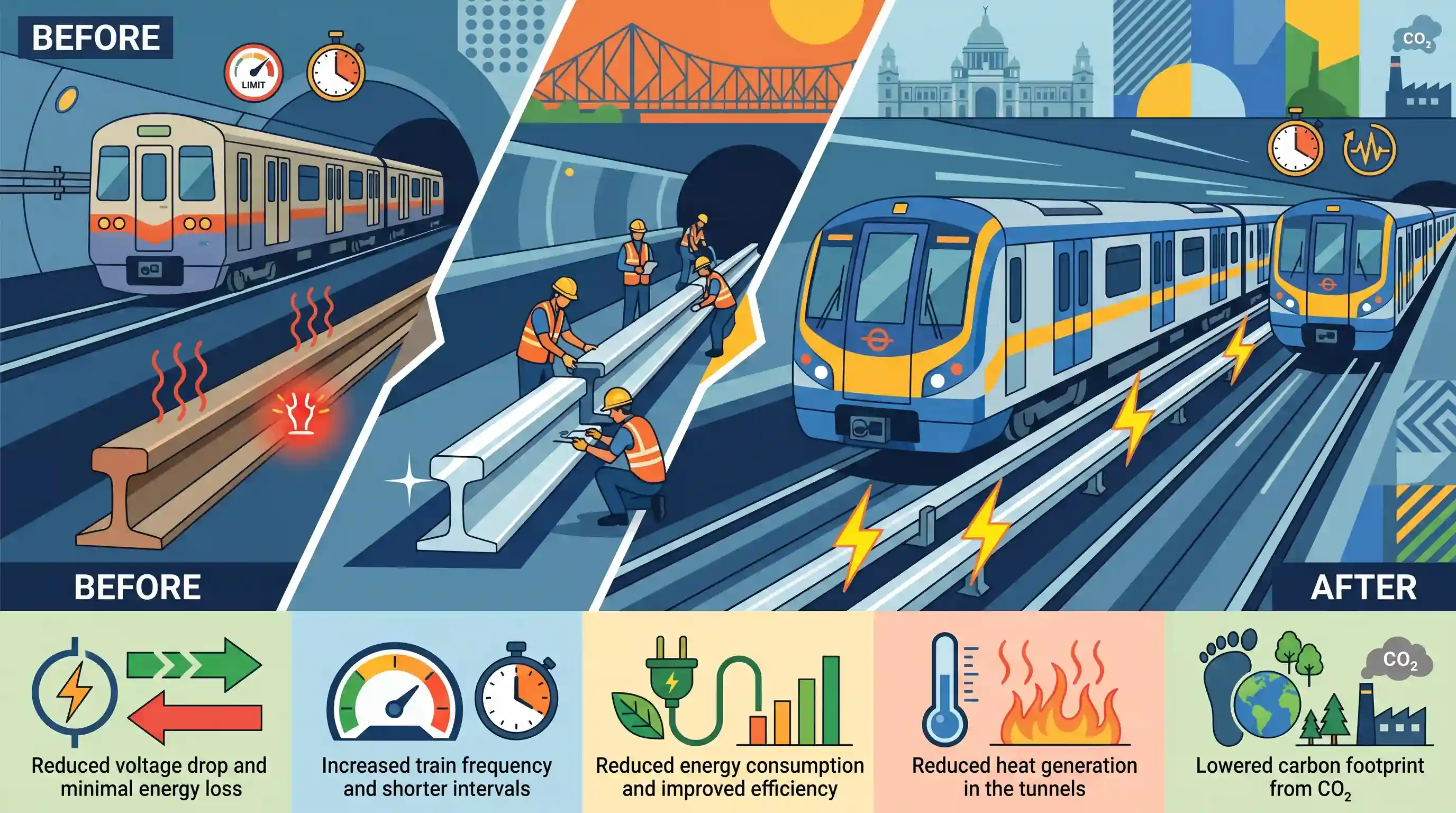
Why It Matters
Demonstrates how technological modernization and material substitutions (aluminium for steel) in urban infrastructure can resolve operational bottlenecks, enhance energy efficiency, and contribute to climate mitigation goals.
Summary
Kolkata Metro has successfully upgraded its underground Blue Line by replacing the conventional steel third rail system with an aluminium third rail. This modernization aims to improve electrical conductivity, reduce voltage drops, and enable faster train operations with shorter headways. The adoption of the aluminium third rail also promises significant environmental and economic benefits through reduced energy consumption, less heat generation in tunnels, and a lowered overall carbon footprint, setting a benchmark for mass rapid transit system (MRTS) upgrades in India.
Key Points
- Kolkata Metro replaced its conventional steel third rail with a highly conductive aluminium third rail on the underground Blue Line to modernize infrastructure.
- Aluminium offers vastly superior electrical conductivity compared to steel, which significantly reduces voltage drops and transmission losses.
- The reduction in energy loss facilitates faster train acceleration, thereby enabling shorter headways and higher frequency of train operations.
- The lower electrical resistance of aluminium results in less heat generation, effectively reducing the cooling load and energy consumption of air-conditioning systems in underground tunnels.
- This energy-efficient technological upgrade contributes to environmental sustainability by lowering power consumption and significantly cutting the carbon footprint of the mass transit system.
Important Terms
Kolkata Metro

India's first metro system, operational since 1984, managed by Indian Railways. It is currently undergoing significant technological modernization to align with global standards like those in London and Singapore.
UPSC context
GS Paper III (Infrastructure: Railways); highlights modernization of India's oldest metro and its role in urban mobility.
Third Rail System
A method of supplying direct current (DC) electricity to trains via a continuous rigid conductor rail placed alongside or between the running tracks.
UPSC context
GS Paper III (Infrastructure/S&T); essential technical knowledge regarding urban transit power supply and electrification.
Aluminium Third Rail
An advanced conductor rail offering superior electrical conductivity (38 million S/m) compared to steel, reducing energy losses, heat generation, and voltage drops during train operations.
UPSC context
GS Paper III (S&T/Energy); represents indigenization and modernization for energy efficiency in railway infrastructure.
Headway
The time or distance interval between two consecutive trains on the same track. Shorter headways increase a metro system's passenger-carrying capacity and efficiency.
UPSC context
GS Paper III (Infrastructure); a key performance indicator (KPI) for evaluating the efficiency of mass transit systems.
Mass Rapid Transit System (MRTS)
High-capacity urban public transit systems, such as metros and light rails, designed to transport large numbers of passengers quickly across metropolitan areas.
UPSC context
GS Paper III (Infrastructure/Urbanization); critical for discussing sustainable urban development and congestion management.
Carbon Footprint
The total amount of greenhouse gases, primarily carbon dioxide, released into the atmosphere by a particular activity; the metro upgrade aims to reduce this by 50,000 tonnes.
UPSC context
GS Paper III (Environment/Climate Change); linked to India's Net Zero targets and the decarbonization of transport.
Prelims Trap
The third rail system provides mechanical support and stability to underground metro trains.
The 'third rail' is an electrical traction system supplying power to the train, not a physical track for the wheels. It replaces overhead wires in space-constrained tunnels.
Static Concepts Connected
What are the primary methods of powering metro rail networks?
- Third Rail System: Uses a semi-continuous rigid conductor rail placed alongside or between the tracks. Common in underground setups due to vertical space constraints.
- Overhead Equipment (OHE): Uses suspended wires (catenary) above the train, collected by a pantograph. Standard for elevated or at-grade metro corridors.
- Voltage Differences: Third rail typically operates on 750V DC (Direct Current), whereas OHE commonly utilizes 25kV AC (Alternating Current).
Why is aluminium scientifically preferred over steel for electrical transit rails?
- Electrical Conductivity: Aluminium exhibits roughly six times lower electrical resistance than steel, significantly minimizing voltage drops across long transit lines.
- Thermal Efficiency: Lower resistance drastically reduces Joule heating (I²R loss), keeping underground tunnels cooler and cutting AC loads.
- Corrosion Resistance: Unlike steel, aluminium naturally forms a protective oxide layer, rendering it highly resistant to rust and reducing maintenance costs.
Cross-Topic Patterns
MRTS Tech + India's Net Zero targets
Energy-efficient MRTS upgrades (like aluminium third rails and regenerative braking) directly tie into India's Panchamrit targets of reducing total carbon emissions and economy-wide carbon intensity by 2030.
Urban Micro-climates + Underground MRTS
Heat from electrical resistance in tunnels necessitates heavy HVAC use. Mitigating this lowers transit cooling loads, connecting GS3 infrastructure modernisation with GS1 urban micro-climate management.

Expect a Prelims science statement comparing steel vs aluminium conductivity, or GS3 Mains linking MRTS upgrades to India's Net Zero goals.
Linked PYQs · 2
Linked PYQs · 2
- 2019MainsGS1
How is efficient and affordable urban mass transport key to the rapid economic development of India?
- 2021MainsGS3
“Investment in infrastructure is essential for more rapid and inclusive economic growth.” Discuss in the light of India's experience.
