Kolkata Airport Customs Seizes Seven Hundred Exotic Invasive Turtles
Source:aviationjeta ↗
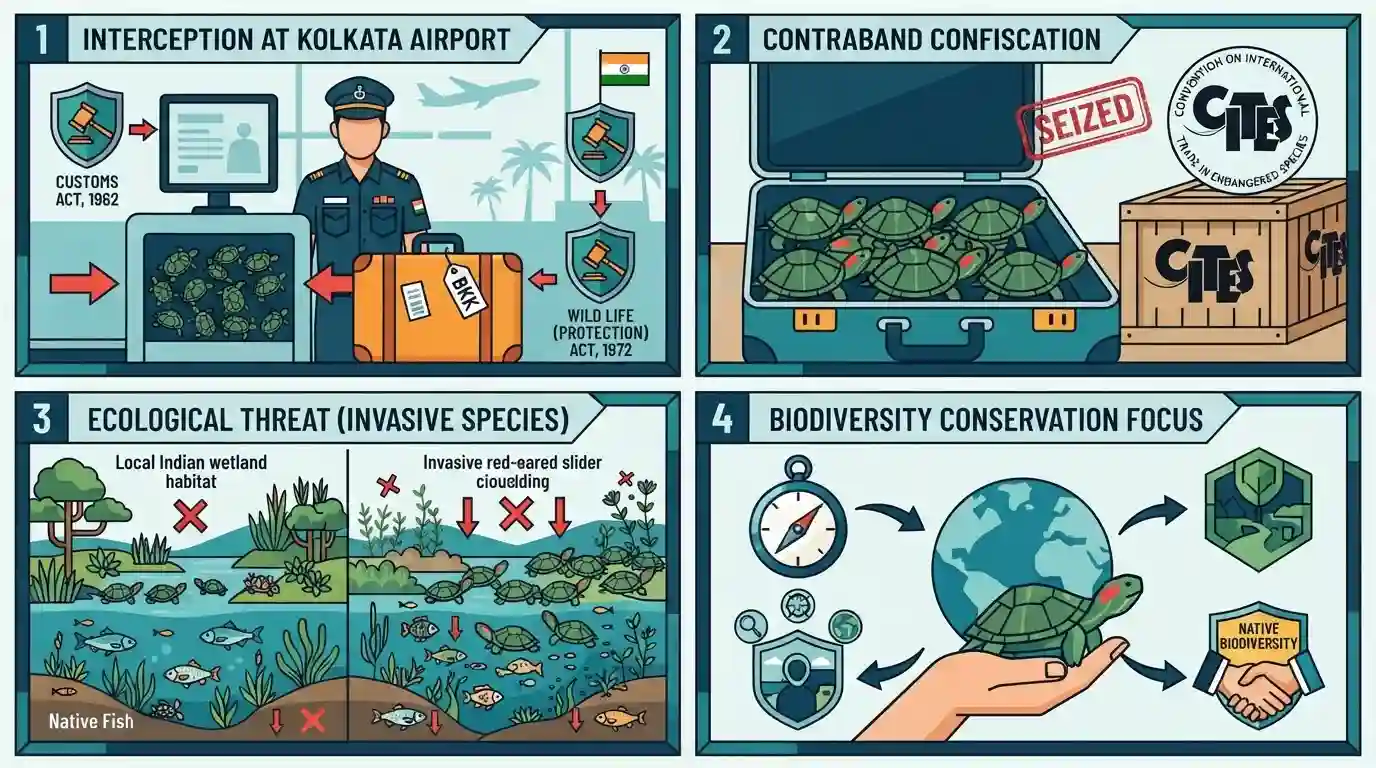
Why It Matters
The illegal wildlife trade and the introduction of invasive species like the Red-eared Slider pose severe threats to native ecosystems and local biodiversity. Understanding global conventions like CITES and national legislations such as the Wildlife Protection Act and Customs Act is vital for environment and governance topics.
Summary
Kolkata Airport Customs seized 707 exotic Red-eared Slider turtles from an Indian passenger arriving from Bangkok. The smuggling attempt was foiled under the Customs Act, 1962, the Wild Life (Protection) Act, 1972, and CITES regulations. The Red-eared Slider is widely traded as a pet but is notoriously harmful as an invasive alien species when introduced to non-native local habitats, posing a threat to local biodiversity.
Key Points
- Kolkata Airport Customs intercepted a passenger arriving from Bangkok and seized 707 live Red-eared Slider turtles.
- The Red-eared Slider (Trachemys scripta elegans) is highly popular in the international pet trade but is considered a dangerous invasive alien species when released into non-native ecosystems.
- The confiscation was conducted under the provisions of the Customs Act, 1962, the Wild Life (Protection) Act, 1972, and CITES guidelines.
- The incident highlights ongoing challenges related to international wildlife smuggling and border security.
Important Terms
Red-eared Slider

A freshwater turtle native to the Americas, widely traded globally as a pet. Highly aggressive and omnivorous, it is classified among the world's 100 worst invasive species because it rapidly outcompetes native turtles for food and habitat.
UPSC context
Important for GS-3 (Environment). UPSC frequently tests examples of invasive alien species and their specific impacts on native Indian biodiversity.
Invasive Alien Species (IAS)
Non-native organisms introduced outside their natural habitat that successfully establish themselves, reproduce rapidly, and outcompete native flora or fauna. They severely disrupt local ecosystems, acting as a leading global driver of biodiversity loss.
UPSC context
Core GS-3 Ecology concept. UPSC tests the ecological impact of IAS, examples in India, and international management frameworks like the CBD.
CITES
The Convention on International Trade in Endangered Species is a multilateral treaty ensuring that international trade in wild animals and plants does not threaten their survival. It regulates cross-border wildlife trade through a strict, tiered permit system.
UPSC context
Crucial for GS-3 (Environment). UPSC frequently asks about its mandate, its Appendices, and how it integrates with India's domestic wildlife laws.
Wild Life (Protection) Act, 1972
India's primary legal framework for wildlife conservation. It safeguards flora and fauna, establishes protected areas, and strictly regulates hunting. A 2022 amendment aligned it with CITES and introduced specific provisions to manage invasive alien species.
UPSC context
Central to GS-3 (Environment). A high-yield topic for Prelims and Mains regarding protected species schedules, conservation reserves, and statutory bodies.
Customs Act, 1962
The central legislation regulating the import and export of goods in India. It empowers authorities to impose duties, clear baggage, and confiscate illicit goods, acting as the primary legal tool to combat international smuggling and wildlife trafficking.
UPSC context
Relevant to GS-3 (Security) concerning border management, transnational organized crime, and the role of customs enforcement in preventing illegal trade.
Prelims Trap
The Red-eared Slider is a native, critically endangered freshwater turtle species protected under Schedule I of the Wild Life (Protection) Act.
It is native to North America and is invasive in India. It is regulated under Schedule IV (CITES) or invasive control provisions, not as a native protected species.
Static Concepts Connected
How does the Wild Life (Protection) Amendment Act, 2022 regulate exotic and invasive species?
- Schedule IV Creation: Establishes Schedule IV to specifically list and regulate specimens of flora and fauna under CITES.
- Invasive Species Control: Empowers the Central Government to regulate, restrict, or ban the import, trade, and possession of invasive alien species.
- CITES Authorities: Designates a Management Authority to issue permits and a Scientific Authority to advise on trade impacts.
What ecological threats are posed by Invasive Alien Species (IAS) like the Red-eared Slider?
- Resource Competition: Outcompetes native Indian turtles (like the Indian roofed turtle) for food, basking sites, and nesting areas.
- Pathogen Transmission: Acts as a potential vector for pathogens like Salmonella, which can jump to native wildlife and humans.
- High Resilience: Exhibits high tolerance to degraded water conditions, enabling rapid population growth in urban water bodies.
Cross-Topic Patterns
CITES compliance and domestic wildlife laws
Illustrates how international treaty commitments under CITES are translated into domestic enforcement mechanisms using Customs and the updated Wild Life (Protection) schedules.
Aviation logistics and biological security
Exposes how rapid global aviation corridors facilitate the movement of illegal wildlife, shifting airports from custom centers to critical ecological bio-security frontiers.

WPA 2022 provisions on invasive species and Schedule IV (CITES) enforcement will likely be framed as a multi-statement question in 2026.
Linked PYQs · 1
Linked PYQs · 1
- 2024WBCS_PRELIMSGS1
The tax imposed on import and export commodity is known as
