Urban Decay and Heritage Conservation Challenges in Kolkata
Source:The Hindu ↗
Why It Matters
Understanding the decay of historic urban centers like Kolkata is crucial for GS1 topics on urbanization and heritage conservation. It provides a real-world case study on the conflict between preserving colonial-era architecture and executing modern urban planning, relevant for analyzing the quality of urban life and the efficacy of initiatives like the Smart Cities Mission.
Summary
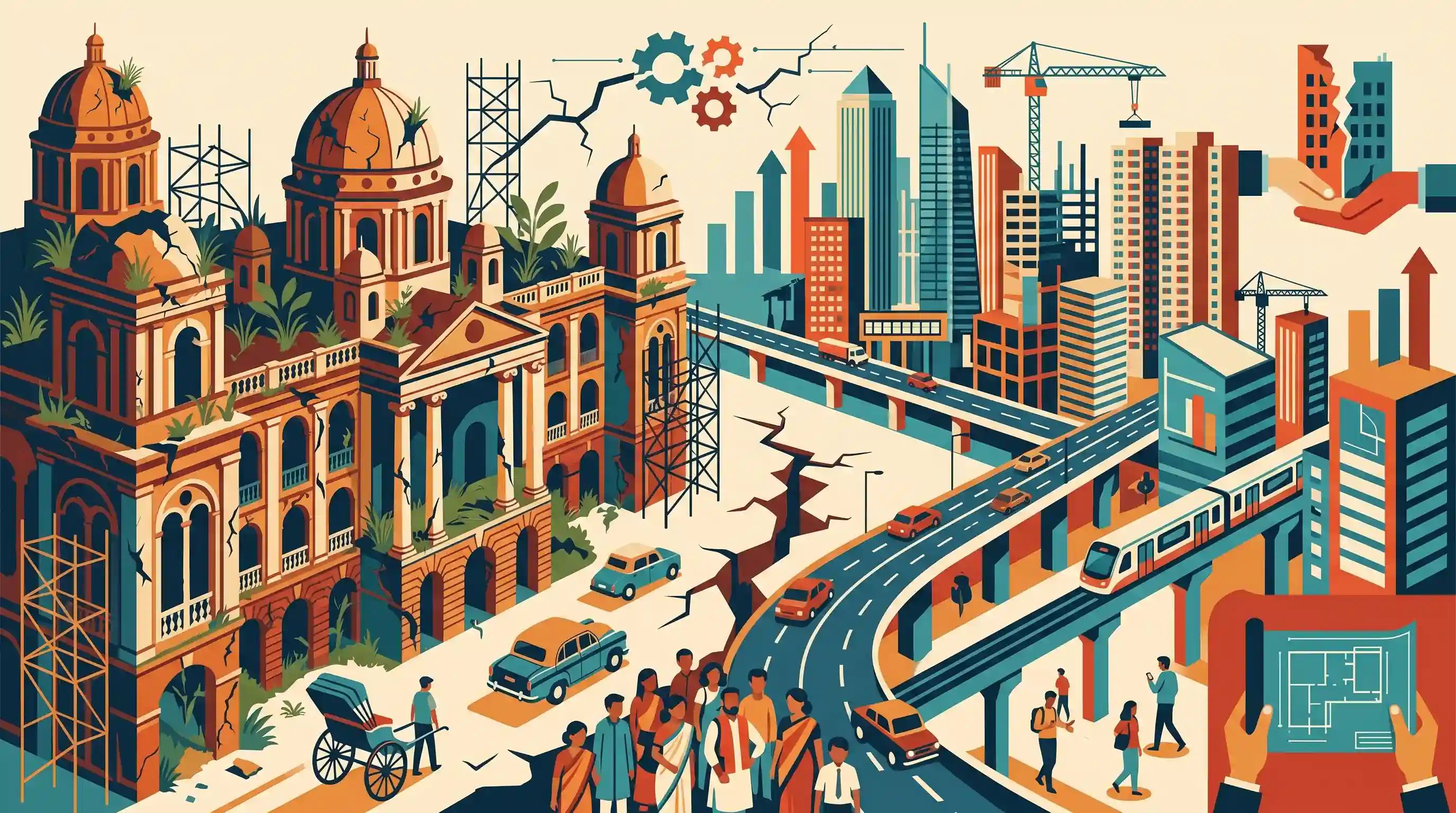
The article examines the ongoing infrastructural and architectural decay of Kolkata, India's former colonial capital. It highlights the deteriorating condition of the city's colonial-era buildings, contrasting its rich historical legacy with current civic neglect. The piece explores the broader challenges of urbanization in India, demonstrating how historic cities struggle to balance heritage conservation, urban planning, and modernization amidst population pressures and real estate development. The crumbling cityscape serves as a reminder of systemic issues in urban governance, including inadequate infrastructure maintenance and a lack of cohesive conservation strategies.
Key Points
- Kolkata, a prominent colonial-era city, is experiencing severe infrastructural decay and a decline in its historic architectural landscape.
- The preservation of colonial heritage is hampered by inadequate urban planning, funding constraints, and real estate pressures.
- The city's crumbling infrastructure reflects broader systemic challenges in Indian urban governance, specifically the struggle to balance heritage conservation with rapid modernization.
- Revitalizing such cities requires comprehensive policies that integrate structural safety, heritage preservation, and sustainable urban development.
Important Terms
Smart Cities Mission

A national initiative launched in 2015 to transform 100 cities into citizen-friendly and sustainable areas through smart technology, infrastructure, and improved governance.
UPSC context
Relevant for GS Paper II (Government Policies) and GS Paper III (Infrastructure/Urbanization); tests knowledge of urban renewal.
AMRUT (Atal Mission for Rejuvenation and Urban Transformation)
A mission launched in 2015 to provide basic civic amenities—water supply, sewerage, and drainage—in 500 cities to improve the quality of life for all residents.
UPSC context
GS Paper III (Infrastructure); tests understanding of schemes addressing basic urban service gaps.
74th Constitutional Amendment Act
The 1992 constitutional amendment that institutionalized Urban Local Bodies (ULBs), granting them constitutional status and defining 18 functional responsibilities under the Twelfth Schedule.
UPSC context
GS Paper II (Polity/Governance); fundamental for understanding the decentralization and authority of municipal corporations.
Kolkata Municipal Corporation (KMC)
The statutory body responsible for the civic administration of Kolkata, operating under the KMC Act, 1980, and managing local heritage grading and infrastructure.
UPSC context
GS Paper II (Local Governance); serves as a case study for urban governance and civic management challenges.
Heritage Conservation
The multidisciplinary process of protecting and restoring historical structures and sites, governed in India by acts like the AMASR Act and agencies like the ASI.
UPSC context
GS Paper I (Art and Culture); tests knowledge of preservation laws and the tension between modernization and history.
Urbanization
The process of population shift from rural to urban areas, often leading to systemic pressures on infrastructure, housing, and the preservation of historical cityscapes.
UPSC context
GS Paper I (Social Issues) and GS Paper III (Economic Development); core topic for urban planning and environmental challenges.
Prelims Trap
"All identified heritage buildings in India are legally protected and maintained by the ASI."
Urban colonial built-heritage and non-monumental civic structures are usually graded and regulated by municipal Heritage Conservation Committees (HCCs) under state laws, not the ASI.
Static Concepts Connected
What are the key features of Indo-Saracenic architecture?
- Cultural Synthesis: Synthesizes British Neo-Classical and Gothic revival elements with Indian motifs like Mughal domes, arches, and Rajput chhatris.
- Modern Materials: Used modern engineering techniques, incorporating iron, steel, and poured concrete behind traditional, ornate Indian facades.
- Prominent Examples: Victoria Memorial (Kolkata), Gateway of India (Mumbai), and Chepauk Palace (Chennai).
How does Transfer of Development Rights (TDR) aid urban heritage conservation?
- The Mechanism: It allows owners of heritage-restricted properties to sell their unutilized Floor Space Index (FSI) to developers in other zones as a certificate.
- Economic Incentive: Provides vital financial compensation to property owners without requiring the demolition or harmful modification of historic structures.
- Zoning Tool: Empowers municipal bodies to successfully balance aggressive real estate development pressures with structural preservation mandates.
Cross-Topic Patterns
Tenancy Laws driving Urban Decay
The 'Pagdi' system and archaic rent control acts artificially freeze rents, removing economic incentives for landlords to maintain heritage properties. This links obsolete economic tenancy laws directly to modern architectural decay.
74th CAA and Municipal Capacity limits
The inability of Urban Local Bodies (ULBs) to fund heritage preservation highlights systemic flaws in devolution under the 74th Amendment, specifically their chronic lack of financial autonomy and specialized capacity.

Mains GS1 2026 could ask to evaluate 'Adaptive Reuse' and 'TDR' as strategies reconciling rapid urbanization with heritage conservation.
Linked PYQs · 5
Linked PYQs · 5
- 2013MainsGS1
Discuss the various social problems which originated out of the speedy process of urbanization in India.
- 2016MainsGS1
With a brief background of quality of urban life in India, introduce the objectives and strategy of the 'Smart City Programme'.
- 2018MainsGS1
Safeguarding the Indian art heritage is the need of the moment. Discuss.
- 2020MainsGS1
Account for the huge flooding of million cities in India including the smart ones like Hyderabad and Pune. Suggest lasting remedial measures.
- 2025MainsGS1
How does smart city in India, address the issues of urban poverty and distributive justice?
