Kuwait Airspace Closure Disruption on Middle East Civil Aviation
Source:The Hindu ↗
Why It Matters
The closure of airspace due to security threats highlights the vulnerabilities of international civil aviation and the broader geopolitical instability in the Middle East, which can significantly impact Indian diaspora and economic interests.
Summary
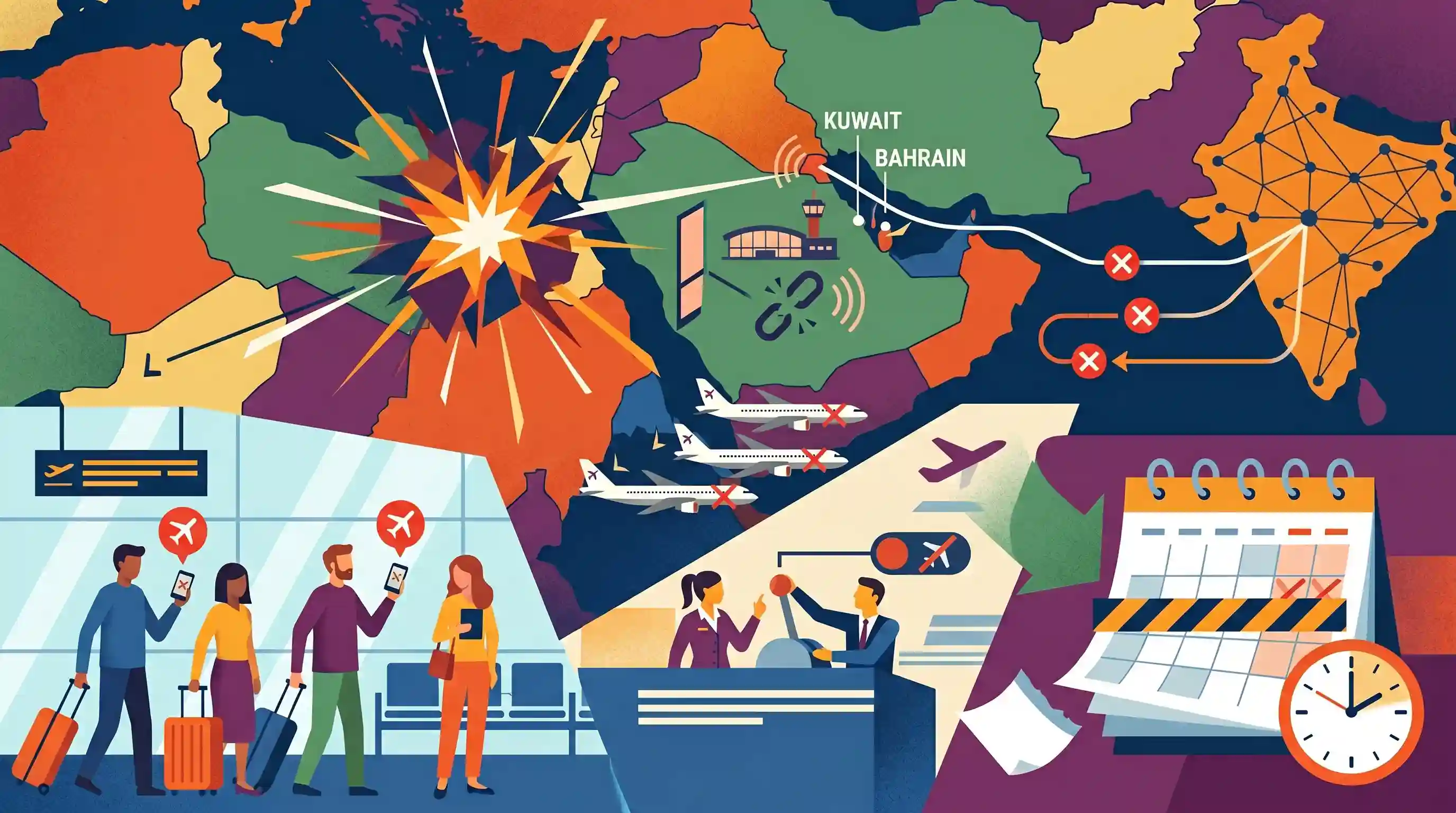
An Air India Express flight scheduled to depart from Kochi to Bahrain was cancelled due to the closure of Kuwait's airspace, which was prompted by an attack at Kuwait International Airport. Consequently, the airline has suspended all its flights to Kuwait until June 6, 2026, causing disruption for passengers.
Key Points
- An Air India Express flight from Kochi to Bahrain was cancelled following the closure of Kuwait's airspace.
- Kuwait closed its airspace following an attack at its international airport.
- Air India Express has suspended all its flights to Kuwait until June 6, 2026.
- The cancellation affected 119 passengers who were scheduled to travel on the flight.
Important Terms
Gulf Cooperation Council (GCC)

A regional political and economic union of six Arab states: Saudi Arabia, UAE, Qatar, Kuwait, Oman, and Bahrain.
UPSC context
GS Paper 2: International Relations; critical for India's energy security and the welfare of its 9-million-strong diaspora.
International Civil Aviation Organization (ICAO)
A specialized United Nations agency established in 1944 to coordinate international air navigation and foster safe growth in global air transport.
UPSC context
GS Paper 2: International Institutions; sets global aviation standards (SARPs) that member states, including India, must follow.
Chicago Convention (1944)
The 1944 agreement that founded the ICAO and established the principle that every state has complete and exclusive sovereignty over its airspace.
UPSC context
GS Paper 2: International Relations; provides the legal basis for airspace closures and international flight rights.
Directorate General of Civil Aviation (DGCA)
The statutory body and apex regulator for civil aviation in India, responsible for safety, airworthiness standards, and licensing.
UPSC context
GS Paper 3: Infrastructure and Economic Development; tests knowledge of regulatory bodies governing Indian connectivity.
Air India Express
A low-cost subsidiary of Air India focused on providing connectivity between India and the Middle East and Southeast Asia.
UPSC context
GS Paper 2/3: Significance for Indian diaspora and economic remittances; vital for regional air connectivity.
NOTAM (Notice to Air Missions)
A time-sensitive advisory issued to pilots regarding potential hazards, changes in facilities, or airspace restrictions.
UPSC context
GS Paper 3: Internal Security/Infrastructure; technical mechanism used to communicate airspace closures during crises.
Prelims Trap
"Civilian commercial flights possess a fundamental right of innocent passage through a foreign country's airspace."
Unlike maritime law under UNCLOS which allows for 'innocent passage' through territorial waters, airspace sovereignty is absolute. States can legally shut airspace during emergencies.
Static Concepts Connected
What are the foundational principles of international civil aviation?
- Absolute Sovereignty: Article 1 of the 1944 Chicago Convention grants every state complete and exclusive sovereignty over the airspace above its territory.
- Freedoms of the Air: Established by the convention, these dictate commercial aviation rights. The 'First Freedom' allows flying across a foreign country without landing.
- ICAO Role: A UN specialized agency created by the Chicago Convention to coordinate and regulate international air travel. India is a member.
What makes India socio-economically vulnerable to Gulf crises?
- Massive Diaspora: The GCC hosts approximately 8.9 million Indians, constituting the largest segment of Non-Resident Indians globally.
- Remittance Dependence: The Gulf region accounts for over 28% of India's total inward remittances, a vital cushion for forex reserves and the current account deficit.
- Evacuation Logistics: Geopolitical shocks require massive, complex state-led repatriations (e.g., Operation Vande Bharat, Operation Raahat) due to sudden airspace or mobility restrictions.
Cross-Topic Patterns
Asymmetric warfare targeting civil infrastructure
Non-state actors increasingly use weaponized UAVs against civilian nodes (like airports in Kuwait, UAE, Saudi Arabia), linking asymmetric warfare to global economic and supply chain disruptions.
West Asia instability and the diaspora-energy matrix
Any geopolitical escalation in the Gulf simultaneously threatens India's two critical lifelines: energy security (crude oil supply) and economic stability (28% of total remittances from the 8.9M-strong diaspora).

Expect a Prelims statement contrasting 'innocent passage' in maritime law (UNCLOS) with 'exclusive airspace sovereignty' (Chicago Conv).
Linked PYQs · 1
Linked PYQs · 1
- 2014MainsGS3
International civil aviation laws provide all countries complete and exclusive sovereignty over the airspace above their territory. What do you understand by 'airspace'? What are the implications of these laws on the space above this airspace? Discuss the challenges which this poses and suggest ways to contain the threat.
