World Environment Day Highlights Five Critical Ecological Challenges
Source:Indian Express ↗
Why It Matters
This article covers high-yield UPSC topics, linking core physical geography concepts (AMOC, sea ice) to current environmental crises, alongside actionable climate finance policies (TFFF) and India's international commitments (NDCs), making it highly relevant for both GS1 (Geography) and GS3 (Environment & Economy).
Summary
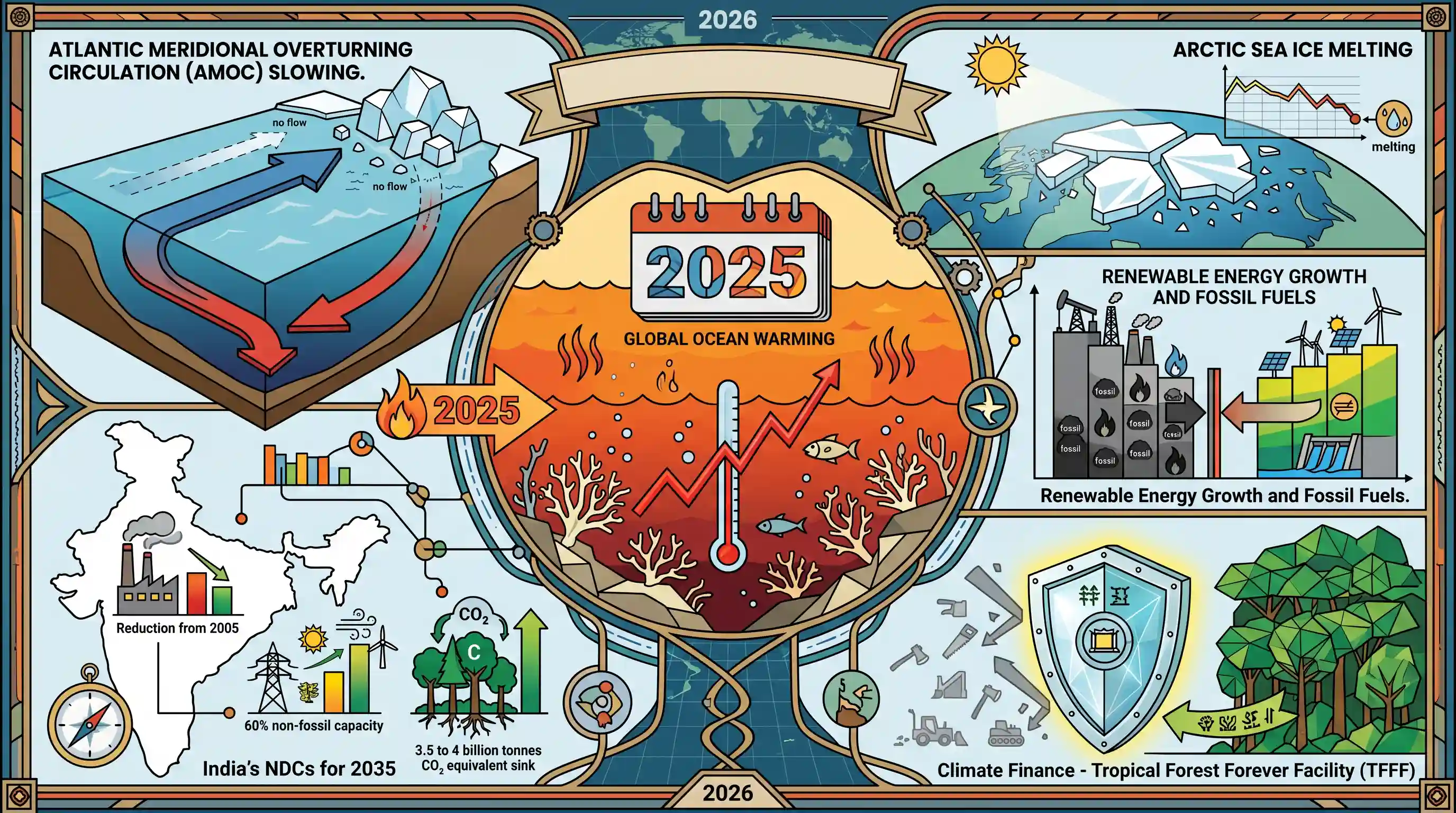
On World Environment Day 2026, experts highlight five critical environmental developments: the dangerous slowing of the Atlantic Meridional Overturning Circulation (AMOC), the persistent but slightly slowed melting of Arctic sea ice, unprecedented global ocean warming in 2025, the reality that renewable energy growth is not currently displacing fossil fuels, and the introduction of the Tropical Forest Forever Facility (TFFF) to fund forest conservation. Additionally, the article discusses India's impending 2035 climate targets (NDCs).
Key Points
- The Atlantic Meridional Overturning Circulation (AMOC) is slowing down and nearing a critical tipping point as melting ice caps disrupt its temperature-salinity balance.
- Although natural variability has slightly slowed the melting rate of Arctic sea ice, the overall alarming trend points to an ice-free summer by 2050.
- Global ocean temperatures reached record highs in 2025, threatening marine ecosystems and exacerbating extreme weather phenomena.
- Despite renewable energy generating 30% of global electricity in 2023, it is primarily meeting new energy demands rather than actively replacing fossil fuels.
- The proposed Tropical Forest Forever Facility (TFFF) aims to financially compensate tropical countries with an annual fee per hectare for preserving standing forests, bypassing complex carbon credit mechanisms.
- India is formulating its new Nationally Determined Contributions (NDCs) for 2035, maintaining focus on renewable energy expansion while navigating its ongoing dependence on coal.
Important Terms
Nationally Determined Contributions (NDCs)

Self-defined national climate plans under the Paris Agreement outlining a country's commitments to reduce greenhouse gas emissions and adapt to climate impacts, updated every five years with increasing ambition.
UPSC context
GS Paper 3 (Environment). Key for questions on global climate governance and India's progress toward its Net Zero 2070 goal.
Tropical Forest Forever Facility (TFFF)
A proposed $125 billion global blended-finance mechanism designed to provide permanent, performance-based payments to tropical nations for maintaining standing forests rather than just reducing deforestation rates.
UPSC context
GS Paper 3 (Environment & Economy). Tests knowledge of innovative climate finance models and international conservation efforts (COP30 outcomes).
Atlantic Meridional Overturning Circulation (AMOC)
A critical system of Atlantic ocean currents that redistributes heat globally; its slowing, driven by freshwater influx from melting ice, is considered a major climate tipping point.
UPSC context
GS Paper 1 (Geography) & GS Paper 3. Essential for understanding oceanography, global heat budgets, and impacts on the Indian Monsoon.
Paris Agreement
A legally binding international treaty adopted in 2015 (COP21) aiming to limit global warming to well below 2°C, preferably 1.5°C, compared to pre-industrial levels.
UPSC context
GS Paper 2 (IR) & Paper 3. The foundational framework for all modern international environmental negotiations and climate policy.
Climate Tipping Points
Critical thresholds in the Earth's climate system which, if exceeded, can lead to large-scale, abrupt, and often irreversible changes in the state of the system.
UPSC context
GS Paper 3 (Environment). Tests understanding of environmental risks, feedback loops, and the urgency of the 1.5°C target.
Prelims Trap
"The Tropical Forest Forever Facility (TFFF) rewards nations by issuing tradeable carbon credits for forest conservation."
The TFFF explicitly bypasses complex, project-based carbon credit markets, instead offering a direct, fixed annual per-hectare payment for preserving standing forests.
Static Concepts Connected
What drives the Atlantic Meridional Overturning Circulation (AMOC) and why is it slowing?
- Thermohaline circulation: It is driven by differences in water temperature and salinity. Cold, salty water in the North Atlantic is dense and sinks, driving a global ocean conveyor belt.
- Freshening effect: Melting Arctic and Greenland ice adds massive amounts of freshwater to the ocean, lowering surface salinity and density, which prevents the water from sinking.
- Climate impacts: A stalled AMOC disrupts global weather, potentially cooling Western Europe while exacerbating sea-level rise along the US East Coast and altering tropical rainfall.
What are the core principles of Nationally Determined Contributions (NDCs)?
- Bottom-up approach: Under the Paris Agreement, NDCs are self-defined national climate pledges detailing domestic emissions reduction targets and adaptation strategies.
- Ratchet mechanism: Countries must submit updated NDCs every five years (e.g., the upcoming 2035 targets), with each pledge requiring a progression in ambition over the previous one.
Cross-Topic Patterns
Blended finance vs. Carbon markets
The TFFF signifies a shift in global climate finance architecture, moving away from complex, project-based carbon offsets toward direct sovereign payments for ecosystem services.
Ocean circulation & Indian Monsoon predictability
AMOC's slowdown disrupts interhemispheric heat transport, which climatologists warn could significantly alter the intensity, timing, and distribution of the Indian summer monsoon.

Expect 2026 Prelims to test AMOC's temperature-salinity dynamics alongside the new TFFF's explicit departure from traditional carbon markets.
Linked PYQs · 5
Linked PYQs · 5
- 2024PrelimsGS1
Which of the following is/are correct inference/inferences from isothermal maps in the month of January? 1. The isotherms deviate to the north over the ocean and to the south over the continent. 2. The presence of cold ocean currents, Gulf Stream and North Atlantic Drift make the North Atlantic Ocean colder and the isotherms bend towards the north. Select the answer using the code given below :
- 2021PrelimsGS1
Consider the following statements : 1. In the tropical zone, the western sections of the oceans are warmer than the eastern sections owing to the influence of trade winds. 2. In the temperate zone, westerlies make the eastern sections of oceans warmer than the western sections. Which of the statements given above is/are correct?
- 2021MainsGS1
How do the melting of the Arctic ice and glaciers of the Antarctic differently affect the weather patterns and human activities on the Earth? Explain.
- 2025MainsGS3
Write a review on India's climate commitments under the Paris Agreement (2015) and mention how these have been further strengthened in COP26 (2021). In this direction, how has the first Nationally Determined Contribution intended by India been updated in 2022?
- 2022MainsGS3
Do you think India will meet 50 percent of its energy needs from renewable energy by 2030 ? Justify your answer. How will the shift of subsidies from fossil fuels to renewables help achieve the above objective ? Explain.
