World Bank poverty lines and India multidimensional poverty index
Source:Indian Express ↗
Why It Matters
Poverty measurement is fundamental to designing targeted welfare policies, resource allocation, and tracking India's progress toward Sustainable Development Goals (SDGs), making it a recurring core topic for both Prelims and Mains (GS III).
Summary
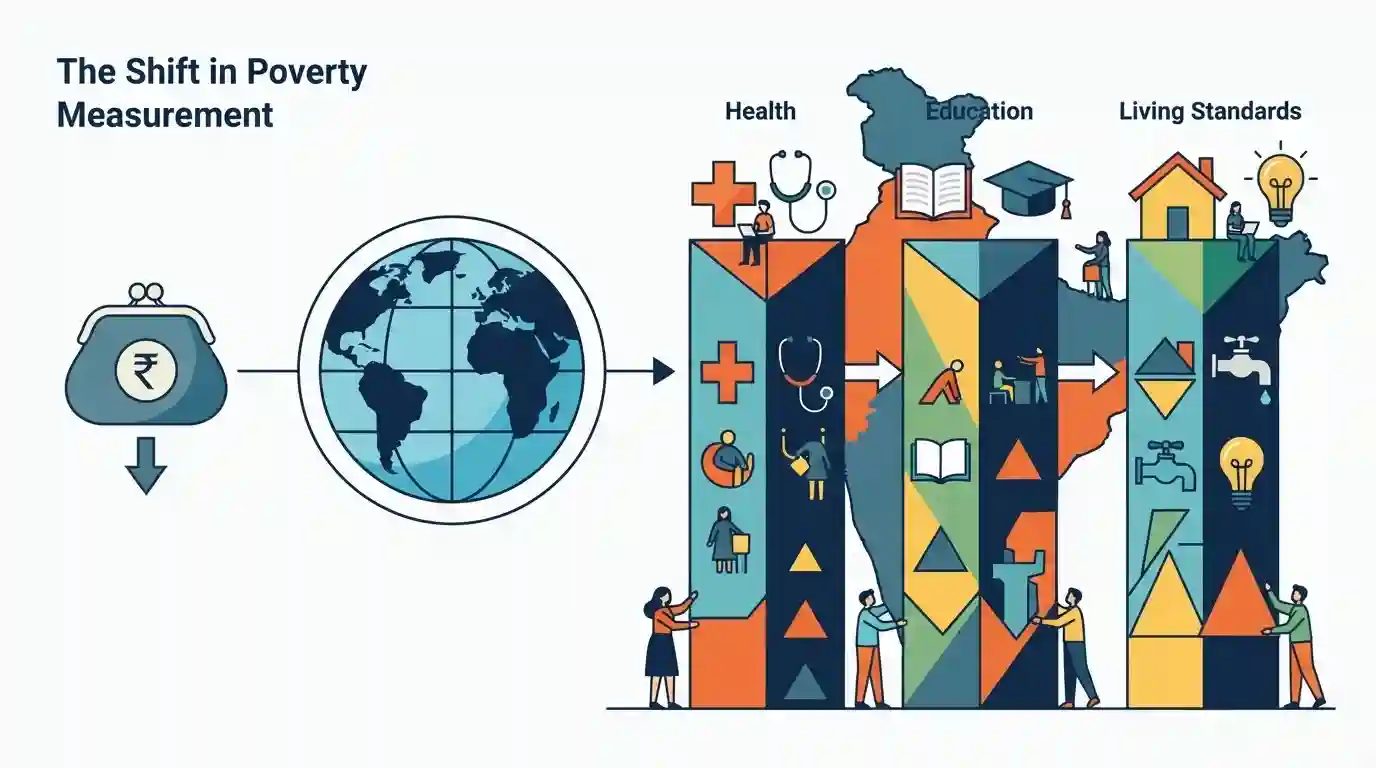
This article examines the conceptual framework of poverty estimation, focusing on the World Bank's revised international poverty lines and India's framework through the National Multidimensional Poverty Index (MPI) compiled by NITI Aayog. It highlights the shift from single-metric monetary consumption lines to holistic, deprivation-based measurements across health, education, and living standards using the Alkire-Foster methodology.
Key Points
- The World Bank has revised its international poverty lines based on purchasing power parities (PPPs), categorizing countries into low-income, lower-middle-income, upper-middle-income, and high-income thresholds.
- India's poverty estimation has evolved from traditional calorie/consumption expenditure-based metrics (such as Tendulkar and Rangarajan committees) toward multidimensional approaches.
- The National Multidimensional Poverty Index (MPI), published by NITI Aayog using the Alkire-Foster methodology, tracks 12 indicators spanning health, education, and standard of living (including India-specific indicators like maternal health and bank accounts).
- Understanding the transition from absolute income-based poverty lines to capability- and deprivation-based measurement frameworks is critical for evaluating inclusive growth and welfare policies.
Important Terms
National Multidimensional Poverty Index

A comprehensive measure of poverty developed by NITI Aayog that captures deprivations across health, education, and living standards using 12 indicators based on the Alkire-Foster methodology.
UPSC context
UPSC Mains GS Paper III (Inclusive Growth & Poverty). Evaluates India's progress on social sector policies and SDG targets.
Global Multidimensional Poverty Index
An international measure of acute multidimensional poverty jointly developed by the UNDP and OPHI, tracking deprivations across health, education, and standard of living for over 100 developing nations.
UPSC context
UPSC Prelims/Mains: Important global indices, international comparisons of human development and poverty reduction.
World Bank
A specialized global financial institution providing loans, credits, and grants to developing countries for capital projects, which sets international monetary poverty lines using Purchasing Power Parity.
UPSC context
UPSC Prelims/Mains GS Paper II/III: Role of international financial institutions in global economic governance and poverty metrics.
NITI Aayog
The apex public policy think tank of the Government of India, providing directional and policy inputs, and responsible for compiling India's National Multidimensional Poverty Index.
UPSC context
UPSC Prelims/Mains GS Paper II: Statutory/Executive bodies, cooperative federalism, and developmental planning in India.
Oxford Poverty and Human Development Initiative (OPHI)
A research center at the University of Oxford that focuses on reducing poverty through multidimensional measurement methodologies, co-developer of the Alkire-Foster method.
UPSC context
UPSC Prelims: International research organizations and methodologies used in developmental indices.
United Nations Development Programme (UNDP)
The United Nations' lead agency on international development, which partners with OPHI to publish the Global MPI and supports countries in achieving sustainable human development.
UPSC context
UPSC Prelims/Mains GS Paper II: Functions and reports of UN specialized agencies and global social development.
Prelims Trap
NITI Aayog's National Multidimensional Poverty Index has officially replaced all monetary consumption expenditure poverty lines in India.
Aspirants often assume NITI Aayog's National MPI replaces statutory monetary poverty lines; in reality, monetary consumption metrics (like NSSO surveys) and multidimensional indices coexist for different policy evaluations.
Static Concepts Connected
What are the key dimensions, indicators, and methodology of India's National Multidimensional Poverty Index?
- Three Dimensions: Three dimensions: health, education, and standard of living, given equal weightage of one-third each in the final index.
- 12 Indicators: Twelve indicators: nutrition, child mortality, maternal health, years of schooling, school attendance, cooking fuel, sanitation, drinking water, electricity, housing, assets, and bank accounts.
- Alkire-Foster Method: Alkire-Foster method: A robust mathematical technique used to identify who is poor by counting simultaneous deprivations across multiple indicators.
Cross-Topic Patterns
MPI metrics + cooperative federalism & fiscal grants
While NITI Aayog compiles the National MPI using OPHI methodology, fiscal devolution and 15th/16th Finance Commission grants increasingly tie performance on human development indicators to state-level resource transfers.
Poverty measurement + capability approach welfare ethics
The shift from calorie-based poverty lines to capability frameworks directly operationalises Amartya Sen's welfare economics, heavily tested in GS Paper 2 governance and GS Paper 4 ethics.

Expect a statement-based question comparing monetary consumption poverty lines with Alkire-Foster multidimensional deprivation indices.
Linked PYQs · 2
Linked PYQs · 2
- 2026PrelimsGS1
Consider the following statements about Multidimensional Poverty Index (MPI) : 1. MPI is calculated using Alkire-Foster methodology. 2. MPI calculated by NITI Aayog has a total of twelve indicators. 3. Maternal Health and Bank Account are common indicators in the MPI of NITI Aayog and MPI of United Nations Development Programme (UNDP). Which of the statements given above is/are correct ?
- 2012PrelimsGS1
The Multi-dimensional Poverty Index developed by Oxford Poverty and Human Development Initiative with UNDP support covers which of the following? 1. Deprivation of education, health, assets and services at household level 2. Purchasing power parity at national level 3. Extent of budget deficit and GDP growth rate at national level Select the correct answer using the codes given below:
