VBA-G RAM G Act and Rural Employment Scheme Restructuring
Source:Indian Express ↗
Why It Matters
The transition from MGNREGA to VB-G RAM G is a watershed reform in India's rural social security paradigm. For UPSC aspirants, it is critical because it fundamentally alters Centre-State fiscal dynamics, changes a landmark rights-based welfare framework, and seeks to balance the demand for rural safety nets with the labor supply requirements of the agricultural sector.
Summary
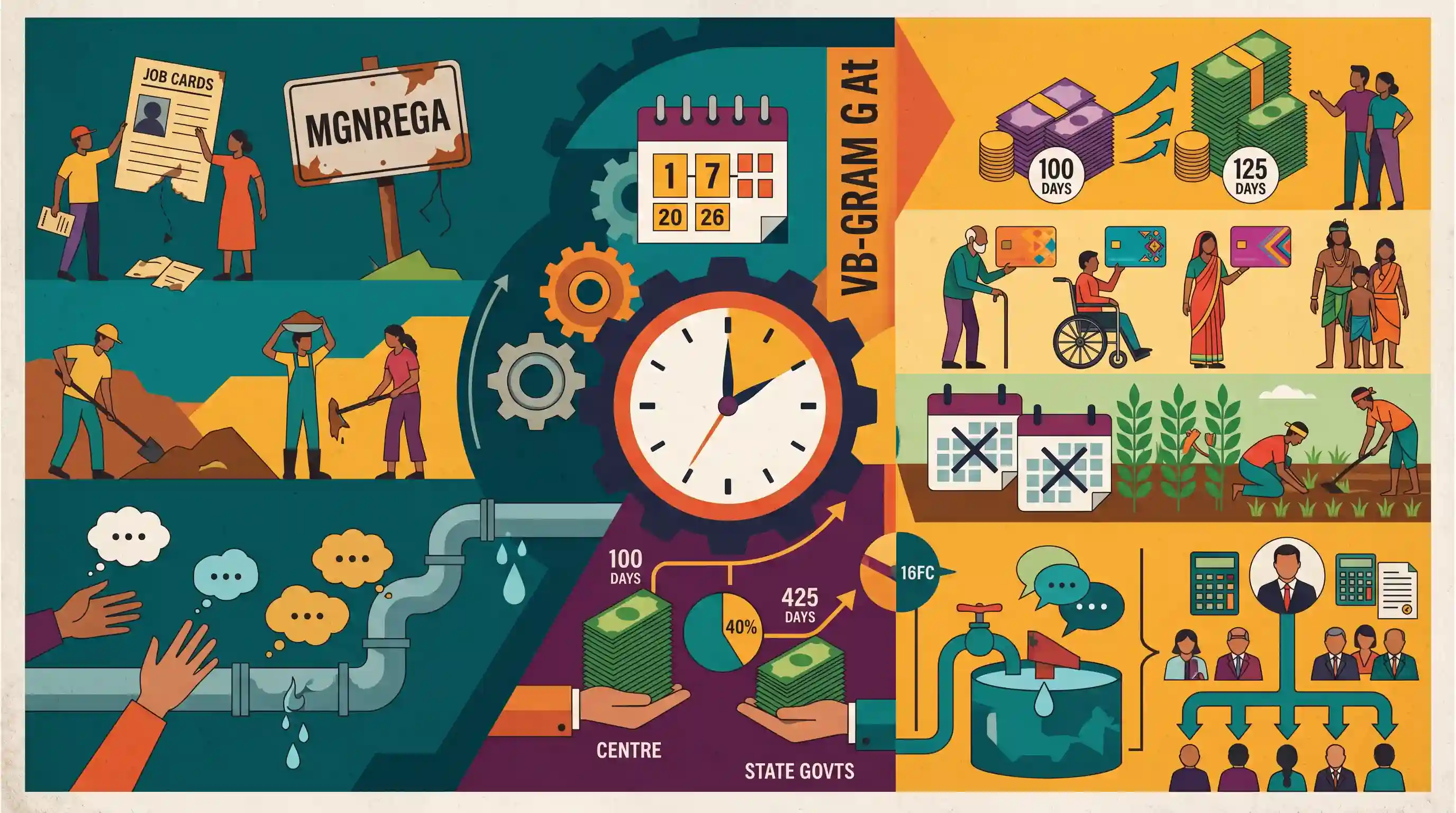
The Viksit Bharat-Guarantee for Rozgar and Ajeevika Mission (Gramin) (VB-G RAM G) Act, 2025 came into effect on July 1, 2026, completely replacing the two-decade-old MGNREGA. While the new framework raises the guaranteed wage employment from 100 to 125 days and introduces targeted cards for vulnerable groups, it represents a major structural shift by introducing a 60-day agricultural season pause, imposing a 40% funding burden on state governments, and transitioning central fund allocations from a demand-driven model to a top-down normative model guided by the 16th Finance Commission’s horizontal devolution recommendations.
Key Points
- On July 1, 2026, the Viksit Bharat-Guarantee for Rozgar and Ajeevika Mission (Gramin) (VB-G RAM G) Act, 2025 officially came into effect, replacing the Mahatma Gandhi National Rural Employment Guarantee Act (MGNREGA), 2005.
- The new scheme increases the guaranteed wage employment limit per rural household from 100 days to 125 days in a financial year.
- A seasonal 60-day agricultural pause has been introduced during peak sowing and harvesting seasons to protect the availability of farm labour for private agriculture.
- Under VB-G RAM G, the funding pattern shifts from 100% Central funding of the wage bill (under MGNREGA) to a 60:40 Centre-State cost-sharing ratio, saving the Centre's fiscal space but increasing the burden on State budgets. Exceptions include Northeastern/Himalayan states and legislative Union Territories (90:10), and non-legislative UTs (100% Central).
- Resource allocation shifts from a bottom-up, state-demand-driven labour budget model to a top-down 'normative allocation' where the Centre determines funding devolutions based on objective parameters linked to the 16th Finance Commission's horizontal devolution recommendations.
- The existing MGNREGA Job Cards will be replaced by Gramin Rozgar Guarantee Cards (valid for 3 years, renewable). Distinct-colored Special Cards will be issued to highly vulnerable groups (single women, PwDs, seniors, released bonded labourers, PVTGs, and transgender individuals) to streamline social protection.
- New daily wages for unskilled manual work have been set under Section 10 of the Act, ranging from ₹300 to ₹409, with a special rate of ₹450 in certain parts of Sikkim. Daily wage hikes exceeded 15% in several northern and northeastern states but remained under 3% in southern states.
- The historical trajectory of wage-employment schemes in India evolved from early initiatives in the 1960s (Rural Manpower Programme) and 1971 (Crash Scheme), structured programs in the 1980s (NREP, RLEGP), consolidation into Jawahar Rozgar Yojana (1993) and Sampoorna Grameen Rozgar Yojana (1999), to the statutory right to work introduced by Maharashtra in 1977, MGNREGA in 2005, and now VB-G RAM G in 2026.
Important Terms
Viksit Bharat-Guarantee for Rozgar and Ajeevika Mission (Gramin) Act, 2025

A landmark rural social welfare legislation enacted to replace MGNREGA, guaranteeing 125 days of unskilled manual wage employment per financial year while promoting productive infrastructure aligned with the Viksit Bharat @2047 vision.
UPSC context
GS Paper II: Welfare Schemes & Governance; tests knowledge of rural development reforms, cooperative federalism, and social security programs.
Mahatma Gandhi National Rural Employment Guarantee Act, 2005
A major rights-based social security legislation that guaranteed at least 100 days of unskilled manual work per financial year to rural households, aiming to address chronic poverty and enhance livelihood security.
UPSC context
GS Paper II & III: Social Justice & Poverty; tests historical understanding of right-to-work frameworks and direct benefit transfers.
Maharashtra Employment Guarantee Act, 1977
India's first state-level legislation that introduced the concept of a statutory "right to work" in rural areas, laying the pilot framework and foundational principles for the later national-level MGNREGA.
UPSC context
GS Paper II: Social Justice; tests understanding of the evolution of social security and pilot welfare schemes in India.
Jawahar Rozgar Yojana
A massive national wage-employment scheme launched in April 1989 by merging NREP and RLEGP, implemented through Panchayati Raj Institutions to generate rural wage employment and create durable community assets.
UPSC context
GS Paper III: Indian Economy & Poverty; tests knowledge of historic rural employment models and decentralised planning.
Sampoorna Grameen Rozgar Yojana
A comprehensive rural employment programme launched in September 2001 by merging EAS and JGSY, focused on providing additional wage employment, rural infrastructure creation, and nutritional security through free foodgrain distribution.
UPSC context
GS Paper II & III: Food Security & Welfare; tests understanding of historical wage employment schemes integrated with nutrition programs.
Ministry of Rural Development
The nodal Union ministry responsible for rural poverty alleviation, infrastructure creation, social security, and livelihood schemes, operating through the Department of Rural Development and the Department of Land Resources.
UPSC context
GS Paper II: Governance & Government Policies; tests knowledge of administrative mechanisms implementing flagship welfare programs in India.
Prelims Trap
VB-G RAM G guarantees 125 days of rural employment on-demand year-round, with the wage bill fully funded by the Central Government.
The new Act introduces a 60-day agricultural blackout pause, shifts to a 60:40 Centre-State wage ratio, and replaces demand-driven funding with top-down normative allocations.
Static Concepts Connected
What is the constitutional and statutory basis of the Right to Work in India?
- DPSP Article 41: Directs the State to secure the right to work, education, and public assistance within limits of its economic capacity.
- Article 21 Link: The Supreme Court has interpreted the right to livelihood as an essential facet of the Right to Life under Article 21.
- Statutory Precedent: Maharashtra was the first state to pass an Employment Guarantee Act in 1977, pioneering statutory rural work.
How do Centrally Sponsored and Central Sector Schemes differ in funding?
- Central Sector: Funded 100% by the Union government and implemented directly by central machinery or designated central agencies.
- Centrally Sponsored: Funded on a shared basis (typically 60:40 or 90:10) and implemented by State governments, matching local priorities.
- VB-G RAM G Shift: Replaces 100% central wage funding with a 60:40 ratio, transforming a demand-driven entitlement into a shared fiscal burden.
Cross-Topic Patterns
Rural welfare vs Private farm labor supply
The 60-day seasonal agricultural pause attempts to resolve the classic economic tension between state welfare safety nets and private sector farm-labor availability during peak harvest seasons.
Fiscal Federalism and Finance Commission
Linking rural scheme funding to the 16th Finance Commission's horizontal devolution criteria creates a unique convergence between statutory welfare rights and national macroeconomic distribution frameworks.

The fiscal and operational shifts in India's rural employment guarantee from demand-driven to 16th FC-linked normative funding is a high-yield 2026 topic.
Linked PYQs · 3
Linked PYQs · 3
- 2011PrelimsGS1
Among the following who are eligible to benefit from the “Mahatma Gandhi National Rural Employment Guarantee Act”?
- 2025MainsGS2
Examine the evolving pattern of Centre-State financial relations in the context of planned development in India. How far have the recent reforms impacted the fiscal federalism in India?
- 2019MainsGS2
Performance of welfare schemes that are implemented for vulnerable sections is not so effective due to absence of their awareness and active involvement at all stages of policy process. Discuss.
