VB-G-RAM-G scheme replaces MGNREGA altering rural employment framework
Source:Indian Express ↗
Why It Matters
Employment guarantee schemes are a core component of India's poverty alleviation strategy. The transition from MGNREGA to VB-G-RAM-G introduces critical changes in fiscal federalism (Centre-State funding) and targeted welfare, making it highly relevant for GS Paper 2 (Governance, Social Justice, and Polity) and GS Paper 3 (Economy).
Summary
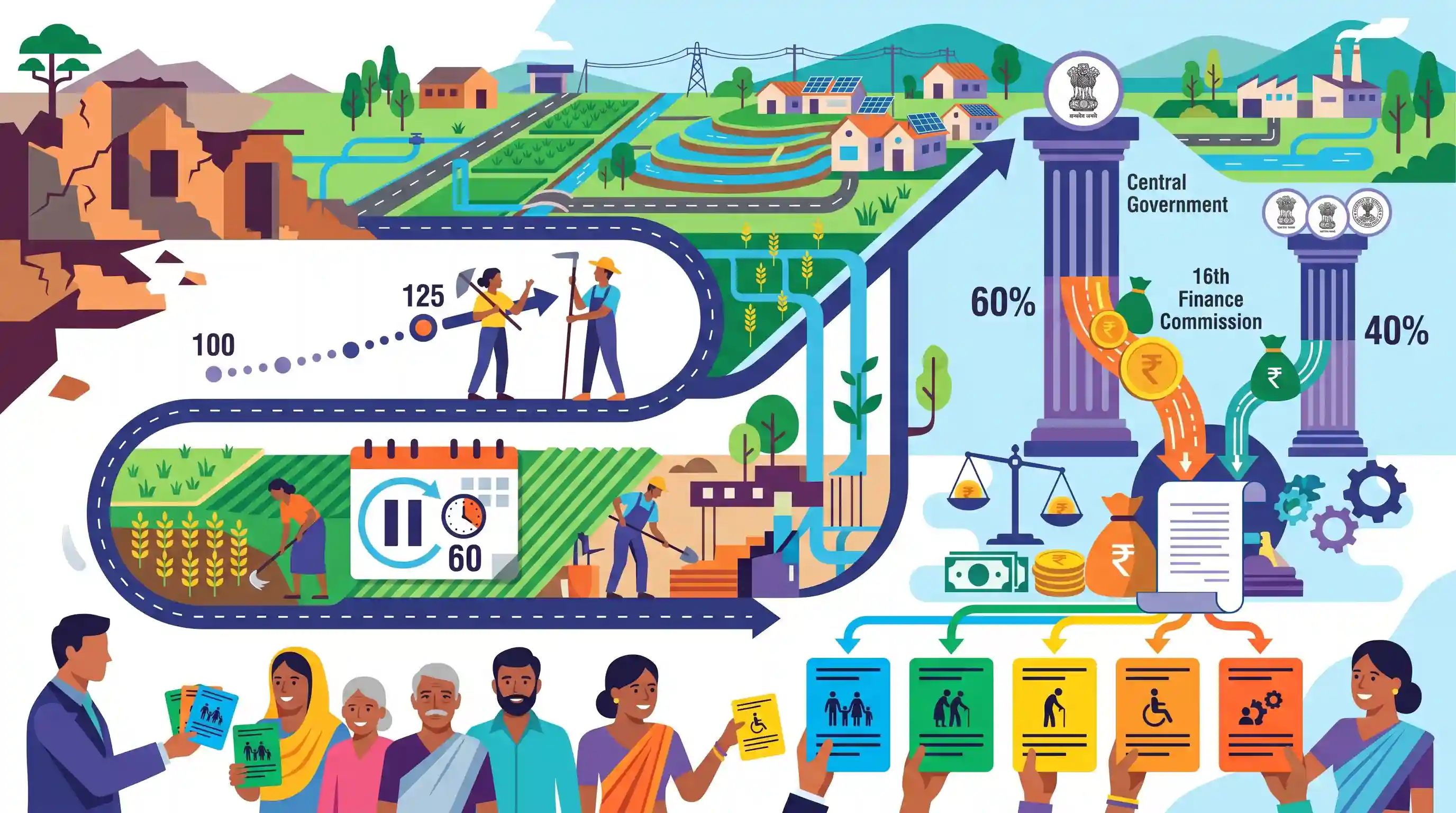
The article provides a detailed overview of the newly introduced VB-G-RAM-G scheme, which replaces MGNREGA for rural employment generation. Key reforms include an increase in guaranteed work days to 125, a 60-day pause during agricultural peaks, and a major shift in the funding mechanism to a 60:40 Centre-State ratio based on the 16th Finance Commission's devolution formula. It also introduces targeted interventions like colour-coded job cards for vulnerable populations, reflecting a broader shift in India's approach to rural poverty alleviation and fiscal federalism.
Key Points
- A new rural employment scheme, VB-G-RAM-G, replaces MGNREGA starting July 1, 2026, increasing guaranteed work days from 100 to 125.
- The scheme mandates a 60-day pause in work during peak agricultural seasons to prevent labor shortages in farming.
- Wage funding shifts from 100% Central responsibility under MGNREGA to a 60:40 Centre-State sharing model, distributed via the 16th Finance Commission's horizontal devolution formula.
- Special colour-coded Gramin Rozgar Guarantee Cards are introduced for vulnerable groups, including single women, PwDs, and transgender individuals.
- The article contextualizes this change within the historical evolution of India's rural employment programs, which date back to the 1960 Rural Manpower Programme.
Important Terms
VB-G-RAM-G (Viksit Bharat-Guarantee for Rozgar and Ajeevika Mission - Gramin)

A statutory rural employment scheme launched in 2026 replacing MGNREGA. It guarantees 125 days of work per household, incorporates a 60-day agricultural peak pause, and follows a 60:40 Centre-State funding ratio based on normative allocations.
UPSC context
GS Paper II & III. Tests understanding of current social security reforms, rural livelihood security, and the transition from rights-based to mission-mode schemes.
Mahatma Gandhi National Rural Employment Guarantee Act (MGNREGA)
Enacted in 2005, this landmark legislation provided a legal guarantee of 100 days of unskilled wage employment to rural households. It was demand-driven and primarily centrally funded until its 2026 repeal.
UPSC context
GS Paper II & III. Tests knowledge of rights-based social safety nets, poverty alleviation history, and the evolution of rural employment policy.
16th Finance Commission
A constitutional body that recommended the tax devolution formula for 2026-2031. Its horizontal devolution criteria are now utilized to determine state-wise normative funding allocations for the VB-G-RAM-G framework.
UPSC context
GS Paper II & III. Tests knowledge of fiscal devolution, Centre-State relations, and the role of constitutional bodies in funding developmental schemes.
Jawahar Rozgar Yojana (JRY)
Launched in 1989 by merging NREP and RLEGP, it was the first major scheme to decentralize implementation to Panchayati Raj Institutions, aiming for rural asset creation and gainful employment generation.
UPSC context
GS Paper II & III. Tests understanding of the history of rural decentralization and the evolution of employment-poverty linkage strategies.
Fiscal Federalism
The economic framework governing financial relations between India's Union and State governments. It describes the shift toward shared funding (60:40) and normative allocations replacing centrally-borne, demand-driven expenditure models in rural development.
UPSC context
GS Paper II & III. Tests conceptual clarity on resource sharing, state financial autonomy, and the impact of funding patterns on federal structure.
National Rural Employment Programme (NREP)
Launched in 1980 (merging the Food for Work Programme), it focused on generating gainful employment while simultaneously creating durable community assets and improving nutritional standards in rural areas.
UPSC context
GS Paper III. Tests knowledge of early-stage rural development strategies and historical precedents for modern employment guarantee schemes.
Prelims Trap
"Like MGNREGA, 100% of the unskilled wage cost in VB-G-RAM-G is funded by the Central Government."
Under MGNREGA, the Centre bore 100% of unskilled wage costs. VB-G-RAM-G changes this fundamental feature to a 60:40 Centre-State sharing model.
Static Concepts Connected
What is Horizontal Devolution by the Finance Commission?
- Meaning: The formula used by the Finance Commission to distribute the divisible pool of taxes among the various states.
- Parameters: Typically includes indicators like Income Distance, Population, Area, Forest/Ecology, and Demographic Performance, weighted differently by each Commission.
- Objective: It aims to ensure equity by providing more resources to states with lower per capita income and higher fiscal needs.
How have rural employment schemes evolved historically before MGNREGA?
- Pre-1990s: The National Rural Employment Programme (1980) and Rural Landless Employment Guarantee Programme (1983) were merged to form Jawahar Rozgar Yojana in 1989.
- Early 2000s: EAS and JGSY were merged into the Sampoorna Grameen Rozgar Yojana (SGRY) in 2001.
- NFFWP to MGNREGA: SGRY and the National Food for Work Programme (2004) were eventually subsumed into the rights-based MGNREGA in 2005.
Cross-Topic Patterns
Labour Shortages vs Rural Welfare
The 60-day pause aligns welfare schemes with agricultural cycles, addressing long-standing farmer complaints that rural employment schemes inflate agricultural wage rates and cause seasonal labour shortages.
CSS Funding & State Fiscal Burden
The shift to a 60:40 model for wages reflects a broader trend of reducing the Union's financial burden in Centrally Sponsored Schemes, heavily impacting state fiscal deficit management.

Expect a comparative multi-statement question in 2026 contrasting MGNREGA's 100% wage funding with VB-G-RAM-G's 60:40 split and 125 days.
Linked PYQs · 5
Linked PYQs · 5
- 2011PrelimsGS1
Among the following who are eligible to benefit from the “Mahatma Gandhi National Rural Employment Guarantee Act”?
- 2006PrelimsGS1
Consider the following statements in respect of welfare schemes launched by the Ministry of Rural Development, Government of India. 1. Drinking water for rural areas in one of the components of the Bharat Nirman Plan. 2. NREGA 2005 provides that statutory minimum wage for agricultural workers must be paid.
- 2025MainsGS2
Examine the evolving pattern of Centre-State financial relations in the context of planned development in India. How far have the recent reforms impacted the fiscal federalism in India?
- 2024MainsGS2
What changes has the Union Government recently introduced in the domain of Centre-State relations ? Suggest measures to be adopted to build the trust between the Centre and the States and for strengthening federalism.
- 2024MainsGS2
Poverty and malnutrition create a vicious cycle, adversely affecting human capital formation. What steps can be taken to break the cycle ?
