Global South presidencies conclude at the 2025 G20 summit
Source:Indian Express ↗
Why It Matters
The conclusion of the Global South quartet of G20 presidencies is a landmark in global geopolitics. It directly addresses UPSC GS2 themes related to India's evolving role in global platforms, international governance architecture, and the geopolitical assertion of developing nations.
Summary
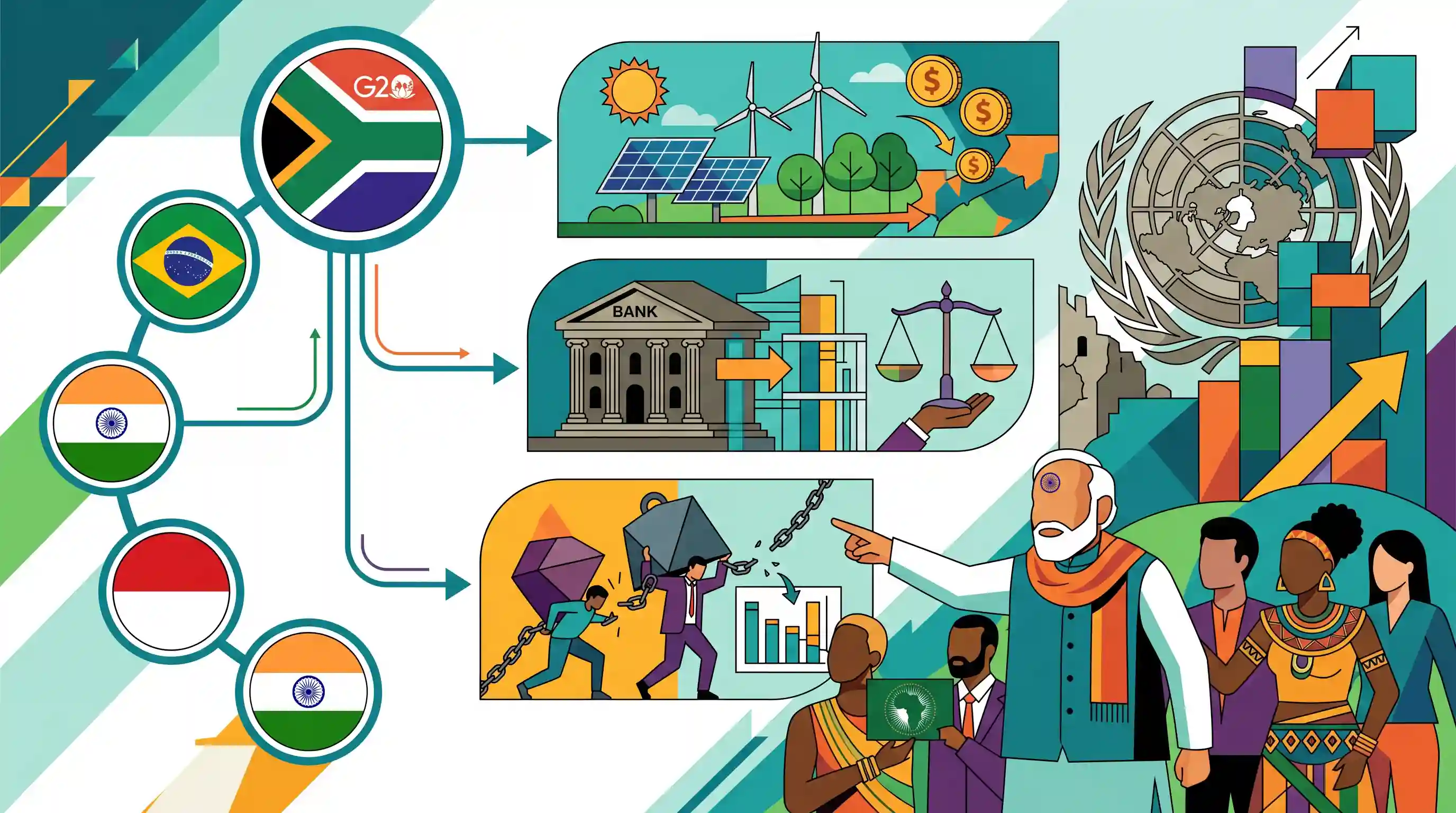
The 2025 G20 Summit held in South Africa is a pivotal moment as it completes a four-year cycle of Global South presidencies. The summit culminated in the South Africa Declaration, which strongly advocates for reforming Multilateral Development Banks (MDBs), restructuring sovereign debt, and boosting climate finance for developing countries. For India, the summit was a platform to consolidate its leadership role in the Global South, building on its achievements from the 2023 presidency, such as integrating the African Union into the bloc. The sustained push for reforming global governance structures, including the UN, highlights the growing leverage of emerging economies in shaping the multilateral world order.
Key Points
- The 2025 G20 Summit in South Africa marks the conclusion of the 'Global South Quartet' of presidencies (Indonesia, India, Brazil, South Africa), shifting the focus of global economic governance towards developing nations.
- The South Africa Declaration emphasizes the urgent need for reforms in Multilateral Development Banks (MDBs) to provide better financing solutions for nations tackling debt and climate change.
- India utilized the summit to reinforce its diplomatic position as the 'Voice of the Global South', sustaining the momentum from its 2023 presidency which saw the inclusion of the African Union into the G20.
- A central theme of the summit was the democratization of international institutions, with strong calls for reforming the United Nations Security Council to reflect contemporary geopolitical realities.
- Developing nations collectively pushed for developed countries to honor and expand their climate finance commitments to enable an equitable green transition.
Important Terms
Johannesburg Declaration (South Africa Declaration)

The consensus document of the 2025 G20 Summit focusing on 'Solidarity, Equality, and Sustainability.' It prioritizes debt relief, MDB reform, and climate finance for developing nations.
UPSC context
GS Paper II: Important for International Relations (IR) and global governance. Tests understanding of consensus-building and Global South priorities.
G20 (Group of Twenty)
The premier forum for international economic cooperation, comprising 19 countries, the European Union, and the African Union. It represents 85% of global GDP and 75% of global trade.
UPSC context
GS Paper II: Fundamental international grouping. Frequently tested in Prelims (members/structure) and Mains (India’s role/multilateralism).
African Union (AU)
A continental body consisting of 55 member states. It became a permanent G20 member in 2023, ensuring Africa’s voice is integrated into global economic policy-making.
UPSC context
GS Paper II: Regional groupings and global governance. Highlighted as a major success of India’s G20 presidency (2023).
Multilateral Development Banks (MDBs)
International financial institutions (e.g., World Bank, AfDB) that provide financing for development. The 2025 Summit called for their reform to increase concessional lending to developing nations.
UPSC context
GS Paper III: Indian Economy/Development. Essential for questions on global financial architecture and sustainable development funding.
Global South
A term referring to diverse nations in Africa, Asia, and Latin America characterized by shared challenges of development, inequality, and historical marginalization in global governance.
UPSC context
GS Paper II: Critical for IR. Tests India’s self-positioning as a leader/voice for developing nations in multilateral forums.
United Nations (UN)
An intergovernmental organization established in 1945. The G20 2025 Summit reaffirmed the need for UN reform to reflect contemporary geopolitical realities, particularly in the Security Council.
UPSC context
GS Paper II: International institutions. Focuses on the 'reformed multilateralism' agenda often pushed by India.
Prelims Trap
The African Union was granted permanent G20 membership during the 2025 South Africa Summit.
The African Union was granted permanent membership during India's 2023 G20 Presidency (New Delhi Summit), not during the 2025 South Africa Summit.
Static Concepts Connected
What distinguishes MDBs from standard commercial banks?
- Sovereign Shareholders: They are governed by member countries (sovereign states) acting as shareholders, rather than private individuals or corporate entities.
- Development Mandate: Their primary focus is on economic development, infrastructure, and poverty reduction via concessional loans and grants, not profit maximization.
- Key Examples: The World Bank Group, Asian Development Bank (ADB), and New Development Bank (NDB) are prominent examples.
How does the G20 function without a permanent secretariat?
- Troika System: Continuity is maintained by a three-member country committee comprising the past, present, and future presidencies.
- Two Tracks: Negotiations run on two parallel tracks: the Finance Track (Finance Ministers/Central Bank Governors) and the Sherpa Track (emissaries of the leaders).
Cross-Topic Patterns
Climate Finance & CBDR-RC Principle
The developing nations' push for climate finance at G20 directly links to the UNFCCC's Common But Differentiated Responsibilities (CBDR), bridging GS2 (Multilateral Institutions) and GS3 (Environment).
Democratization of UN via G4/L69
The South Africa Declaration's call for UN reform mirrors the long-standing demands of the G4 and L.69 groups, highlighting the Global South's historical institutional marginalization.

G20's 'Global South Quartet' + MDB reforms + Climate Finance overlap will likely form a complex multi-statement Prelims 2026 question.
Linked PYQs · 4
Linked PYQs · 4
- 2020PrelimsGS1
In which one of the following groups are all the four countries members of G20?
- 2023PrelimsGS1
Consider the following statements about G-20: 1. The G-20 group was originally established as a platform for the Finance Ministers and Central Bank Governors to discuss the international economic and financial issues. 2. Digital public infrastructure is one of India's G-20 priorities. Which of the statements given above is/are correct?
- 2019MainsGS2
‘The long-sustained image of India as a leader of the oppressed and marginalised nations has disappeared on account of its new found role in the emerging global order.’ Elaborate.
- 2025MainsGS2
"The reform process in the United Nations remains unresolved, because of the delicate imbalance of East and West and entanglement of the USA vs. Russo-Chinese alliance.” Examine and critically evaluate the East-West policy confrontations in this regard.
