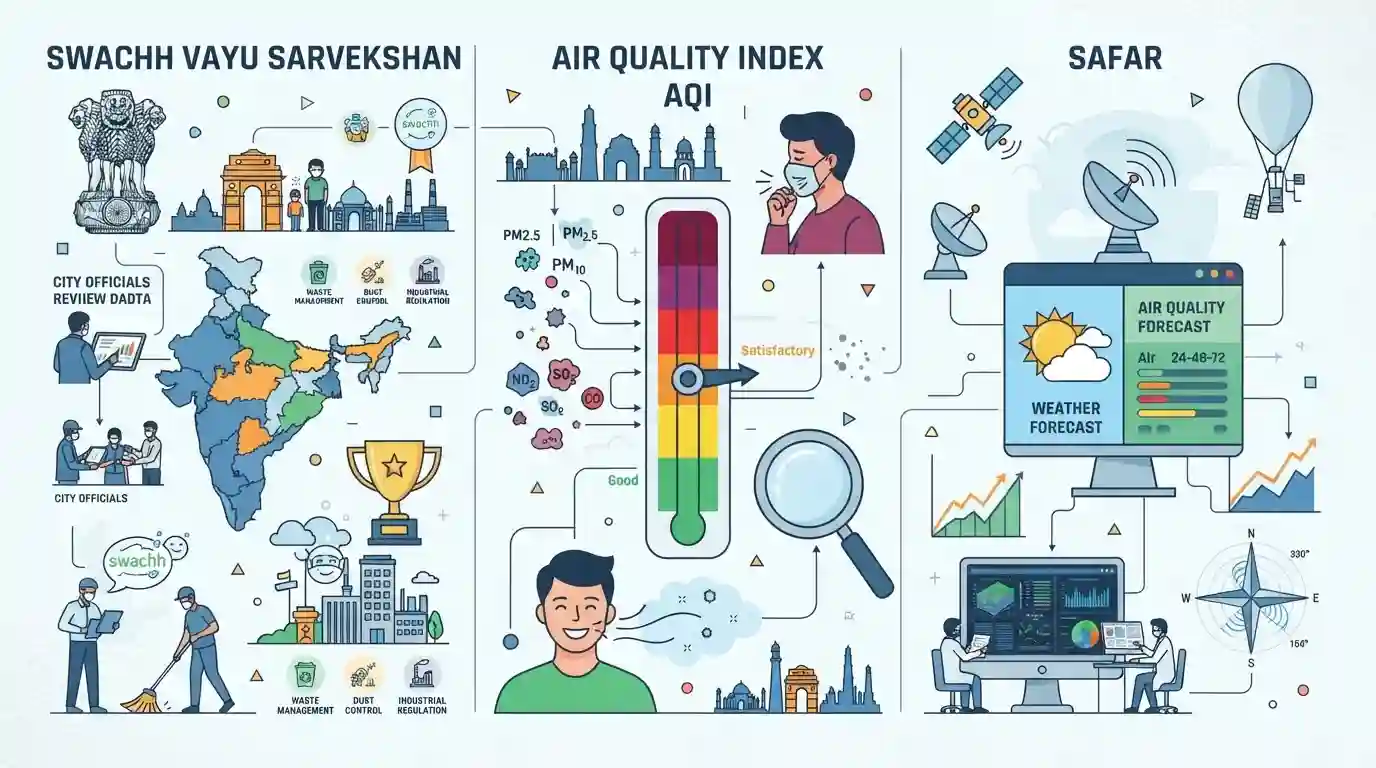
Comparative Framework of Air Quality Indices and Monitoring Systems
Source:Indian Express ↗
কেন এটি গুরুত্বপূর্ণ
Air pollution is a persistent core topic in UPSC Prelims and Mains (GS3). Questions frequently test the nuances of various environmental monitoring indices, rankings, and scientific forecasting systems implemented in India.
সারসংক্ষেপ
The article breaks down key concepts related to air quality monitoring and management in India, comparing Swachh Vayu Sarvekshan, the Air Quality Index (AQI), and SAFAR (System of Air Quality and Weather Forecasting and Research), which is essential for environmental governance questions in UPSC exams.
মূল বিষয়
- Swachh Vayu Sarvekshan is an initiative by the Ministry of Environment, Forest and Climate Change to rank cities under the National Clean Air Programme based on air quality improvement measures.
- Air Quality Index (AQI) transforms complex air quality data of various pollutants into a single number, color, and descriptor for public understanding.
- SAFAR (System of Air Quality and Weather Forecasting and Research) provides location-specific real-time air quality information and weather forecasts, developed by IITM Pune.
- Understanding the differences between administrative rankings (Swachh Vayu Sarvekshan), public health indices (AQI), and scientific research/forecasting systems (SAFAR) is vital for UPSC Prelims and Mains.
গুরুত্বপূর্ণ শব্দ
National Clean Air Programme

A national initiative launched by the Ministry of Environment, Forest and Climate Change in 2019 to reduce particulate matter concentration in targeted Indian cities.
UPSC context
UPSC Prelims/Mains: Tests knowledge of government policies, urban environmental governance, and pollution abatement strategies.
Swachh Vayu Sarvekshan
An annual ranking exercise by the Ministry of Environment, Forest and Climate Change assessing Indian cities on air pollution mitigation measures under the NCAP.
UPSC context
UPSC Prelims: Important for current affairs, urban governance rankings, and environmental management schemes.
SAFAR
An operational air quality and weather forecasting system developed by IITM Pune to provide real-time air quality data and advance warnings for major cities.
UPSC context
UPSC Prelims: Evaluates scientific mechanisms, forecasting frameworks, and institutional setups addressing air pollution.
Ministry of Environment, Forest and Climate Change
The nodal apex ministry in the central government responsible for environmental administration, forest conservation, climate change policies, and pollution control frameworks.
UPSC context
UPSC Prelims/Mains: Core to environmental governance, statutory bodies, and ministry-level mandates.
Central Pollution Control Board
A statutory organization established in 1974 under the Water Act, tasked with setting national ambient air quality standards and coordinating pollution control nationwide.
UPSC context
UPSC Prelims: Frequently tested for statutory authority origins, pollution standards, and environmental acts.
Indian Institute of Tropical Meteorology
A premier research institution under the Ministry of Earth Sciences specializing in atmospheric sciences, weather forecasting, and climate research.
UPSC context
UPSC Prelims: Tests institutional framework for meteorological and climate research in India.
প্রিলিমস ফাঁদ
SAFAR is an initiative implemented directly by the Ministry of Environment, Forest and Climate Change under the CPCB framework.
Aspirants often confuse SAFAR (under MoES/IITM Pune) with CPCB's routine AQI monitoring stations, assuming all air indices are managed exclusively by the MoEFCC.
সংযুক্ত স্থির ধারণা
What are the core pollutants and index categories under India's National Air Quality Index (AQI)?
- Eight Pollutants: Tracks eight major pollutants including PM10, PM2.5, NO2, SO2, CO, O3, NH3, and Pb.
- Six Categories: Categorized into six distinct color-coded categories ranging from Good to Severe.
- Nodal Agency: Developed by the Central Pollution Control Board (CPCB) in consultation with IIT Kanpur.
আন্তঃবিষয় প্যাটার্ন
NCAP targets + 15th Finance Commission grants
NCAP targets and urban air quality action plans link directly to the 15th Finance Commission's performance-based grants for urban local bodies to combat air pollution.

Expect a matching-type prelims question pairing air monitoring frameworks (SAFAR, AQI, NCAP) with their nodal ministries/agencies.
সংযুক্ত PYQ · 2
সংযুক্ত PYQ · 2
- 2020MainsGS3
What are the key features of the National Clean Air Programme (NCAP) initiated by the Government of India?
- 2021MainsGS3
Describe the key points of the revised Global Air Quality Guidelines (AQGs) recently released by the World Health Organisation (WHO). How are these different from its last update in 2005? What changes in India's National Clean Air Programme are required to achieve these revised standards?
