Supreme Court Links Road Safety to Article 21
Source:Indian Express ↗
Why It Matters
This development is a prime example of judicial activism expanding fundamental rights, paralleling the constitutionalization of environmental rights. It demonstrates the practical application of Article 142 to bridge governance gaps in infrastructure safety, a critical topic for GS-II (Polity/Governance) and GS-III (Infrastructure).
Summary
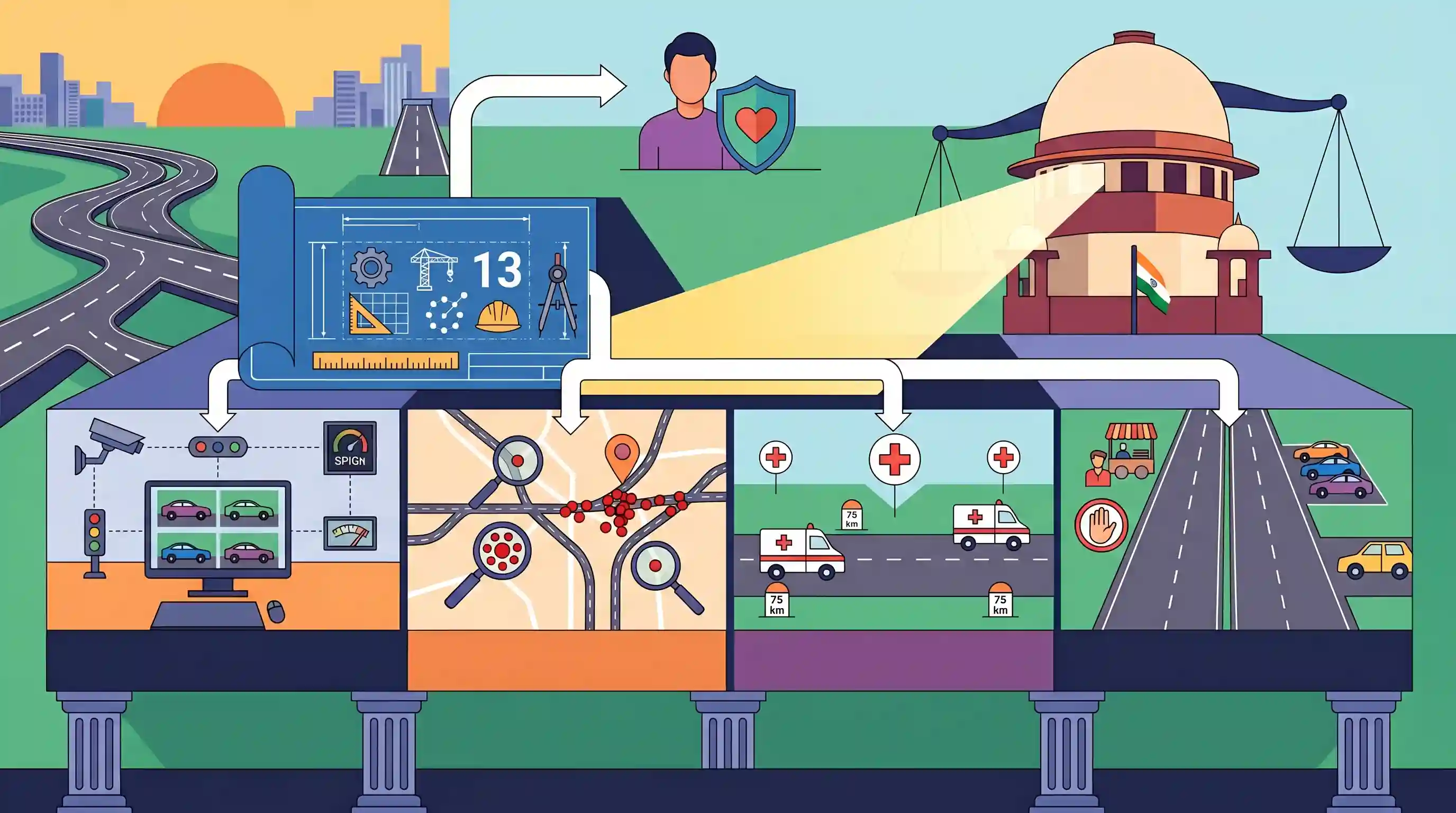
In a landmark suo motu intervention triggered by severe highway fatalities, the Supreme Court of India declared that road safety is an integral facet of the Right to Life under Article 21. Utilizing its extraordinary powers under Article 142 to ensure "complete justice," the Court issued a binding 13-point safety blueprint applicable to the NHAI and state governments. The directives mandate infrastructure and governance upgrades, including the deployment of Advanced Traffic Management Systems (ATMS), systematic mapping of accident blackspots, ensuring ambulance availability every 75 km, and strictly prohibiting encroachments and parking on highway carriageways.
Key Points
- The Supreme Court expanded the scope of Article 21 (Right to Life and Personal Liberty) by explicitly recognizing the fundamental right to a safe commuting environment.
- The Court invoked its extraordinary powers under Article 142 to enforce comprehensive road safety measures in the absence of adequate statutory compliance.
- A 13-point safety blueprint was issued, mandating the removal of encroachments within the Right of Way, prevention of carriageway parking, and the creation of highway lay-bys.
- NHAI and State Governments are directed to map accident "blackspots," deploy Advanced Traffic Management Systems (ATMS), and ensure ambulance availability every 75 km on highways.
Important Terms
Article 21 (Right to Life)

Article 21 of the Constitution protects life and personal liberty. The Supreme Court has expanded this to include the right to safe, hazard-free roads as a mandate for the State.
UPSC context
GS Paper II (Polity); tests the evolving interpretation of Fundamental Rights and State obligations toward citizens.
Article 142
A constitutional provision granting the Supreme Court extraordinary power to pass any order necessary for "complete justice," often used to fill legislative gaps in public safety or governance.
UPSC context
GS Paper II (Judiciary); tests understanding of the Court’s discretionary powers and the concept of Judicial Activism.
13-point safety blueprint
A binding pan-India set of directions issued by the Supreme Court in 2026, mandating specific infrastructure, enforcement, and emergency response upgrades to reduce highway fatalities.
UPSC context
GS Paper II (Governance); tests the judiciary’s role in administrative reform and public policy implementation.
Advanced Traffic Management System (ATMS)
An AI-based integrated solution for real-time highway monitoring. It uses video incident detection, speed sensors, and automated number plate recognition to manage traffic and alert emergency services.
UPSC context
GS Paper III (Infrastructure/Science & Tech); tests digital governance and smart infrastructure solutions for public safety.
National Highways Authority of India (NHAI)
A statutory body under the Ministry of Road Transport and Highways, established in 1988, responsible for the development, maintenance, and management of India’s National Highways network.
UPSC context
GS Paper II (Statutory Bodies); tests knowledge of autonomous agencies managing critical national infrastructure.
Accident Blackspots
A specific road stretch (approx. 500m) or junction where an abnormally high number of fatal accidents have occurred over three years, typically due to engineering or design flaws.
UPSC context
GS Paper III (Infrastructure); tests technical understanding of road safety engineering and accident prevention strategies.
Prelims Trap
"The Constitution explicitly guarantees the Right to Road Safety under Part III."
It is an implied right read into Article 21 by the Supreme Court's judicial interpretation, not explicitly written in the original constitutional text.
Static Concepts Connected
What is the scope and application of Article 142?
- Complete Justice: Empowers the Supreme Court to pass any decree necessary for doing "complete justice" in any cause or matter pending before it.
- Exclusive to SC: This extraordinary discretionary power is available exclusively to the Supreme Court of India, not to High Courts.
- Statutory override: It can override ordinary statutory laws to ensure justice, but it cannot bypass express and fundamental constitutional provisions.
How does the Supreme Court expand the scope of Article 21?
- Maneka Gandhi case: Post-1978, the Court shifted towards a substantive 'due process' approach, ruling that 'life' is not mere animal existence but living with human dignity.
- Implied rights: The Court continually discovers unenumerated rights within Article 21, including the right to privacy, clean environment, climate change protection, and now safe commuting.
Cross-Topic Patterns
Article 142 & Separation of Powers
Mandating exact administrative tasks like ambulance placement every 75 km highlights the GS2 debate on judicial activism blurring the lines with executive domain.
Infrastructure liability under GS3
Shifting the blame from driver error to engineering flaws connects GS3 road infrastructure with GS2 constitutional rights, opening avenues for constitutional tort claims against NHAI.

Expect a 2026 Prelims question mapping recent implied Article 21 rights (privacy, climate change, road safety) or testing Art 142 scope.
Linked PYQs · 5
Linked PYQs · 5
- 2024PrelimsGS1
Under which of the following Articles of the Constitution of India, has the Supreme Court of India placed the Right to Privacy ?
- 2021PrelimsGS1
'Right to Privacy' is protected under which Article of the Constitution of India?
- 2018PrelimsGS1
Right to Privacy is protected as an intrinsic part of Right to Life and Personal Liberty. Which of the following in the Constitution of India correctly and appropriately imply the above statement?
- 2022MainsGS2
“The most significant achievement of modern law in India is the constitutionalization of environmental problems by the Supreme Court.” Discuss this statement with the help of relevant case laws.
- 2019PrelimsGS1
With reference to the Constitution of India, prohibitions or limitations or provisions contained in ordinary laws cannot act as prohibitions or limitations on the constitutional powers under Article 142. It could mean which one of the following?
