Supreme Court Ruling on Road Safety and Right to Life
Source:Indian Express ↗
Why It Matters
This article illustrates the Supreme Court's ongoing expansive interpretation of Article 21 (Right to Life) and its use of Article 142. It serves as a crucial example for Mains answers discussing judicial activism, the dynamic nature of the Constitution, and governance challenges related to road infrastructure and public safety.
Summary
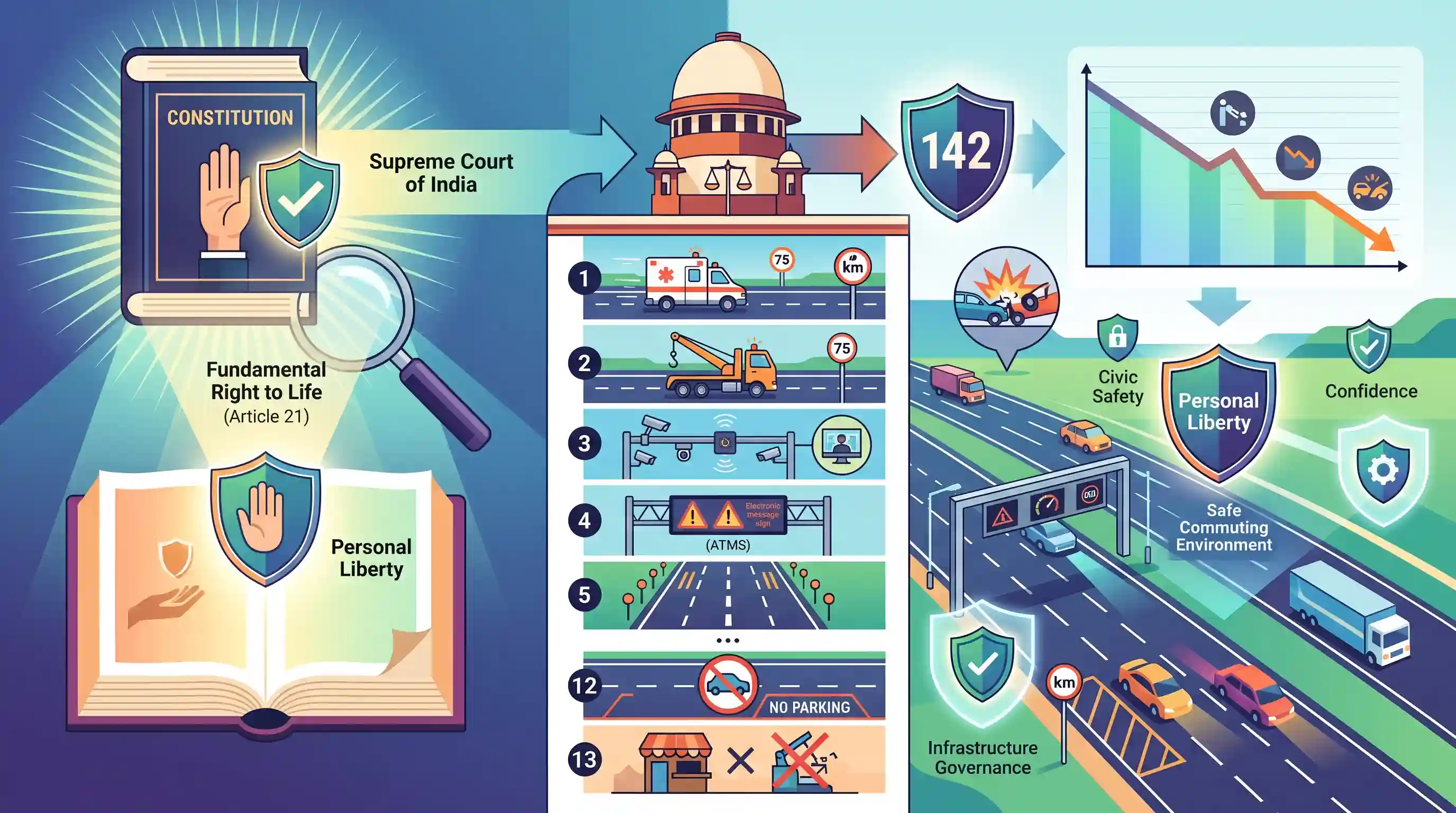
The Supreme Court of India has linked road safety to the Fundamental Right to Life under Article 21, asserting that a safe commuting environment is an integral facet of personal liberty. Triggered by a tragic accident in November 2025, the Court exercised its extraordinary powers under Article 142 to issue a comprehensive 13-point directive to central and state transport authorities. The mandates focus on reducing the high fatality rates on National and State Highways by requiring Advanced Traffic Management Systems (ATMS), emergency infrastructure (ambulances/cranes every 75 km), and strict regulations against carriageway parking and unauthorized roadside eateries. This ruling is another prime example of the judiciary's expansive interpretation of Article 21 to enforce civic safety and infrastructure governance.
Key Points
- The Supreme Court expanded the ambit of Article 21 (Right to Life) to explicitly include the right to a safe commuting environment.
- Invoking its extraordinary powers under Article 142 to do 'complete justice', the SC issued a 13-point directive to transport departments.
- Key directives include the mandatory deployment of Advanced Traffic Management Systems (ATMS), ambulances every 75 km, and systematic identification of accident 'blackspots'.
- The ruling bans heavy vehicle parking on carriageways and prohibits the opening of new dhabas/eateries within the Right of Way on highways.
- The SC highlighted that while National Highways constitute only 2% of India's road network, they account for a disproportionate 30% of road accident fatalities.
Important Terms
Article 21

Fundamental Right guaranteeing life and personal liberty; judicially expanded to include the right to safe, well-maintained roads as an essential facet of a dignified life.
UPSC context
GS-2 (Polity); tests the evolution of Fundamental Rights and the judiciary's role in expanding civil liberties.
Article 142
Constitutional provision granting the Supreme Court extraordinary power to pass decrees or orders necessary for doing 'complete justice' in any pending cause or matter.
UPSC context
GS-2 (Judiciary); evaluates understanding of judicial discretion and the power to fill legislative vacuums for public welfare.
Advanced Traffic Management System (ATMS)
A technology-led highway management suite using AI cameras, sensors, and digital signs for real-time traffic monitoring, incident detection, and automated enforcement of safety rules.
UPSC context
GS-3 (Infrastructure/Technology); relevant for modernizing logistics, highway safety (Vision Zero), and smart infrastructure governance.
Supreme Court of India
The highest judicial body in India, acting as the 'Guardian of the Constitution' and frequently utilizing Public Interest Litigation (PIL) to enforce civic rights.
UPSC context
GS-2 (Polity); focuses on the separation of powers and the trend of judicial activism in India.
State Transport Departments
State-level executive bodies responsible for enforcing motor vehicle laws, managing regional connectivity, and implementing safety directives issued by the Center or Judiciary.
UPSC context
GS-2 (Governance); highlights the challenges of multi-departmental coordination and cooperative federalism in infrastructure safety.
Prelims Trap
The Right to a safe commuting environment is explicitly listed as a Fundamental Right under the Indian Constitution.
It is an implied right read into Article 21 by the Supreme Court through judicial interpretation, not explicitly written in the constitutional text.
Static Concepts Connected
What is the scope of Article 142 of the Indian Constitution?
- Complete Justice: Empowers the Supreme Court to pass any decree necessary for doing 'complete justice' in any pending matter before it.
- Enforceability: These orders are enforceable throughout India in a manner prescribed by Parliament or, until then, by the President.
- Judicial Activism: Often invoked to fill legislative or executive gaps in areas like environmental protection, civic safety, and human rights.
What are notable implied rights read into Article 21 by the Supreme Court?
- Right to Privacy: Recognized as intrinsic to life and personal liberty in the landmark K.S. Puttaswamy judgment (2017).
- Clean Environment: Established through cases like M.C. Mehta, asserting the fundamental right to pollution-free air and water.
- Right to Livelihood: Recognized in Olga Tellis v. BMC, ruling that depriving individuals of livelihood deprives them of life.
Cross-Topic Patterns
Judicial Activism vs. Separation of Powers
Mandating exact infrastructure like ATMS or ambulances borders on executive policymaking. This reignites the GS2 debate on judicial overreach and the limits of Article 142.
The National Highway Infrastructure Paradox
Links GS3 infrastructure growth to GS2 governance. The statistic that National Highways form 2% of roads but cause 30% of fatalities exposes critical gaps in safety enforcement.

Expect a GS2 Mains question evaluating if Article 142 'complete justice' directives on road safety constitute judicial overreach.
Linked PYQs · 5
Linked PYQs · 5
- 2023MainsGS2
“The Constitution of India is a living instrument with capabilities of enormous dynamism. It is a constitution made for a progressive society.” Illustrate with special reference to the expanding horizons of the right to life and personal liberty.
- 2021PrelimsGS1
'Right to Privacy' is protected under which Article of the Constitution of India?
- 2018PrelimsGS1
Right to Privacy is protected as an intrinsic part of Right to Life and Personal Liberty. Which of the following in the Constitution of India correctly and appropriately imply the above statement?
- 2022MainsGS2
“The most significant achievement of modern law in India is the constitutionalization of environmental problems by the Supreme Court.” Discuss this statement with the help of relevant case laws.
- 2024MainsGS3
What is the technology being employed for electronic toll collection on highways? What are its advantages and limitations? What are the proposed changes that will make this process seamless? Would this transition carry any potential hazards?
