Road Safety Challenges and Policy Measures in India
Source:Indian Express ↗
Why It Matters
Road safety is a multi-dimensional challenge bridging infrastructure deficit, governance, and public health. For UPSC aspirants, it is a critical topic in GS Paper 3 (Infrastructure/Investment) and GS Paper 2 (Governance/Health), as preventing road fatalities directly impacts India's economic growth and social welfare.
Summary
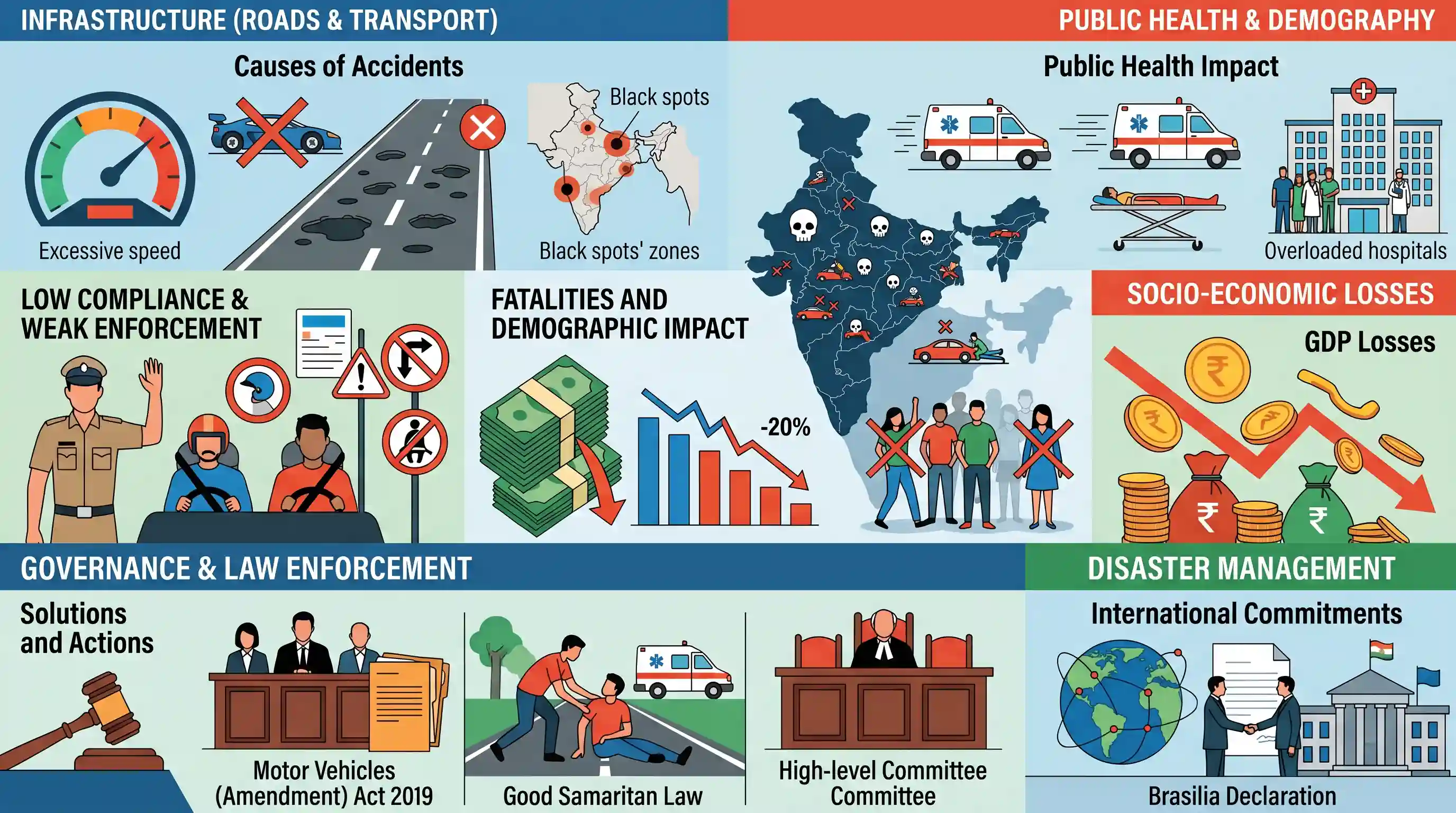
This 'Knowledge Nugget' examines the critical issue of road accidents in India, analyzing the latest data from the Ministry of Road Transport and Highways (MoRTH). It highlights that India suffers a disproportionately high rate of road fatalities driven by over-speeding, poor road infrastructure (black spots), and weak compliance with safety rules. The article details the socio-economic impacts, including significant GDP losses and the loss of youth (demographic dividend). It also evaluates India's countermeasures, emphasizing the role of the Motor Vehicles (Amendment) Act 2019, the Good Samaritan Law, the Supreme Court-appointed Justice K.S. Radhakrishnan Committee, and international commitments like the Brasilia Declaration.
Key Points
- India accounts for nearly 11% of global road crash fatalities despite having only 1% of the world's vehicle population, indicating a severe public safety challenge.
- The primary causes of road accidents are behavioral (over-speeding, driving under the influence, lack of helmets/seatbelts) and systemic (faulty road engineering, 'black spots', weak law enforcement).
- Road traffic accidents disproportionately affect the demographic dividend, with the majority of victims falling in the 18-45 age group, leading to an estimated annual economic loss of 1% to 3% of India's GDP.
- Legislative and policy measures to curb accidents include the Motor Vehicles (Amendment) Act of 2019 for stricter penalties, the Good Samaritan Law to protect bystanders who help victims, and Bharat NCAP to elevate vehicular safety standards.
- The Justice K.S. Radhakrishnan Committee guidelines mandate state governments to rectify black spots, ensure strict enforcement of traffic rules, and improve emergency trauma care.
Important Terms
Motor Vehicles (Amendment) Act, 2019

A 2019 legislative update to the 1988 Act, introducing steeper penalties for traffic violations, electronic monitoring, vehicle recall provisions, and legal protection for Good Samaritans to improve road safety and transparency.
UPSC context
GS II (Governance) and GS III (Infrastructure); tests understanding of regulatory reforms and legislative measures for public safety.
Brasilia Declaration on Road Safety
A 2015 international agreement co-sponsored by the WHO, where India and other nations committed to halving global road traffic deaths by 2030, aligning with Sustainable Development Goal (SDG) 3.6.
UPSC context
GS II (International Relations) and GS III (Infrastructure); relevant for questions on India's global commitments and sustainable development targets.
Good Samaritan Law
Legal provisions protecting bystanders who voluntarily assist accident victims from civil or criminal liability and harassment by police or hospitals, encouraging timely aid during the critical 'Golden Hour'.
UPSC context
GS II (Governance and Social Justice); tests knowledge of citizen-centric legal reforms and judicial interventions (SaveLIFE Foundation case).
Bharat New Car Assessment Programme (Bharat NCAP)
An indigenous star-rating system launched in 2023 for crash-testing passenger vehicles in India. It aims to empower consumers, improve vehicle safety standards, and enhance the global competitiveness of Indian automobiles.
UPSC context
GS III (Infrastructure and Economy); relevant for industry standards, safety infrastructure, and 'Make in India' initiatives.
Supreme Court Committee on Road Safety
Established in 2014, this committee monitors state compliance with road safety laws, focusing on 'four Es': Education, Engineering (roads/vehicles), Enforcement, and Emergency Care to reduce fatalities.
UPSC context
GS II (Judiciary and Governance); highlights the role of the judiciary in monitoring executive implementation of public health policies.
Ministry of Road Transport and Highways (MoRTH)
The nodal ministry responsible for formulating road transport policies and publishing the annual "Road Accidents in India" report, which provides critical data for national safety interventions.
UPSC context
GS III (Infrastructure); primary source for official transport data and infrastructure development policy.
Prelims Trap
The Good Samaritan Law is a standalone Act passed by Parliament to protect bystanders assisting road accident victims.
Good Samaritan protections are not a separate standalone Act. They are codified under Section 134A of the Motor Vehicles (Amendment) Act, 2019.
Static Concepts Connected
What are the key global commitments on road safety?
- Brasilia Declaration: Co-sponsored by WHO (2015), setting targets for global fatality reduction. India is a signatory.
- SDG Target 3.6: Aims to halve the number of global road traffic deaths and injuries by 2030.
- Decade of Action: The UN proclaimed 2021–2030 as the Second Decade of Action for Road Safety.
What are the key institutional changes in the MV(A) Act 2019?
- National Road Safety Board: Created to advise central and state governments on road safety and traffic management.
- Good Samaritan Protection: Section 134A shields helpers from civil/criminal liability, institutionalizing earlier Supreme Court guidelines.
- Motor Vehicle Accident Fund: Provides compulsory insurance cover to all road users in India for certain types of accidents.
Cross-Topic Patterns
Demographic Dividend vs. Morbidity
Road accidents disproportionately kill youth (18-45), eroding India's demographic dividend and causing immense GDP loss. This links physical infrastructure safety directly to macroeconomic growth constraints.
Judicial Activism in Public Safety
The Good Samaritan guidelines and the Justice Radhakrishnan Committee highlight how PILs (e.g., SaveLIFE Foundation) and Supreme Court directives often fill legislative vacuums in public safety governance.

Expect a multi-statement Prelims question mapping the Brasilia Declaration to SDG 3.6, combined with MV(A) Act 2019 bodies like the NRSB.
Linked PYQs · 4
Linked PYQs · 4
- 2024MainsGS3
What is the technology being employed for electronic toll collection on highways? What are its advantages and limitations? What are the proposed changes that will make this process seamless? Would this transition carry any potential hazards?
- 2021MainsGS3
“Investment in infrastructure is essential for more rapid and inclusive economic growth.” Discuss in the light of India's experience.
- 2019MainsGS1
How is efficient and affordable urban mass transport key to the rapid economic development of India?
- 2024MainsGS2
In a crucial domain like the public healthcare system the Indian State should play a vital role to contain the adverse impact of marketisation of the system. Suggest some measures through which the State can enhance the reach of public healthcare at the grassroots level.
