Reserve Bank of India Role in Monetary Policy and Forex Management
Source:Indian Express ↗
Why It Matters
The RBI is the cornerstone of India's economic framework. Questions directly testing the RBI's functions, its tools for inflation targeting, forex market interventions, and open market operations frequently appear in both Prelims and Mains.
Summary
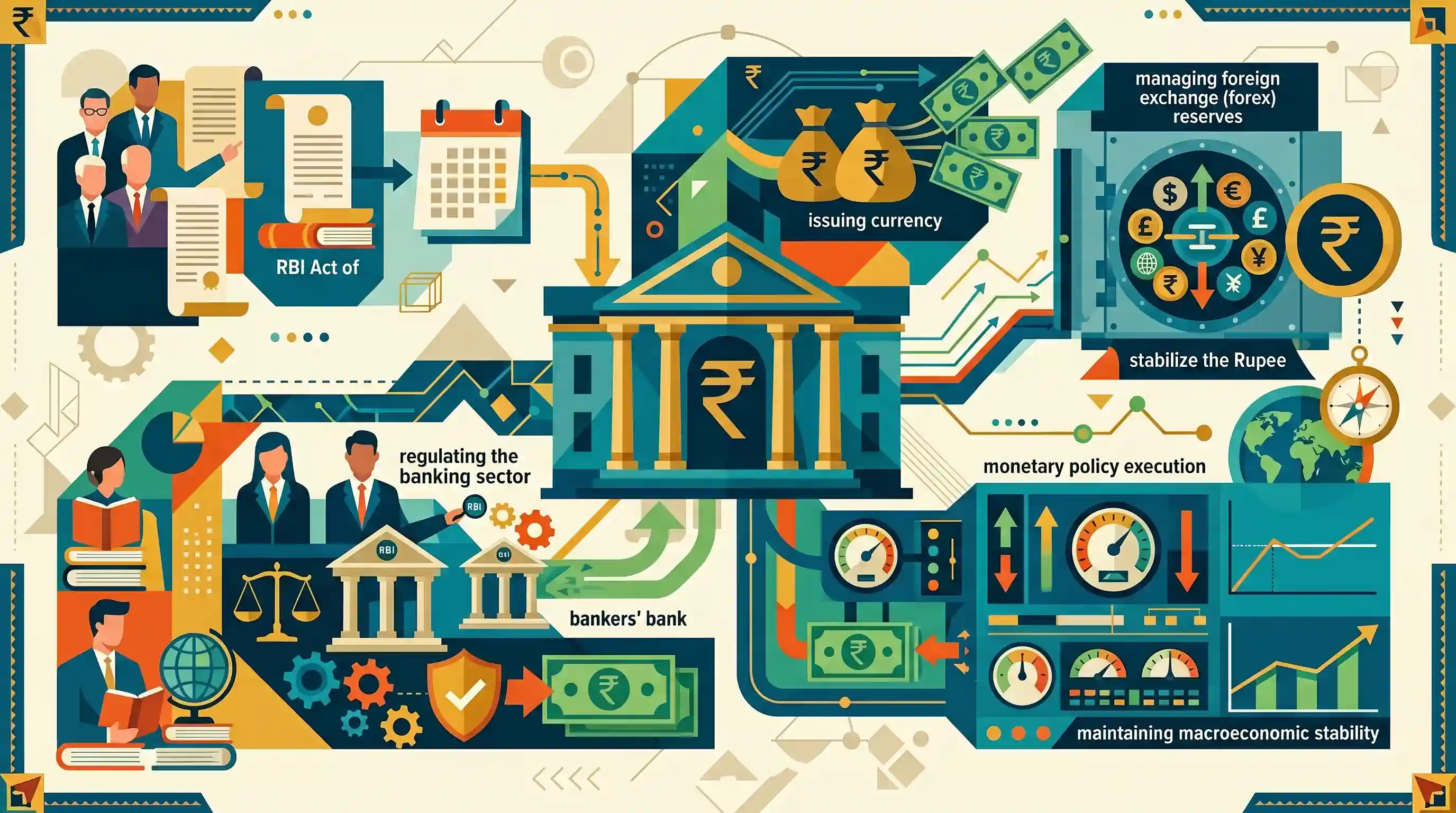
The Reserve Bank of India (RBI) was established on April 1, 1935, based on the Hilton Young Commission's recommendations and the RBI Act of 1934. It serves as India's central monetary authority, tasked with issuing currency, regulating the banking sector, managing foreign exchange (forex) reserves, and maintaining macroeconomic stability. Understanding the RBI's functions—such as monetary policy execution, forex management to stabilize the Rupee, and its role as the bankers' bank—is a fundamental topic for the UPSC examination, particularly within the Economy syllabus.
Key Points
- The Reserve Bank of India (RBI) commemorates its foundation on April 1, marking its establishment in 1935 under the Reserve Bank of India Act, 1934.
- The establishment of the RBI was guided by the recommendations of the Hilton Young Commission to separate the control of currency and credit from the government.
- As the central banking institution, the RBI is tasked with regulating the issuance of bank notes, keeping reserves to secure monetary stability, and operating the currency and credit system.
- The RBI is the custodian of India's foreign exchange (forex) reserves, actively intervening in forex markets to curb volatility and stabilize the exchange rate of the Indian Rupee.
Important Terms
Reserve Bank of India (RBI)

India’s central bank and apex monetary authority, established in 1935. It regulates the banking system, issues currency, manages forex reserves, and formulates monetary policy to ensure price stability while supporting economic growth.
UPSC context
GS Paper 3 (Economy). Critical for understanding monetary policy frameworks, inflation management, and financial sector stability.
Reserve Bank of India Act, 1934
The statutory legislation that established the RBI and defines its powers. It mandates currency management, banking services for governments, and the regulation of "Scheduled Banks" listed in its Second Schedule.
UPSC context
GS Paper 3 (Economy). Tests the legal basis of central banking, RBI’s autonomy, and the regulatory framework for financial institutions.
Hilton Young Commission
Formally the Royal Commission on Indian Currency and Finance (1926). It recommended creating a central bank to separate currency and credit control from government influence, leading to the RBI's establishment.
UPSC context
GS Paper 3 (History/Economy). Significant for the historical evolution of India's banking system and the origins of modern monetary institutions.
Monetary Policy
The framework used by the RBI to regulate money supply and interest rates. It aims to achieve price stability (inflation targeting) and maintain adequate liquidity to support economic growth.
UPSC context
GS Paper 3. Central to the economy syllabus; covers the Monetary Policy Committee (MPC) and tools like Repo and Reverse Repo.
Foreign Exchange Reserves (Forex)
External assets held by the RBI, including foreign currencies, gold, and Special Drawing Rights (SDRs). They are used to stabilize the Rupee, manage trade deficits, and buffer against external shocks.
UPSC context
GS Paper 3 (External Sector). Vital for topics like Balance of Payments, exchange rate management, and India’s global economic resilience.
Scheduled Banks
Banks included in the Second Schedule of the RBI Act, 1934. They must maintain a specific capital base, are eligible for RBI loans, and must comply with statutory reserve requirements.
UPSC context
GS Paper 3 (Banking). Distinguishes various tiers of the banking system and their respective regulatory and operational privileges under the RBI.
Bankers' Bank
A key RBI role where it maintains accounts for commercial banks, facilitates inter-bank settlements, and acts as the "Lender of Last Resort" by providing emergency liquidity to maintain systemic stability.
UPSC context
GS Paper 3 (Banking). Explains the RBI's operational relationship with the banking sector and its role in preventing financial contagion.
Prelims Trap
"The RBI was established as a fully government-owned central bank in 1935."
The RBI was initially established as a private shareholders' bank in 1935. It was nationalized post-independence in 1949 under the Reserve Bank (Transfer to Public Ownership) Act.
Static Concepts Connected
What is 'sterilization' of foreign exchange intervention by the RBI?
- Forex intervention: The RBI buys or sells foreign currency (like US Dollars) to stabilize the Rupee's exchange rate.
- Liquidity impact: When the RBI buys dollars, it injects Rupee liquidity into the domestic market, which can potentially fuel inflation.
- Sterilization action: To neutralize this, the RBI conducts Open Market Operations (selling G-Secs) to absorb the excess Rupee liquidity, 'sterilizing' the economy.
What are the primary sources of the Reserve Bank of India's income?
- Domestic Assets: Interest earned on holding domestic government securities (G-Secs) and from short-term lending to commercial banks (via LAF).
- Foreign Assets: Returns from investing India's foreign exchange reserves in secure overseas sovereign bonds and trading foreign currency.
- Seigniorage: The economic profit derived from the printing and issuing of currency notes.
Cross-Topic Patterns
Institutional continuity post-1947
The RBI's transition from a colonial-era private entity under the 1934 Act to a nationalized pillar of India's economy in 1949 links modern Indian history with post-independence economic consolidation.
Forex defense vs. Export competitiveness
The RBI's active forex intervention to curb Rupee volatility protects domestic inflation targets, but constantly requires balancing against the need to keep Indian exports globally competitive.

Expect a multi-statement Prelims question merging RBI's historical origins (Hilton Young) with its modern sterilization operations.
Linked PYQs · 5
Linked PYQs · 5
- 2025PrelimsGS1
Which of the following are the sources of income for the Reserve Bank of India? I. Buying and selling Government bonds II. Buying and selling foreign currency III. Pension fund management IV. Lending to private companies V. Printing and distributing currency notes Select the correct answer using the code given below.
- 2012PrelimsGS1
The Reserve Bank of India (RBI) acts as a bankers' bank. This would imply which of the following? 1. Other banks retain their deposits with the RBI. 2. The RBI lends funds to the commercial banks in times of need. 3. The RBI advises the commercial banks on monetary matters. Select the correct answer using the codes given below:
- 2024PrelimsGS1
Consider the following statements in respect of the digital rupee : 1. It is a sovereign currency issued by the Reserve Bank of India (RBI) in alignment with its monetary policy. 2. It appears as a liability on the RBI's balance sheet. 3. It is insured against inflation by its very design. 4. It is freely convertible against commercial bank money and cash. Which of the statements given above are correct?
- 2023PrelimsGS1
Which one of the following activities of the Reserve Bank of India is considered to be part of 'sterilization'?
- 2022PrelimsGS1
With reference to the Indian economy, consider the following statements: 1. If the inflation is too high, Reserve Bank of India (RBI) is likely to buy government securities. 2. If the rupee is rapidly depreciating, RBI is likely to sell dollars in the market. 3. If interest rates in the USA or European Union were to fall, that is likely to induce RBI to buy dollars. Which of the statements given above are correct?
