PM JANMAN Household Survey for Vulnerable Tribal Groups
Source:Indian Express ↗
हे का महत्त्वाचे आहे
Crucial for understanding targeted governance, welfare administration, and tribal development schemes like PM-JANMAN aimed at reaching the most marginalized sections of society.
सारांश
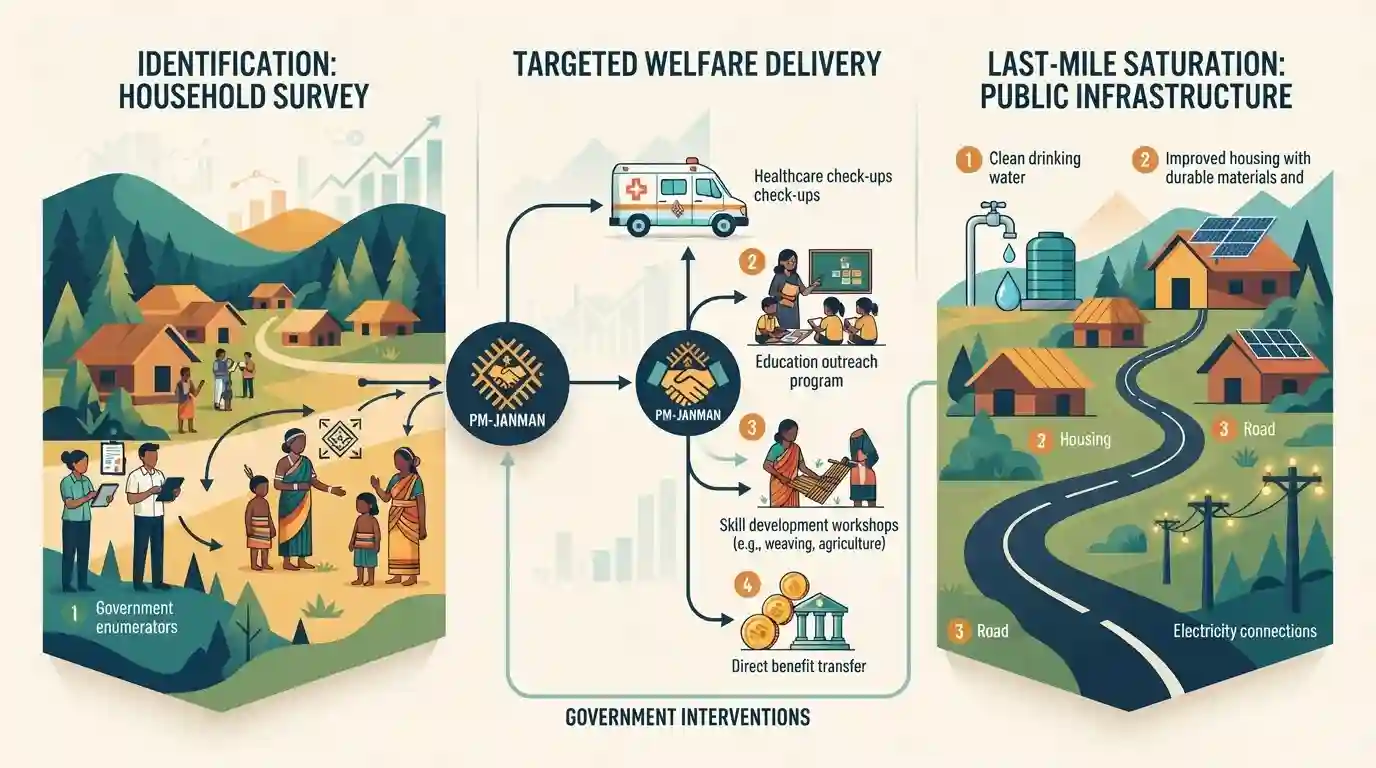
The article discusses the household survey of Particularly Vulnerable Tribal Groups (PVTGs) under the PM-JANMAN (Pradhan Mantri Janjati Adivasi Nyaya Maha Abhiyan) initiative, focusing on targeted welfare delivery, identification criteria, and last-mile saturation of essential public infrastructure for the most vulnerable communities in India.
मुख्य मुद्दे
- Focus on Particularly Vulnerable Tribal Groups (PVTGs) through household surveys under PM-JANMAN.
- PM-JANMAN aims to saturate PVTG households and habitations with basic facilities like safe housing, clean drinking water, education, health, and livelihood opportunities.
- Criteria for PVTG status include pre-agricultural level of technology, stagnant or declining population, extremely low literacy, and a subsistence economy.
महत्त्वाच्या संज्ञा
PM-JANMAN

A comprehensive government mission launched to improve the socio-economic conditions of Particularly Vulnerable Tribal Groups (PVTGs) by saturating their habitations with essential public infrastructure and welfare services.
UPSC context
UPSC Prelims/Mains (GS Paper II): Tests knowledge of government welfare schemes targeting vulnerable tribal sections and inclusive growth.
Pradhan Mantri Janjati Adivasi Nyaya Maha Abhiyan
The full name for the PM-JANMAN mission, focused on delivering targeted welfare, housing, connectivity, and health infrastructure to the country's most isolated tribal communities.
UPSC context
UPSC Prelims/Mains (GS Paper II): Important for questions on tribal development policies, equity, and last-mile welfare delivery.
Ministry of Tribal Affairs
The nodal central ministry responsible for formulating and implementing policies, programs, and schemes for the socio-economic development of Scheduled Tribes and PVTGs in India.
UPSC context
UPSC Prelims/Mains (GS Paper II): Tests understanding of governance structures, administrative ministries, and institutional mechanisms for vulnerable sections.
संबंधित स्थिर संकल्पना
What are the defining criteria and constitutional safeguards for Particularly Vulnerable Tribal Groups (PVTGs) in India?
- Identification Criteria: Criteria for identification include pre-agricultural level of technology, stagnant or declining population, extremely low literacy, and a subsistence economy.
- Nomenclature Shift: Initially named Primitive Tribal Groups (PTGs) in 1975, they were renamed PVTGs by the Government of India in 2006.
- Constitutional Basis: Articles 341 and 342 empower the President to notify Scheduled Castes and Scheduled Tribes respectively across States and UTs.
आंतर-विषय नमुने
PVTG Welfare + Fifth Schedule Governance
PM-JANMAN convergence mechanism bridges tribal welfare with the Fifth and Sixth Schedules, ensuring last-mile delivery of infrastructure in remote habitations.

PM-JANMAN's criteria (75 groups, 9 ministries) and PVTG identification parameters are prime targets for matching statements in Prelims.
संबंधित PYQ · 3
संबंधित PYQ · 3
- 2019PrelimsGS1
Consider the following statements about Particularly Vulnerable Tribal Groups (PVTGs) in India : 1. PVTGs reside in 18 States and one Union Territory. 2. A stagnant or declining population is one of the criteria for determining PVTG status. 3. There are 95 PVTGS officially notified in the country so far. 4. Irular and Konda Reddi tribes are included in the list of PVTGs. Which of the statements given above are correct?
- 2019MainsGS2
Performance of welfare schemes that are implemented for vulnerable sections is not so effective due to absence of their awareness and active involvement at all stages of policy process. Discuss.
- 2023MainsGS2
“Development and welfare schemes for the vulnerable, by its nature, are discriminatory in approach.” Do you agree? Give reasons for your answer.
