Global Nuclear Arms Control and Strategic Stability Frameworks
Source:Indian Express ↗
Why It Matters
Understanding nuclear arms control treaties is crucial for grasping global geopolitical stability. The New START treaty and NPT are highly relevant for UPSC Mains GS-2 (International Relations) and Prelims, as questions often test knowledge of international treaties, nuclear disarmament efforts, and shifting US-Russia dynamics.
Summary
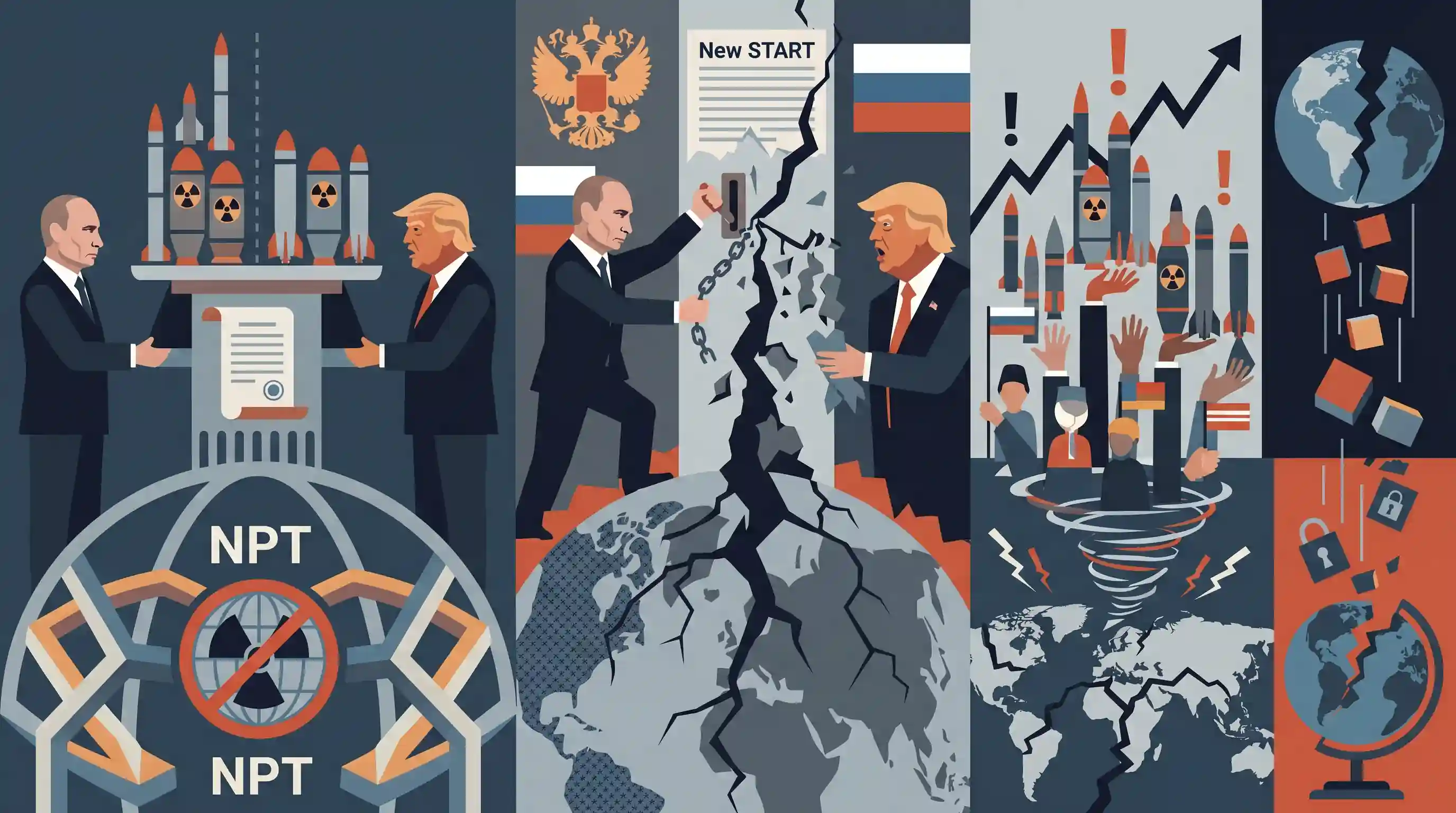
The article explores the evolving landscape of global nuclear arms control, centering on the impacts of Vladimir Putin and Donald Trump on key agreements. It highlights the critical role of the New START treaty in limiting the strategic nuclear arsenals of the US and Russia, and examines the implications of Russia suspending its participation. The piece also situates these bilateral tensions within the broader context of the Non-Proliferation Treaty (NPT), warning that the unravelling of these foundational pacts could destabilize global security and potentially trigger a new nuclear arms race.
Key Points
- The New START treaty is the last remaining bilateral nuclear arms control agreement between the US and Russia, capping the number of deployed strategic nuclear warheads.
- Recent geopolitical tensions, notably the suspension of Russia's participation by Vladimir Putin, have cast a shadow of uncertainty over the treaty's future.
- The Non-Proliferation Treaty (NPT) remains the foundational global framework for nuclear non-proliferation, disarmament, and peaceful use of nuclear energy, though it faces strains from big-power rivalry.
- The potential collapse of bilateral arms control regimes raises fears of a renewed nuclear arms race, fundamentally altering global strategic stability and security architecture.
Important Terms
New START Treaty

A 2011 bilateral agreement between the US and Russia limiting deployed strategic nuclear warheads and launchers. It expired in February 2026 following Russia's 2023 suspension amid tensions over the Ukraine conflict.
UPSC context
GS II: Bilateral agreements affecting India's interests; critical for understanding global nuclear stability and the breakdown of arms control architecture.
Non-Proliferation Treaty (NPT)
A 1970 international treaty aiming to prevent the spread of nuclear weapons, promote peaceful nuclear energy, and pursue disarmament. It classifies states as nuclear-weapon or non-nuclear-weapon states based on 1967 status.
UPSC context
GS II: Important international treaties; significant as India remains a non-signatory, citing the treaty's discriminatory nature regarding nuclear 'haves' and 'have-nots'.
Nuclear Suppliers Group (NSG)
A 48-nation export control regime regulating the transfer of nuclear materials and technology to prevent proliferation. It was formed in 1974 specifically in response to India’s first nuclear test.
UPSC context
GS II: Effect of policies of developed countries; India’s quest for membership is a key foreign policy objective to secure energy needs.
North Atlantic Treaty Organization (NATO)
A military alliance established in 1949 for collective defense. Its 'nuclear sharing' policy allows non-nuclear members to host U.S. nuclear weapons, serving as a core component of its deterrence strategy.
UPSC context
GS II: Global groupings and agreements; relevant for regional security dynamics and the geopolitical fallout of the Russia-Ukraine war on global stability.
International Atomic Energy Agency (IAEA)
An autonomous international organization that promotes the peaceful use of nuclear energy and verifies compliance with non-proliferation obligations through safeguards and on-site inspections of nuclear facilities.
UPSC context
GS II: Important international institutions; tests knowledge of the agency’s mandate in monitoring nuclear programs and its role in India's Civil Nuclear Deal.
Prelims Trap
Russia has formally withdrawn from the New START treaty, rendering it null and void.
Russia suspended its participation in 2023 (halting inspections/data sharing) but did not formally withdraw, pledging to still respect the numerical caps on warheads.
Static Concepts Connected
What is the NPT framework and why does India oppose it?
- Three pillars: It rests on three foundational principles: non-proliferation, disarmament, and the peaceful use of nuclear energy.
- P5 Monopoly: It legally recognizes only 5 countries (US, Russia, UK, France, China) as Nuclear-Weapon States based on an arbitrary pre-Jan 1, 1967 test cutoff date.
- India's stance: India refuses to sign, opposing the treaty as structurally discriminatory, permanently dividing the world into "nuclear haves" and "nuclear have-nots."
What are the core tenets of India's Nuclear Doctrine?
- No First Use (NFU): India will not be the first to use nuclear weapons, but retaliation to a first strike will be massive and designed to inflict unacceptable damage.
- Credible Minimum Deterrence: Maintaining a survivable nuclear arsenal sufficient to guarantee a devastating retaliatory strike, without engaging in a numerical arms race.
- Non-Nuclear States: India strictly pledges the non-use of nuclear weapons against non-nuclear weapon states.
Cross-Topic Patterns
NPT holdout + NSG India waiver exception
India’s unique 2008 NSG waiver allowed global nuclear commerce despite its NPT non-signatory status, frequently tested by UPSC as a testament to India's clean proliferation record.
Arms control collapse + Space militarization
The collapse of terrestrial bilateral treaties like New START and INF accelerates modern military pivots toward hypersonics and space-based ASAT weapons, threatening the outdated Outer Space Treaty.

Expect a 2026 prelims question contrasting New START (bilateral, suspended) with multilateral pacts like NPT/TPNW and India's exact status.
Linked PYQs · 4
Linked PYQs · 4
- 2011PrelimsGS1
The "New START" treaty was in the news. What is this treaty?
- 2015PrelimsGS1
Consider the following countries: 1. China 2. France 3. India 4. Israel 5. Pakistan Which among the above are Nuclear Weapons States as recognized by the Treaty on the Non-Proliferation of Nuclear Weapons, commonly known as Nuclear Non-Proliferation Treaty (NPT)?
- 2018PrelimsGS1
What is/are the consequence/consequences of a country becoming the member of the 'Nuclear Suppliers Group'? 1. It will have access to the latest and most efficient nuclear technologies. 2. It automatically becomes a member of "The Treaty on the Non-Proliferation of Nuclear Weapons (NPT)". Which of the statements given above is/are correct?
- 2025MainsGS2
"The reform process in the United Nations remains unresolved, because of the delicate imbalance of East and West and entanglement of the USA vs. Russo-Chinese alliance.” Examine and critically evaluate the East-West policy confrontations in this regard.
