Tribal Welfare Schemes And Sickle Cell Mission Initiatives
Source:Indian Express ↗
Why It Matters
Questions on government initiatives, particularly for vulnerable groups like PVTGs and specific health missions such as sickle cell elimination, frequently feature in Prelims and Mains GS2.
Summary
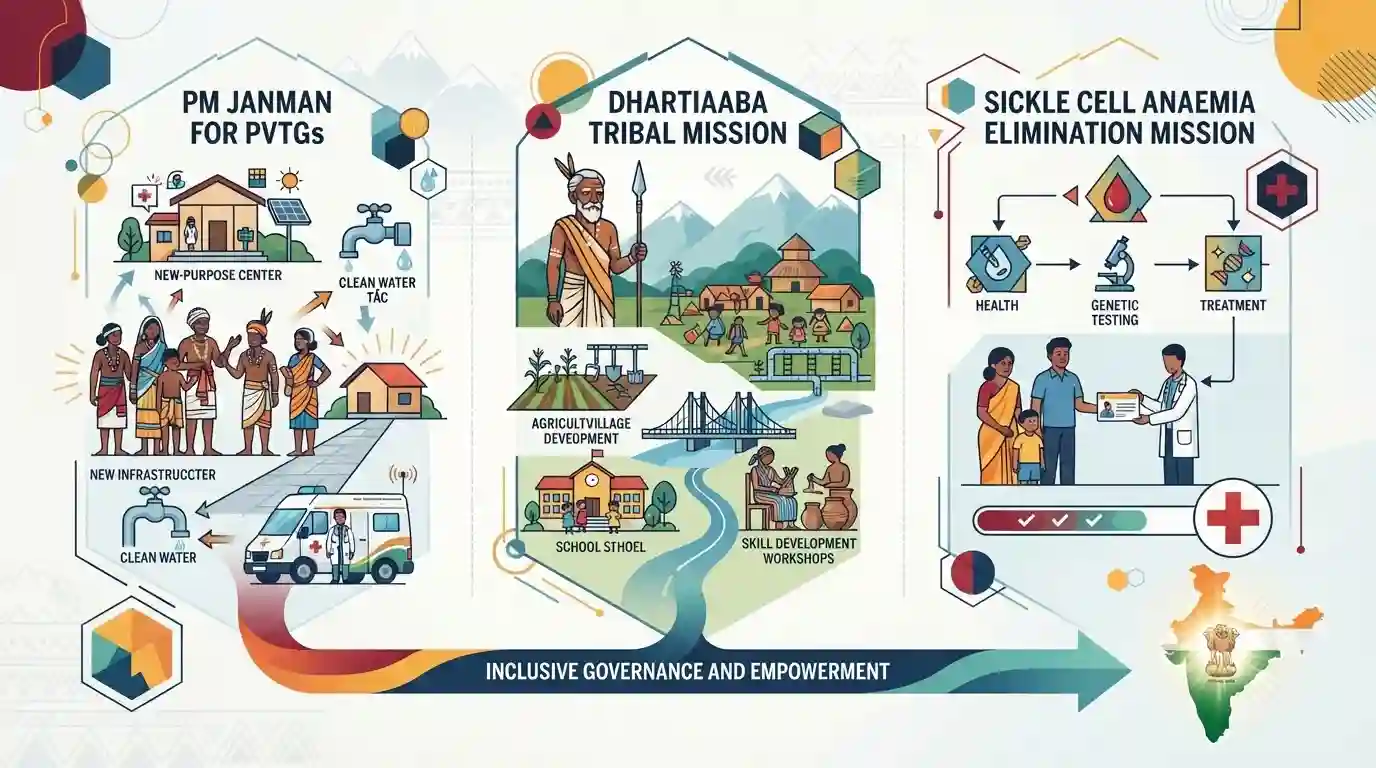
An overview of key central welfare schemes targeting tribal development in India, including PM JANMAN for Particularly Vulnerable Tribal Groups (PVTGs), the Dhartiaaba Tribal Mission, and the Sickle Cell Anaemia Elimination Mission, highlighting their core objectives, health goals, and significance for inclusive governance.
Key Points
- PM JANMAN focuses on holistic development and basic amenities for Particularly Vulnerable Tribal Groups (PVTGs).
- Dhartiaaba Tribal Mission targets comprehensive saturation of development schemes in tribal villages.
- Sickle Cell Anaemia Elimination Mission aims to eliminate sickle cell genetic disease as a public health problem by 2047, with a special focus on tribal areas.
- These interventions aim to address systemic health, education, and livelihood gaps among vulnerable indigenous communities in India.
Important Terms
PM JANMAN

A special central scheme launched to socio-economically uplift Particularly Vulnerable Tribal Groups (PVTGs) by providing critical interventions like housing, clean water, healthcare, and education across multiple line ministries.
UPSC context
GS Paper II (Welfare Schemes for Vulnerable Sections) and GS Paper I (Scheduled Tribes). Tests understanding of targeted developmental interventions for marginalized groups.
Dharti Aaba Tribal Mission
A comprehensive central mission focused on closing infrastructure gaps in tribal villages and ensuring total saturation of welfare schemes and entitlements for tribal populations across India.
UPSC context
GS Paper II (Social Sector & Welfare Schemes) and GS Paper I (Issues related to Scheduled Tribes). Important for questions on rural and tribal infrastructure development.
Sickle Cell Anaemia Elimination Mission
A national health initiative launched to eliminate sickle cell disease as a public health problem by 2047, focusing on universal screening, early diagnosis, and management, especially in tribal areas.
UPSC context
GS Paper II (Health Sector Development & Vulnerable Sections). Tests policies addressing genetic health burdens specific to marginalized tribal communities.
Ministry of Tribal Affairs
The apex central government ministry in India responsible for formulating policies, planning, and coordinating programs for the socio-economic development of Scheduled Tribes.
UPSC context
GS Paper II (Governance and Statutory Bodies). Tests knowledge of institutional frameworks dedicated to tribal welfare and administrative accountability.
Static Concepts Connected
What are the criteria for identifying Particularly Vulnerable Tribal Groups (PVTGs) in India?
- Technology level: Pre-agricultural level of technology.
- Population trend: Stagnant or declining population growth.
- Literacy rate: Extremely low levels of literacy compared to other tribal groups.
- Economic base: Subsistence level of economy relying on food gathering or hunting.
Cross-Topic Patterns
Tribal Welfare & Public Health Convergence
Tribal health interventions intersect with the National Health Mission and constitutional provisions like Article 275(1) and the Fifth/Sixth Schedules for decentralized governance.
Saturation Governance & Multi-Ministerial Convergence
PM-JANMAN and DAJGUA reflect a shift from fragmented sectoral outlays to saturation-based saturation models across multiple central ministries.

Expect statement-based questions pairing PVTG identification criteria (Dhebar Commission) with specific 2047 targets for sickle cell elimination.
Linked PYQs · 3
Linked PYQs · 3
- 2019PrelimsGS1
Consider the following statements about Particularly Vulnerable Tribal Groups (PVTGs) in India : 1. PVTGs reside in 18 States and one Union Territory. 2. A stagnant or declining population is one of the criteria for determining PVTG status. 3. There are 95 PVTGS officially notified in the country so far. 4. Irular and Konda Reddi tribes are included in the list of PVTGs. Which of the statements given above are correct?
- 2021PrelimsGS1
At the national level, which ministry is the nodal agency to ensure effective implementation of the Scheduled Tribes and Other Traditional Forest Dwellers (Recognition of Forest Rights) Act, 2006?
- 2026PrelimsGS1
Consider the following statements about the provisions pertaining to the Scheduled Castes and the Scheduled Tribes in India : 1. Provisions regarding the administration of the Tribal Areas in the States of Assam, Meghalaya, Tripura and Mizoram are given in the Fifth Schedule of the Constitution of India. 2. Some tribes of India are entitled to exemption from paying Income Tax on certain incomes. 3. The Constitution of India provides for reservation of seats in Panchayats for women belonging to the Scheduled Castes and the Scheduled Tribes. Which one of the following conclusions based on the above statements is correct ?
