National Cooperative Policy 2025 and Rural Development
Source:Indian Express ↗
Why It Matters
Cooperatives are an explicit part of the UPSC syllabus (GS2: Role of NGOs, SHGs, various groups/associations, donors, charities, institutional and other stakeholders; GS3: Inclusive growth, Agriculture). The recent formation of the Ministry of Cooperation and the launch of this specific 2025 policy makes the sector a high-probability area for questions concerning rural development, agricultural credit (PACS), and the constitutional status of cooperatives (97th Amendment).
Summary
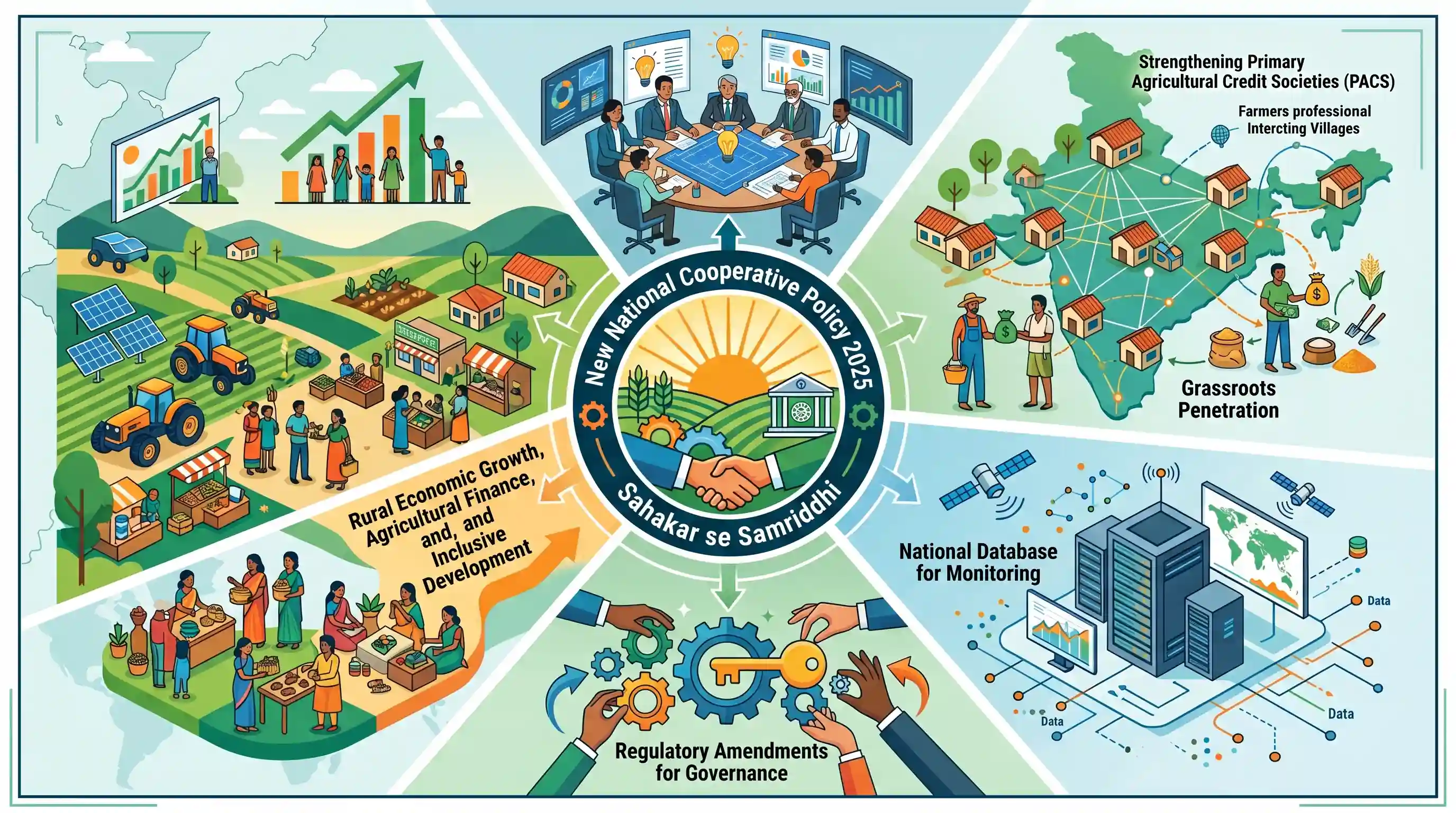
The article details the New National Cooperative Policy 2025, exploring its mission to revitalize and expand India's cooperative sector under the overarching theme of 'Sahakar se Samriddhi'. Prepared by a committee led by Suresh Prabhu, the policy focuses on deepening cooperative penetration at the grassroots level, specifically by strengthening Primary Agricultural Credit Societies (PACS). It calls for a national database for improved monitoring, regulatory amendments for better governance, and leveraging cooperatives as a vital engine for rural economic growth, agricultural finance, and inclusive socio-economic development.
Key Points
- Guided by the vision of 'Sahakar se Samriddhi' (Prosperity through Cooperation), the policy aims to drive a cooperative-based economic development model in India.
- Drafted by a national-level committee headed by Suresh Prabhakar Prabhu under the relatively new Ministry of Cooperation.
- Prioritizes the strengthening and digitization of Primary Agricultural Credit Societies (PACS) to expand cooperative credit networks to all uncovered villages and panchayats.
- Proposes the creation of a comprehensive National Cooperative Database to facilitate data-driven policy planning, monitor sector growth, and ensure transparent governance.
- Focuses on updating regulatory frameworks, including amendments to the Multi-State Co-operative Societies Act, to enhance accountability and operational efficiency across cooperative institutions.
- Aims to closely integrate cooperative societies with agriculture and rural development strategies, fostering financial inclusion and robust rural value chains.
Important Terms
New National Cooperative Policy 2025

A strategic roadmap replacing the 2002 framework to modernize India's cooperative sector. It aims for 'Sahkar se Samriddhi' by strengthening grassroots institutions like PACS and expanding into emerging sectors.
UPSC context
GS Paper 2 & 3: Government policies for rural development and inclusive growth through the 'Sahkar se Samriddhi' vision.
97th Constitutional Amendment Act
Enacted in 2011, it granted constitutional status to cooperatives, adding Part IXB, Article 43B (DPSP), and making the right to form cooperatives a Fundamental Right under Article 19(1)(c).
UPSC context
GS Paper 2: Landmark constitutional provisions and judicial reviews (e.g., Supreme Court's ruling on state vs. multi-state cooperatives).
Ministry of Cooperation
Established in July 2021 to provide a dedicated administrative, legal, and policy framework for strengthening the cooperative movement and facilitating 'Ease of Doing Business' for cooperatives.
UPSC context
GS Paper 2: Institutional framework and governance; reflects the government's shift toward community-based developmental partnerships.
Primary Agricultural Credit Societies (PACS)
Grassroots-level cooperative credit institutions providing short and medium-term agricultural loans to farmers. They serve as the final link in the three-tier short-term cooperative credit structure.
UPSC context
GS Paper 3: Agricultural finance and rural economy; critical for financial inclusion and credit delivery to small farmers.
Multi-State Co-operative Societies Act
A central legislation governing cooperative societies with operations in more than one state. Recent 2023 amendments enhanced transparency, electoral reforms, and governance via a Cooperative Election Authority.
UPSC context
GS Paper 2: Regulatory framework for associations; tests knowledge of central vs. state jurisdiction in the cooperative sector.
Urban Cooperative Banks (UCBs)
Member-owned financial institutions in urban/semi-urban areas regulated by a dual framework: RBI for banking functions and the Registrar of Cooperative Societies for administrative management.
UPSC context
GS Paper 3: Indian Economy and banking structure; specifically the 2020 amendments granting RBI greater supervisory control.
Prelims Trap
"The Ministry of Cooperation directly regulates all primary cooperative societies across India."
Cooperative societies are a State subject (Entry 32 of State List). The Union Ministry of Cooperation only regulates Multi-State Cooperative Societies (Union List Entry 44).
Static Concepts Connected
How does the Constitution recognize and protect Cooperative Societies?
- Fundamental Right: Article 19(1)(c) guarantees the right to form cooperative societies, added by the 97th Constitutional Amendment Act (2011).
- Directive Principle (DPSP): Article 43B directs the State to promote voluntary formation, autonomous functioning, and democratic control of cooperatives.
- Part IX-B: Articles 243ZH to 243ZT dictate terms for incorporation, board elections, and governance of cooperatives.
What is the structural role of Primary Agricultural Credit Societies (PACS)?
- Lowest Tier: PACS form the grassroots tier of the short-term cooperative credit structure, below District Central Cooperative Banks (DCCBs) and State Cooperative Banks (StCBs).
- Direct Interface: They deal directly with rural borrowers, providing short-term crop loans and distributing agricultural inputs like fertilizers and seeds.
- Multipurpose Shift: New policies aim to convert PACS into multipurpose entities, allowing them to function as Common Service Centres (CSCs) and fair price shops.
Cross-Topic Patterns
PACS + Decentralized Grain Storage
PACS are now central to the 'World's Largest Grain Storage Plan', linking rural credit institutions directly to food security and decentralized MSP procurement infrastructure.
Cooperatives + FPO Convergence
The drive to establish 2 lakh new multipurpose PACS heavily intersects with the 10,000 FPOs scheme, creating overlapping nodes for agricultural marketing and value addition.

Expect a multi-statement question in 2026 linking the structural role of PACS with the 97th Amendment and the 2021 SC ruling on Part IX-B.
Linked PYQs · 4
Linked PYQs · 4
- 2021PrelimsGS1
With reference to Urban Cooperative Banks' in India, consider the following statements : 1. They are supervised and regulated by local boards set up by the State Governments. 2. They can issue equity shares and preference shares. 3. They were brought under the purview of the Banking Regulation Act, 1949 through an Amendment in 1966. Which of the statements given above is/are correct?
- 2014MainsGS3
In the villages itself no form of credit organization will be suitable except the cooperative society. -All India Rural Credit Survey. Discuss this statement in the background of agricultural finance in India. What constraints and challenges do financial institutions supplying agricultural finance face? How can technology be used to better reach and serve rural clients?
- 2017MainsGS2
The emergence of the Self-Help Groups (SHGs) in contemporary times points to the slow but steady withdrawal of the State from developmental activities." Examine the role of the SHGs in developmental activities and the measures taken by the Government of India to promote the SHGs.
- 2014MainsGS2
The penetration of Self Help Groups (SHGs) in rural areas in promoting participation in development programmes is facing socio-cultural hurdles. Examine.
