UNEP Assessment on Global Temperature Overshoot Risks
Source:Indian Express ↗
ఇది ఎందుకు ముఖ్యం
Understanding climate overshoot and emissions targets is critical for aspirants studying global environmental governance, international climate negotiations (COP), and sustainable development strategies.
సారాంశం
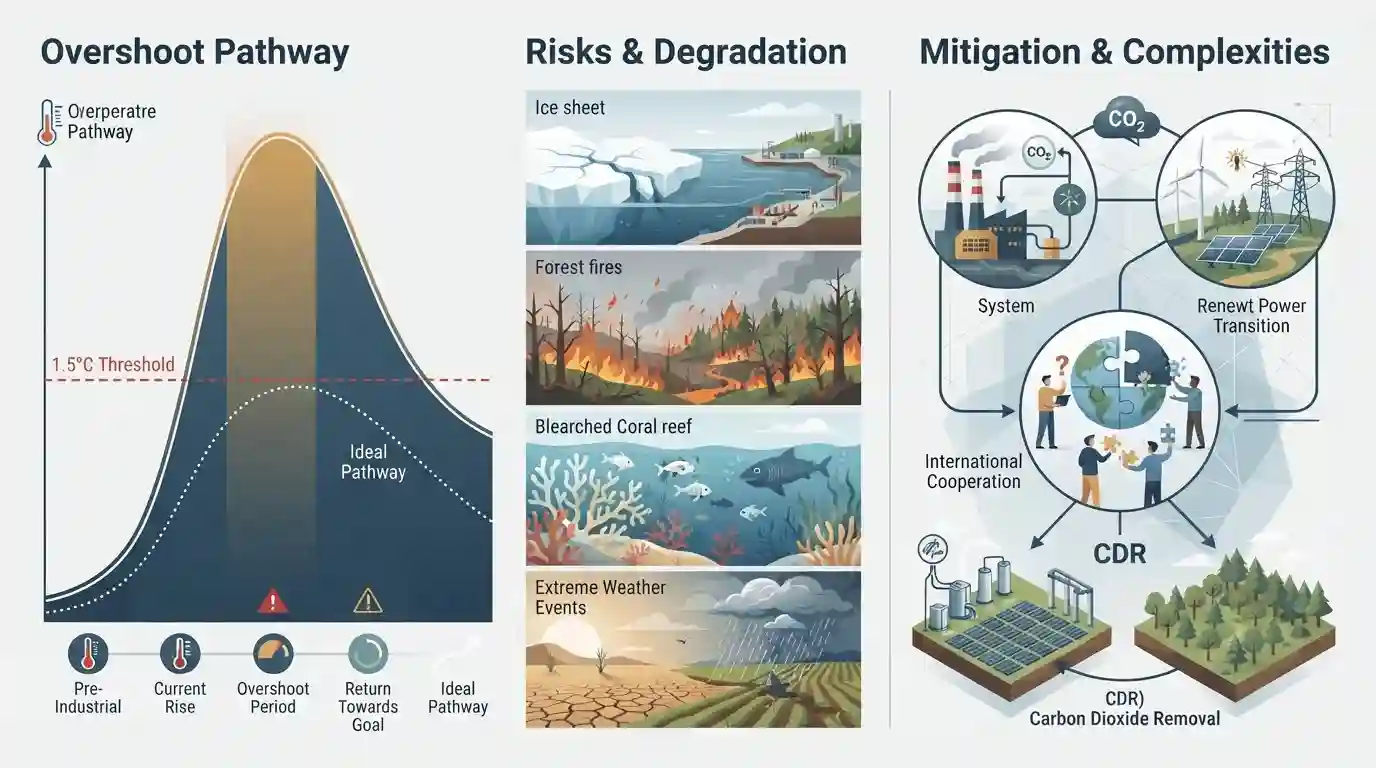
The article discusses the concept of climate overshoot, where global temperature increases exceed the 1.5°C threshold stipulated under the Paris Agreement. Drawing on insights typically highlighted by bodies like the United Nations Environment Programme (UNEP), it explores the risks, complexities, and mitigation challenges involved when global warming breaches critical safety limits.
ముఖ్య అంశాలు
- The concept of climate 'overshoot' refers to a temporary or extended period where global temperature increases exceed the 1.5°C threshold above pre-industrial levels before attempting to bring them back down through carbon dioxide removal (CDR).
- Reports by organizations like the United Nations Environment Programme (UNEP) highlight the severe risks, irreversible impacts, and tipping points associated with any temperature overshoot.
- Relying heavily on future unproven carbon removal technologies creates immense ecological and governance risks rather than prioritizing immediate, aggressive emission reductions.
ముఖ్యమైన పదాలు
Paris Agreement

A legally binding international treaty on climate change adopted in 2015 at COP21, aiming to limit global warming to well below 2°C, preferably 1.5°C, compared to pre-industrial levels.
UPSC context
UPSC Prelims/Mains (GS Paper III): Key global environmental agreement, NDCs, climate change goals, and international negotiations.
United Nations Environment Programme (UNEP)
A specialized agency of the United Nations established in 1972 that coordinates global environmental policies, promotes sustainable development, and publishes influential reports like the Emissions Gap Report.
UPSC context
UPSC Prelims: International organizations, environmental bodies, and global reports on climate and pollution.
IPCC
The Intergovernmental Panel on Climate Change is the UN body established in 1988 to assess climate science, providing policymakers with authoritative scientific evaluations on climate change impacts and risks.
UPSC context
UPSC Prelims/Mains (GS Paper III): Core scientific body informing global climate policy, assessment reports, and climate science fundamentals.
అనుసంధానమైన స్థిర భావనలు
What are the key mechanisms and limitations of Carbon Dioxide Removal (CDR) technologies under international climate frameworks?
- Conventional CDR: Conventional methods include afforestation, reforestation, and soil carbon sequestration, which have lower cost but face land-use competition and permanence risks.
- Novel Technologies: Novel methods include Direct Air Capture with Carbon Storage (DACCS) and Bioenergy with Carbon Capture and Storage (BECCS), facing high energy penalties and immature scale.
- Mitigation Risk: IPCC models note that heavy reliance on unproven CDR creates moral hazard and delays immediate fossil fuel phase-out.
అంతర-అంశ నమూనాలు
Carbon Removal vs Fiscal Deficits
Coupling net-zero targets with unproven CDR tech tests fiscal sustainability and capital allocation priorities in central bank climate risk assessments.
Climate Litigation & State Liability
UNEP emission gap reports interface with international climate law and state responsibility under customary international law for irreversible loss and damage.

UNEP overshoot reports + CDR limits + tipping points will likely feature in a multi-statement environment prelims question.
అనుసంధాన PYQలు · 3
అనుసంధాన PYQలు · 3
- 2025MainsGS3
Write a review on India's climate commitments under the Paris Agreement (2015) and mention how these have been further strengthened in COP26 (2021). In this direction, how has the first Nationally Determined Contribution intended by India been updated in 2022?
- 2022MainsGS3
Discuss global warming and mention its effects on the global climate. Explain the control measures to bring down the level of greenhouse gases which cause global warming, in the light of the Kyoto Protocol, 1997.
- 2022PrelimsGS1
"Climate Action Tracker" which monitors the emission reduction pledges of different countries is a :
