Madhav National Park designated as India's 58th tiger reserve
Source:Indian Express ↗
Why It Matters
Important for Prelims questions on newly declared tiger reserves, national parks, wildlife corridors, and Ramsar wetland sites in India.
Summary
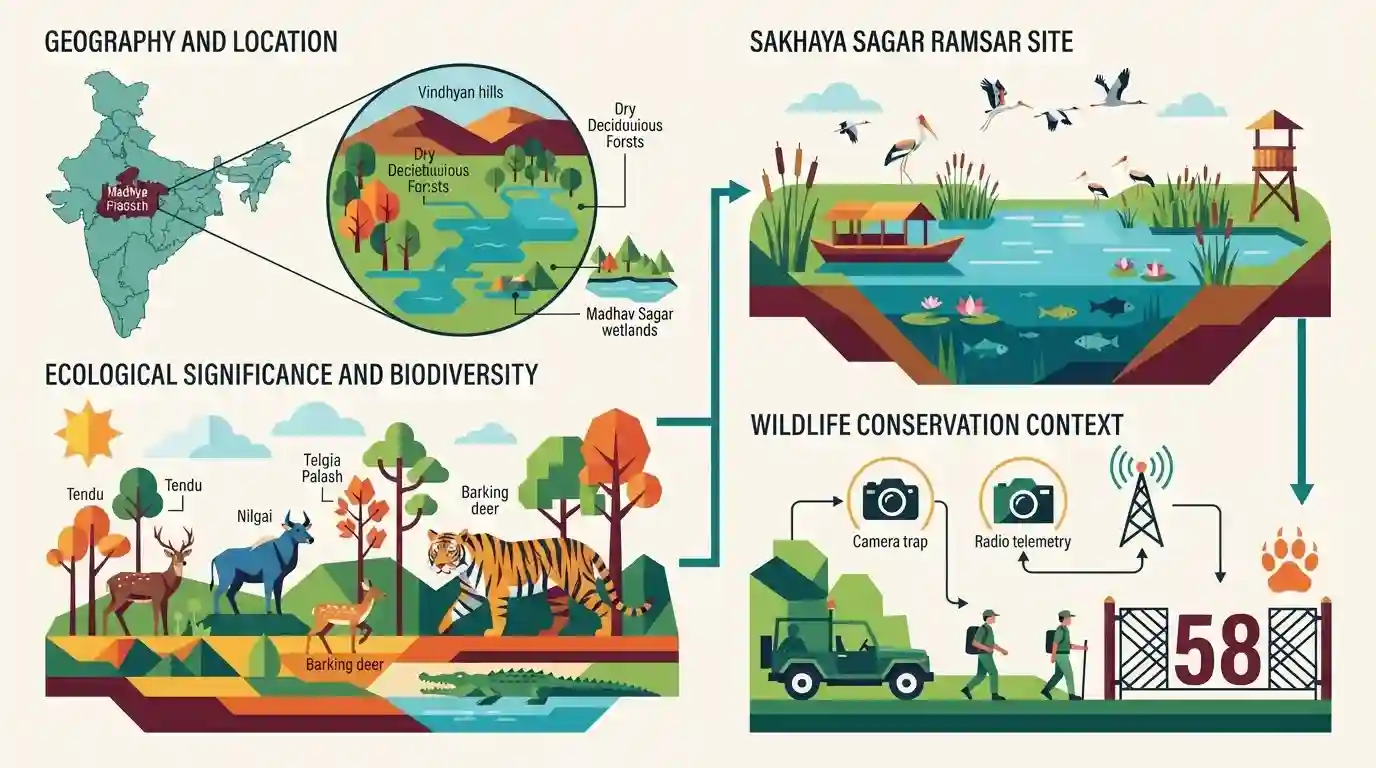
The article discusses the designation of Madhav National Park in Madhya Pradesh as India's 58th Tiger Reserve, highlighting its geography, ecological significance, Sakhya Sagar Ramsar site, and wildlife conservation context.
Key Points
- Madhav National Park in Madhya Pradesh has been designated as India's 58th Tiger Reserve by the NTCA.
- The reserve features Sakhya Sagar, an artificial lake established in 1918 on the Manier River, which is designated as a Ramsar site.
- Madhya Pradesh holds a prominent position with multiple tiger reserves, continuing its role as the 'Tiger State' of India.
- Important geographical and ecological features include wildlife corridors, historical monuments within the park, and successful tiger reintroduction initiatives.
Important Terms
Wild Life (Protection) Act, 1972

India's primary statutory legislation enacted in 1972 providing frameworks for the protection of wild animals, birds, and plants, establishing protected areas, and regulating hunting and trade.
UPSC context
UPSC Prelims/Mains (GS Paper III): Essential biodiversity legislation frequently tested for protected area categories, schedules, and conservation mechanisms.
Ramsar Convention
An intergovernmental treaty adopted in 1971 for the conservation and wise use of wetlands and their resources, recognizing their ecological significance globally.
UPSC context
UPSC Prelims/Mains (GS Paper III): Crucial for environmental conventions, wetland ecosystem management, and India's designated Ramsar sites.
National Tiger Conservation Authority (NTCA)
A statutory body established under the Wildlife (Protection) Act, 1972, tasked with strengthening tiger conservation, overseeing Project Tiger, and managing tiger reserves.
UPSC context
UPSC Prelims/Mains (GS Paper III): Tests knowledge of statutory bodies, wildlife management, and Project Tiger initiatives.
Static Concepts Connected
What is the statutory backing, composition, and mandate of the National Tiger Conservation Authority (NTCA)?
- Statutory Basis: Statutory Body: Established in December 2005 under the Wildlife (Protection) Act, 1972, following recommendations of the Tiger Task Force.
- Composition: Composition: Chaired by the Union Minister for Environment, Forest and Climate Change, with an expert Vice-Chairperson and various official and non-official members.
- Core Mandate: Mandate: Approving tiger conservation plans, providing statutory authority to Project Tiger, ensuring normative standards, and addressing livelihood concerns of local people.
Cross-Topic Patterns
Tiger Corridors & Project Cheetah Logistical Links
The establishment of Madhav as a vital corridor between Ranthambore and Kuno links tiger conservation directly with trans-state cheetah reintroduction logistics under Project Cheetah.

Expect a match-the-following or statement-based question on Madhya Pradesh tiger reserves, Ramsar sites, and statutory status of NTCA.
Linked PYQs · 2
Linked PYQs · 2
- 2026PrelimsGS1
With reference to Madhav National Park, which of the following statements is/are correct ? 1. It was declared a Tiger Reserve in India in 2025. 2. Sakhya Sagar, which is designated as a Ramsar Site, is situated within this National Park. 3. Its area is shared between Madhya Pradesh and Rajasthan. Select the answer using the code given below :
- 2020PrelimsGS1
Among the following Tiger Reserves, which one has the largest area under "Critical Tiger Habitat"?
