India Semiconductor Mission Evolution and Strategic Significance
Source:Indian Express ↗
Why It Matters
Semiconductor manufacturing is critical for India's technological sovereignty, economic growth, and strategic self-reliance. Questions frequently target industrial policy frameworks like ISM and the challenges of high-tech manufacturing in India.
Summary
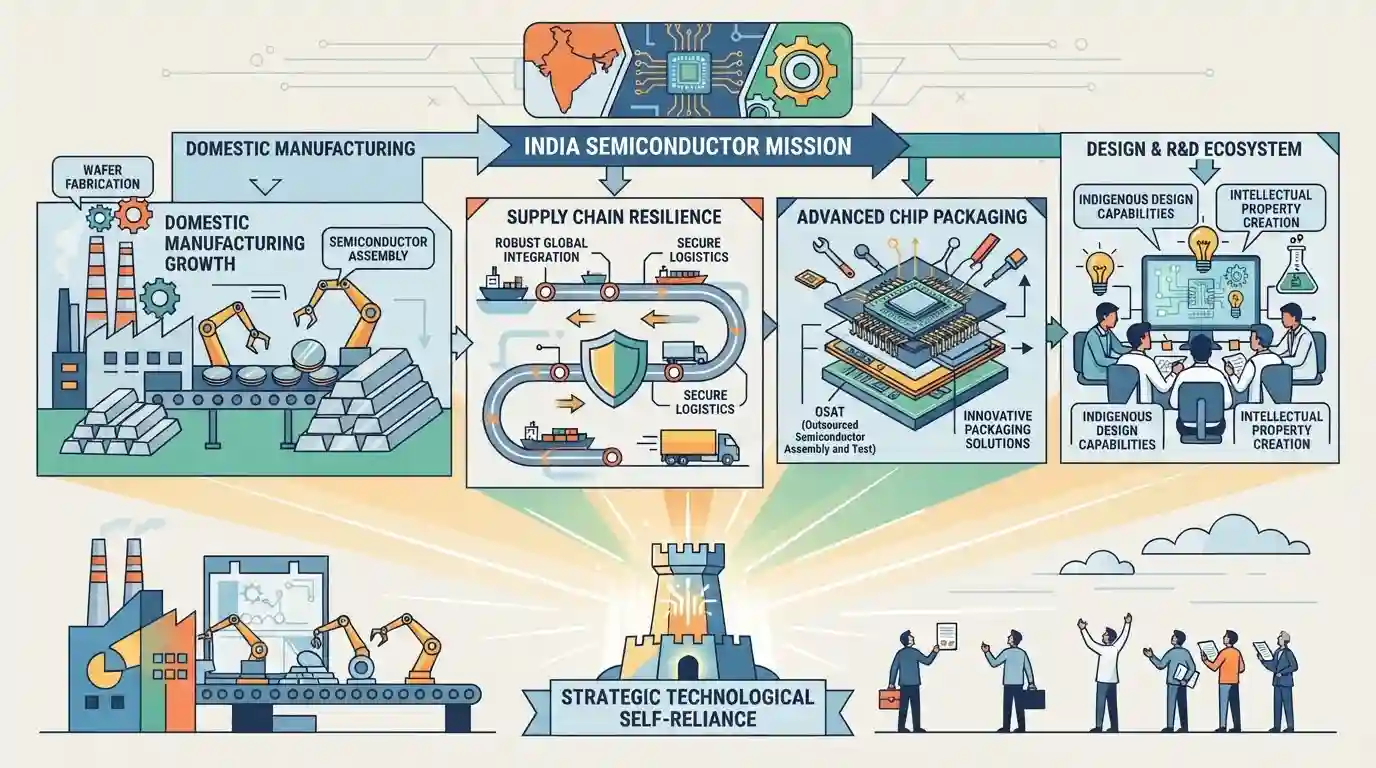
An overview of the India Semiconductor Mission (ISM) and its next phase, focusing on boosting domestic manufacturing, supply chain resilience, advanced chip packaging, design, and strategic technological self-reliance for UPSC aspirants.
Key Points
- India Semiconductor Mission (ISM) aims to establish a comprehensive semiconductor and display ecosystem in the country.
- ISM 2.0 focuses on expanding support to compound semiconductors, packaging, sensor technologies, and design infrastructure.
- Critical challenges include high capital intensity, supply chain vulnerabilities, water and power requirements, and specialized talent shortage.
- Strategic importance spans across national security, self-reliance (Aatmanirbhar Bharat), and reducing import dependence on electronics.
Important Terms
India Semiconductor Mission

A specialized division within the Ministry of Electronics and Information Technology (MeitY) designed to build a vibrant semiconductor and display ecosystem in India, driving domestic manufacturing and technological self-reliance.
UPSC context
Important for GS Paper III (Science & Technology, Industrial Policy) to test understanding of government initiatives promoting high-tech manufacturing and supply chain resilience.
India Semiconductor Mission 2.0
The enhanced subsequent phase of India's flagship semiconductor initiative aimed at expanding support to advanced packaging, equipment, raw materials, specialty gases, R&D, and skilling.
UPSC context
Relevant for GS Paper III under industrial growth, indigenization of critical technology, and strategic electronics policies.
Ministry of Electronics and Information Technology
The nodal central government ministry responsible for policy formulation, promotion of electronics, and implementation of digital governance and technology missions like the ISM in India.
UPSC context
Crucial for GS Paper II and III regarding government ministries, administrative setup, and execution of national digital and technological strategies.
Static Concepts Connected
What are the core stages of the semiconductor manufacturing value chain?
- Chip Design: Conception of electronic circuits using Electronic Design Automation (EDA) software and creation of indigenous Intellectual Property (IP).
- Front-End Fabrication: Manufacturing ultra-pure silicon ingots, slicing them into wafers, and etching microscopic circuits using photolithography in a cleanroom Fab.
- Back-End Assembly: Testing, marking, and packaging the separated chips (OSAT/ATMP) to protect them and enable integration onto circuit boards.
Cross-Topic Patterns
Semiconductors + Infrastructure & Water Stress
Semiconductor fabrication requires millions of gallons of ultra-pure water and uninterrupted power, testing India's green energy targets and municipal water management infrastructure simultaneously.
ISM + PLI Schemes & Supply Chain Resilience
The push for domestic chip manufacturing aligns with the Production-Linked Incentive (PLI) schemes across electronics, solar PV, and critical minerals to insulate supply chains from geopolitical shocks.

Expect statement-based questions on ISM 2.0 pillars, distinguishing between ATMP/OSAT packaging and front-end fabrication fabs.
Linked PYQs · 3
Linked PYQs · 3
- 2025MainsGS3
India aims to become a semiconductor manufacturing hub. What are the challenges faced by the semiconductor industry in India? Mention the salient features of the India Semiconductor Mission.
- 2026PrelimsGS1
Which one of the following pairs of semiconductor plants in India and their locations is not correctly matched ?
- 2026PrelimsGS1
Which of the following statements about DHRUV64 is/are correct? 1. It is the third chip fabricated under the DIR-V Programme with an overall aim to enable the creation of microprocessors for India. 2. It is India's first homegrown 1.0 GHz, 64-bit dual-core microprocessor. Select the answer using the code given below :
