Global Carbon Budget and Emission Assessment for Climate Action
Source:Indian Express ↗
Why It Matters
Understanding the Global Carbon Budget is vital for UPSC aspirants studying international climate reports, carbon sinks, emission trends, and India's position on global climate governance.
Summary
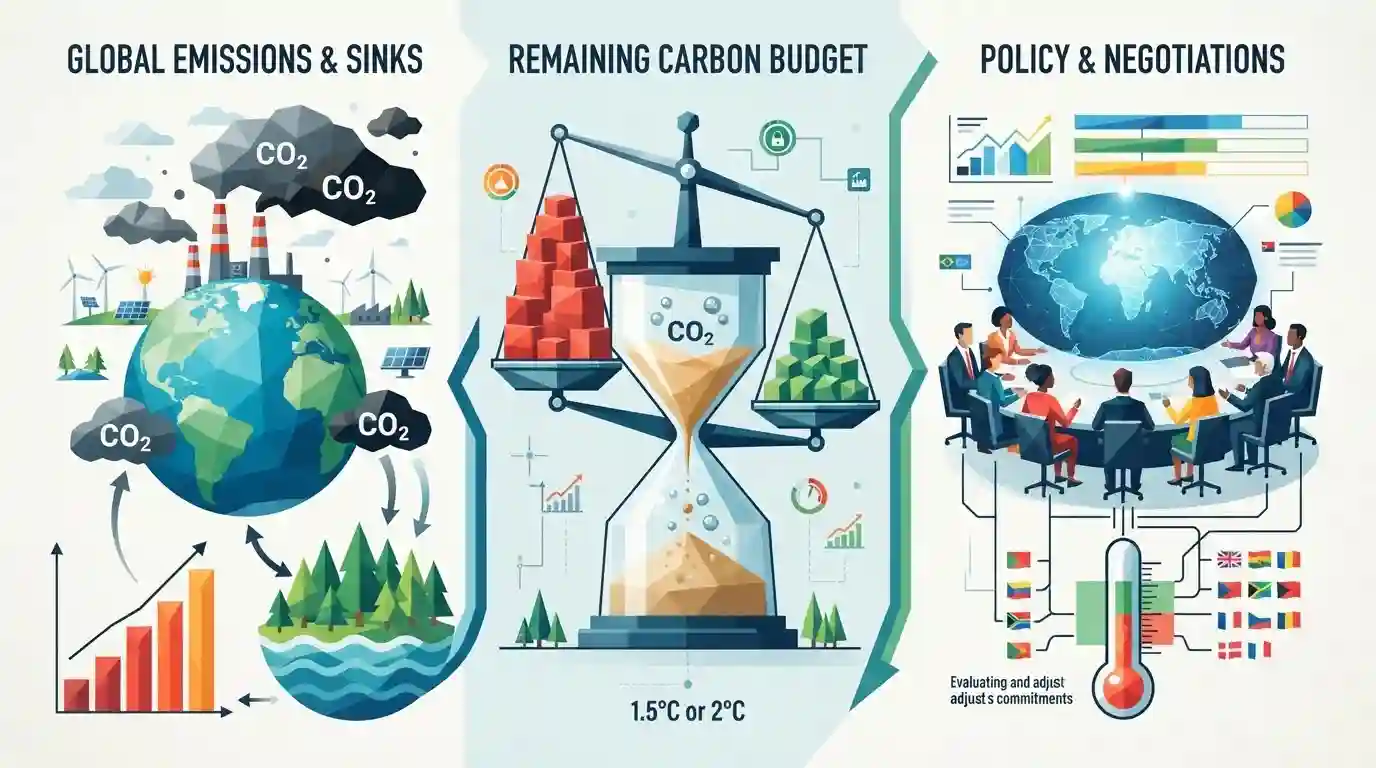
The article discusses the Global Carbon Budget, an essential scientific assessment providing critical updates on global greenhouse gas emissions, carbon sinks, and remaining carbon budgets. It explores how these emissions assessments inform global climate negotiations, monitor progress under the Paris Agreement, and help policymakers evaluate national commitments against necessary trajectories to combat global warming.
Key Points
- The Global Carbon Budget is an annual assessment tracking global greenhouse gas emissions and sinks.
- It provides crucial scientific data on carbon dioxide emissions from fossil fuels and land-use changes.
- The report helps evaluate global progress toward meeting the goals of the Paris Agreement.
- It highlights critical gaps between national climate pledges and the actual emissions trajectory required to limit global warming.
Prelims Trap
The Global Carbon Budget report is formally published and authored by the Intergovernmental Panel on Climate Change (IPCC).
The Global Carbon Budget is published by the Global Carbon Project (an international science team), not directly authored as an official negotiating document by the UNFCCC or IPCC itself, though it informs them.
Static Concepts Connected
What are the primary natural carbon sinks and how do they function under climate stress?
- Ocean Sinks: Oceans absorb roughly a quarter of anthropogenic CO2, leading to ocean acidification and declining absorption efficiency under warming waters.
- Land Sinks: Terrestrial ecosystems absorb carbon via photosynthesis and soil storage, but droughts, wildfires, and deforestation convert them from sinks to net sources.
- Feedback Risks: Warming-induced positive feedback loops progressively weaken the capacity of both oceanic and terrestrial sinks.
Cross-Topic Patterns
Carbon Budget + UNFCCC Global Stocktake
Global Carbon Budget findings directly feed into the UNFCCC Global Stocktake, linking empirical emissions science with mandatory periodic review mechanisms under international climate law.
Natural Sinks + Planetary Boundaries + EIA
The degradation of ocean and land carbon sinks illustrates the intersection of climate science with planetary boundaries and domestic environmental impact assessments.

Global Carbon Budget metrics, natural sink saturation, and remaining carbon quotas frequently appear in multi-statement climate prelims.
Linked PYQs · 3
Linked PYQs · 3
- 2025PrelimsGS1
Consider the following statements : I. Carbon dioxide (CO2) emissions in India are less than 0.5 t CO2/ capita. II. In terms of CO2 emissions from fuel combustion, India ranks second in Asia-Pacific region. III. Electricity and heat producers are the largest sources of CO2 emissions in India. Which of the statements given above is/are correct?
- 2026PrelimsGS1
Consider the following statements with reference to India's response to climate change : I. India's Long-Term Low Emission Development Strategy (LT-LEDS) is a crucial tool for achieving net-zero emissions by 2070. II. India's 4th Biennial Update Report (BUR-4) submitted in December, 2024 recorded around 8% decrease in Greenhouse gas emissions in 2020 over 2019. III. Climate-resilient development necessarily depends on quick and short-term achievement of emission reduction targets. Which of the following relationships among the above statements is/are correct ? 1. Statement I is empirically supported by statement II. 2. Statement III contradicts the approach implicit in statement I. 3. Statement I and statement III together establish the premise of long-term sustainability. Select the answer using the code given below :
- 2025MainsGS3
Write a review on India's climate commitments under the Paris Agreement (2015) and mention how these have been further strengthened in COP26 (2021). In this direction, how has the first Nationally Determined Contribution intended by India been updated in 2022?
