Economic Survey 2025-26 Highlights Macroeconomic Trends
Source:Indian Express ↗
Why It Matters
The Economic Survey is a foundational document for UPSC preparation. It provides official economic data, analyzes government policies, and highlights future economic challenges, forming the basis for numerous Prelims and Mains (GS3) questions on Indian economy and development.
Summary
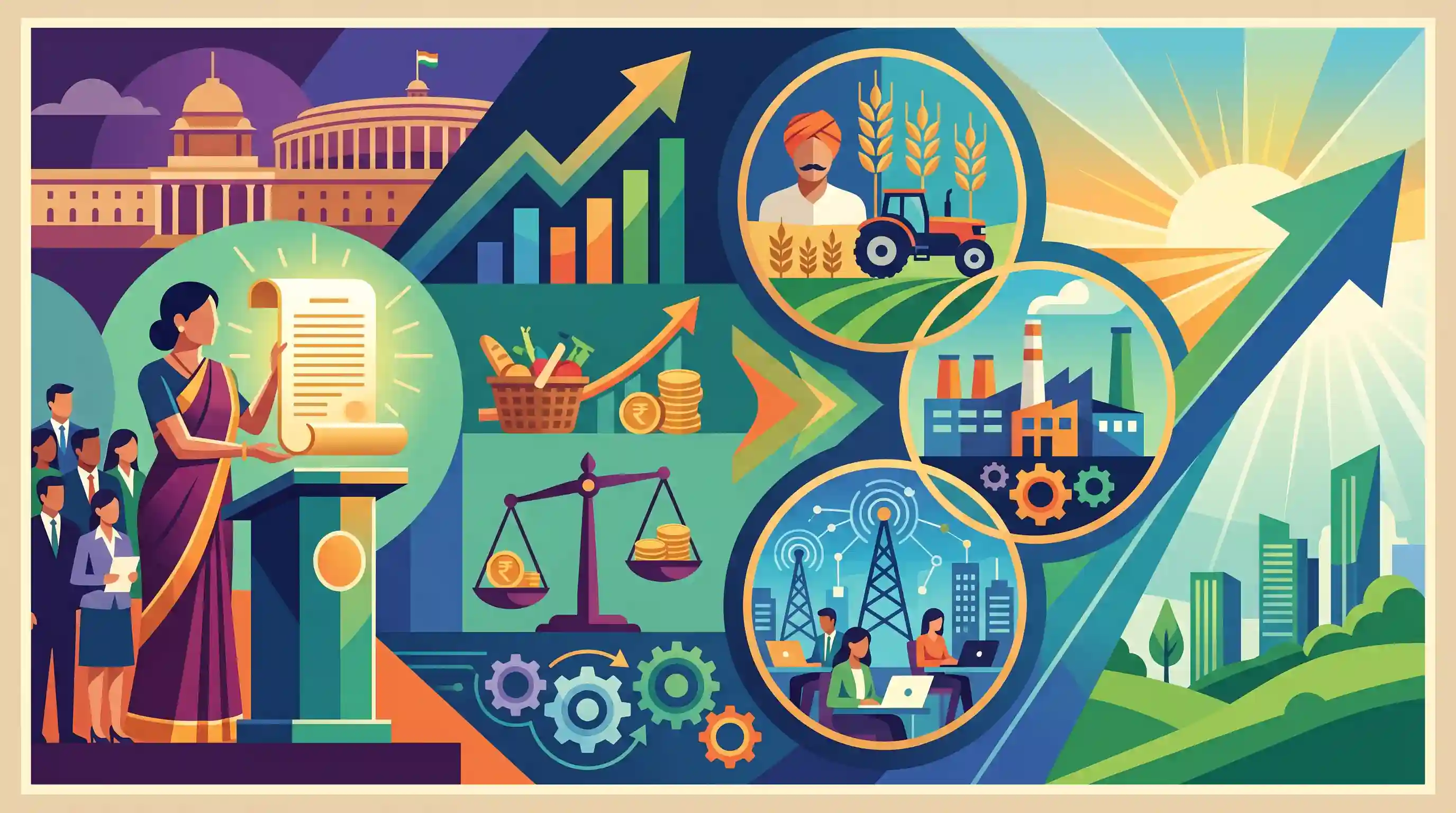
This 'Knowledge Nugget' provides UPSC aspirants with key takeaways from the Economic Survey 2025-26. Tabled by the Finance Minister and prepared by the Department of Economic Affairs, the survey reviews the macroeconomic stability of India. It assesses vital parameters such as GDP growth, inflation, and fiscal deficit, while evaluating the performance of core sectors like agriculture, industry, and services to outline the future growth trajectory of the Indian economy.
Key Points
- The Economic Survey 2025-26 was tabled in Parliament, providing a comprehensive assessment of the Indian economy's performance over the past year.
- Prepared by the Economic Division of the Department of Economic Affairs (DEA) under the guidance of the Chief Economic Advisor (CEA).
- The survey outlines key macroeconomic indicators, including GDP growth projections, inflation trends, and the fiscal deficit path.
- It highlights sectoral growth across agriculture, manufacturing, and services, emphasizing structural reforms required for sustained economic development and job creation.
Important Terms
Economic Survey 2025-26

The Ministry of Finance's flagship annual document reviewing the economy's performance over the previous year and providing a growth outlook. It is tabled in Parliament before the Union Budget.
UPSC context
GS Paper III: Indian Economy. Vital for understanding macroeconomic trends, sectoral growth (7.4% GDP forecast), and government policy justifications.
Union Budget 2025-26
An annual document (Article 112) outlining the government's estimated receipts and expenditures for the upcoming fiscal year. It translates the Economic Survey's diagnosis into fiscal action.
UPSC context
GS Paper III: Budgeting and Fiscal Policy. Tests knowledge of the constitutional process, resource allocation, and new welfare schemes.
Department of Economic Affairs (DEA)
A nodal department within the Ministry of Finance responsible for formulating macroeconomic policies and preparing the Union Budget and Economic Survey.
UPSC context
GS Paper II & III: Executive/Budgeting. Tests understanding of the institutional framework behind India’s financial and economic governance.
Chief Economic Advisor (CEA)
The high-ranking official in the Ministry of Finance who heads the Economic Division and acts as the primary architect of the Economic Survey.
UPSC context
GS Paper III: Indian Economy. Relevant for understanding the 'narrative' and theoretical frameworks (like "V-shaped recovery" or "Green growth") used in the Survey.
Fiscal Deficit
The difference between the government's total expenditure and its total non-borrowed receipts, indicating the total borrowing requirements to bridge the funding gap.
UPSC context
GS Paper III: Fiscal Policy. A key metric for debt sustainability; often tested regarding FRBM Act targets and fiscal consolidation.
Annual Financial Statement
The formal constitutional name for the Union Budget under Article 112, which must be 'laid before' both Houses of Parliament by the President.
UPSC context
GS Paper II: Polity/Budgetary Process. Important for constitutional provisions and the distinction between 'voted' and 'charged' expenditure.
Prelims Trap
"The government is constitutionally mandated to present the Economic Survey and its recommendations are binding."
The presentation of the Economic Survey is neither constitutionally mandated nor are its recommendations binding on the government. It is simply a traditional advisory document.
Static Concepts Connected
What is the historical and administrative background of the Economic Survey?
- Preparation body: Drafted by the Economic Division of the Department of Economic Affairs (DEA) under the guidance of the Chief Economic Advisor (CEA).
- Historical evolution: First presented in 1950-51 alongside the Union Budget. It was de-linked and separated from the Budget in 1964.
- Advisory nature: It is a non-binding, retrospective analysis of the economy and its recommendations do not bind the government's policy choices.
What are the key macroeconomic indicators tracked for fiscal stability?
- Fiscal Deficit: Total revenue shortfall of the government compared to its total expenditure, indicating the government's borrowing needs.
- Inflation (CPI/WPI): Tracks retail and wholesale price stability. The RBI is legally mandated to keep retail inflation (CPI) at 4% with a margin of +/- 2%.
- GDP Growth: Measures overall economic expansion and sectoral contributions from agriculture, industry, and services to assess structural transformation.
Cross-Topic Patterns
Macro-stability & RBI inflation targeting
The Survey's assessment of inflation trends directly informs the RBI's Monetary Policy Committee. Prelims often tests Survey data alongside RBI's quantitative policy tools.
Manufacturing share & demographic dividend
Emphasizing MSMEs and manufacturing growth in the Survey links directly to GS3 employment debates and the structural transition required to harness India's demographic dividend.

Expect a multi-statement Prelims question mixing the historical evolution of the Survey (1950-1964) with its non-binding statutory status.
Linked PYQs · 4
Linked PYQs · 4
- 2025PrelimsGS1
With reference to the Government of India, consider the following information: Organization Some of its functions It works under I. Directorate of Enforcement Enforcement of the Fugitive Economic Offenders Act, 2018 Internal Security Division-I, Ministry of Home Affairs II. Directorate of Revenue Intelligence Enforces the Provisions of the Customs Act, 1962 Department of Revenue, Ministry of Finance III. Directorate General of Systems and Data Management Carrying out big data analytics to assist tax officers for better policy and nabbing tax evaders Department of Revenue, Ministry of Finance In how many of the above rows is the information correctly matched?
- 2022PrelimsGS1
In India, which one of the following is responsible for maintaining price stability by controlling inflation?
- 2023MainsGS3
Faster economic growth requires increased share of the manufacturing sector in GDP, particularly of MSMEs. Comment on the present policies of the Government in this regard.
- 2022MainsGS3
Economic growth in the recent past has been led by increase in labour productivity." Explain this statement. Suggest the growth pattern that will lead to creation of more jobs without compromising labour productivity.
