Western Ghats Eco Sensitive Zones Governance Framework
Source:Indian Express ↗
Why It Matters
Crucial for MPSC aspirants to understand environmental governance, biodiversity conservation frameworks, and the geographical significance of the Western Ghats in Maharashtra and peninsular India.
Summary
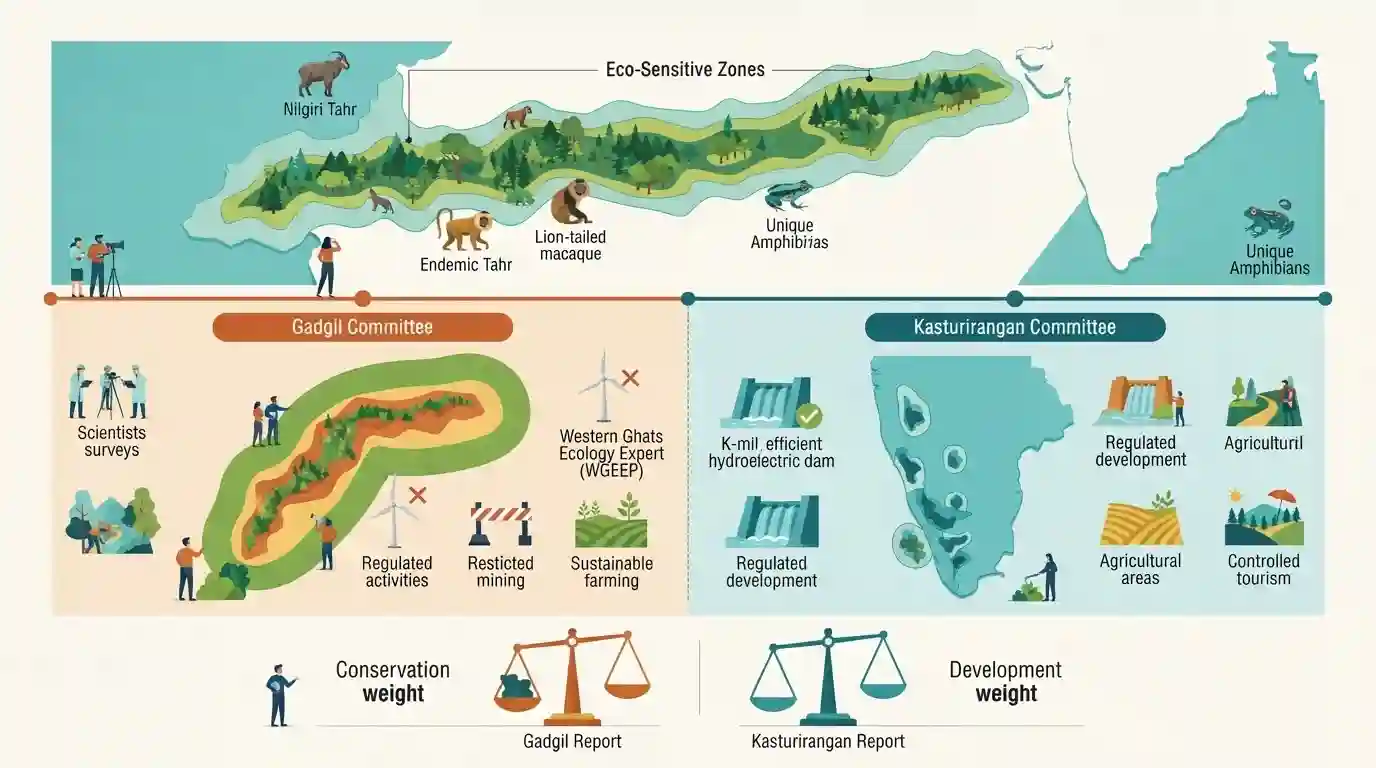
The article explores the concept of Eco-Sensitive Zones (ESZs) with a specific focus on the Western Ghats, reviewing landmark committees like the Gadgil and Kasturirangan committees and their recommendations for balancing developmental needs with environmental conservation in ecologically fragile regions.
Key Points
- The Western Ghats span across six states, including Maharashtra, and are designated as one of the world's hottest biodiversity hotspots.
- Two major committees, the Western Ghats Ecology Expert Panel (Gadgil Committee) and the High Level Working Group (Kasturirangan Committee), were appointed to recommend measures for protecting the ecology of the Western Ghats.
- Gadgil Committee recommended classifying the entire Western Ghats into Ecologically Sensitive Zones (ESZ 1, 2, and 3) with strict regulatory oversight, while the Kasturirangan Committee recommended protecting 37% of the area under ESZ.
- Eco-Sensitive Zones (ESZs) are notified under the Environment (Protection) Act, 1986, to act as a shock absorber around protected areas like national parks and wildlife sanctuaries.
Important Terms
Environment (Protection) Act, 1986

An omnibus umbrella legislation enacted in 1986 under Article 253, empowering the Central Government to coordinate actions, set standards, and notify Eco-Sensitive Zones (ESZs) to protect and improve the human environment.
UPSC context
MPSC Paper I/II (Environment & Polity): Tests foundational statutory provisions for environmental regulation, centralizing ecological protection powers in India.
Ministry of Environment, Forest and Climate Change (MoEFCC)
The apex central government ministry responsible for planning, promoting, and implementing environmental, forestry, and climate change policies and legislative frameworks across India.
UPSC context
MPSC Paper II (Governance): Essential nodal body regarding environmental administration, policy formulation, and notification of ecologically sensitive regions.
Gadgil Committee
The Western Ghats Ecology Expert Panel (2011) led by Madhav Gadgil, which recommended declaring 75% of the Western Ghats as an Ecologically Sensitive Area with decentralized governance and strict mining bans.
UPSC context
MPSC Paper I (Geography & Environment): Core committee report on Western Ghats conservation, frequently asked for its stringent ecological recommendations.
Kasturirangan Committee
The High-Level Working Group (2013) led by K. Kasturirangan that recommended restricting the Ecologically Sensitive Area designation to 37% of the Western Ghats using satellite remote-sensing methodology.
UPSC context
MPSC Paper I (Environment & Development): Frequently tested committee report balancing sustainable development with biodiversity conservation in fragile regions.
Prelims Trap
Both Gadgil and Kasturirangan committees recommended classifying 100% of the Western Ghats as Ecologically Sensitive Zones with identical restrictions.
Aspirants often confuse Gadgil Committee's complete region-wide ESZ classification with Kasturirangan's 37% targeted ESA approach.
Static Concepts Connected
What are the key differences between Gadgil and Kasturirangan Committees on Western Ghats?
- Gadgil Approach: Gadgil Panel recommended entire Western Ghats as Ecologically Sensitive, with bottom-up democratic governance and strict bans on mining and major dams.
- Kasturirangan Approach: Kasturirangan Panel recommended protecting only 37% of the region using remote sensing, adopting a more developmental-friendly, top-down regulatory framework.
Cross-Topic Patterns
Western Ghats conservation vs. infrastructure demands
The debate between developmental projects and ecological preservation in the Western Ghats directly intersects with state-level administrative implementation challenges in Maharashtra's Konkan region.
Gadgil vs. Kasturirangan committee parameters
Comparing committee recommendations (Gadgil vs. Kasturirangan) tests analytical clarity on statutory definitions under the Environment (Protection) Act, 1986.

Expect a matching or statement-based question comparing Madhav Gadgil and Kasturirangan committee recommendations on Western Ghats.
Linked PYQs · 2
Linked PYQs · 2
- 2017MPSC_PRELIMSGS1
Which of the following mountains are considered as one of the top biodiversity hot spots ?
- 2022MPSC_PRELIMSGS1
In India, which of the following has become a hot-spot with reference to threats to biodiversity ?
