E-Governance and Digital Public Infrastructure in India
Source:Indian Express ↗
Why It Matters
E-governance and DPI are recurring themes in GS Paper 2, directly linked to transparency, accountability, and efficient public service delivery.
Summary
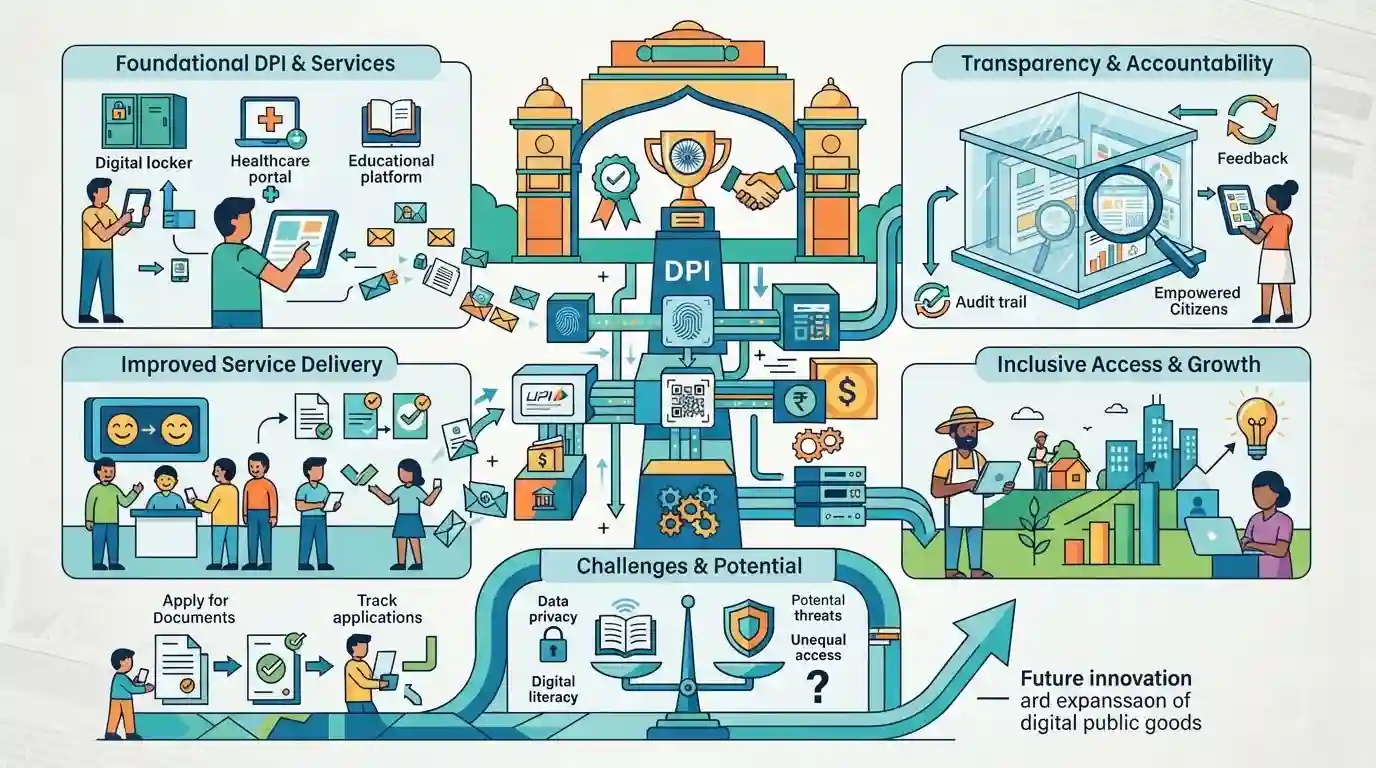
The article discusses e-governance awards and the significance of Digital Public Infrastructure (DPI) in transforming public service delivery, transparency, and citizen-government interactions in India.
Key Points
- E-governance initiatives focus on leveraging digital technology to enhance public service delivery, transparency, and administrative efficiency.
- Digital Public Infrastructure (DPI) serves as a foundational layer for scaling public and private digital services across India.
- National e-Governance Awards recognize innovative digital interventions, citizen-centric applications, and excellence in governance models.
Important Terms
Digital Public Infrastructure

A foundational stack of open digital systems—such as Aadhaar, UPI, and DigiLocker—that enables secure identity verification, instant payments, and document sharing to facilitate public and private service delivery.
UPSC context
UPSC GS Paper II: Governance, Polity & Social Justice. Tests understanding of digital inclusion, fintech, and transparent public service delivery.
National e-Governance Awards
Prestigious annual awards administered by the Department of Administrative Reforms and Public Grievances (DARPG) to recognize excellence in implementing digital governance and citizen-centric e-governance initiatives.
UPSC context
UPSC GS Paper II: E-governance applications, models, successes, limitations, and potential. Tests awareness of administrative innovations.
Digital India
A flagship umbrella program launched by the Government of India to transform the country into a digitally empowered society and knowledge economy through broadband highways, universal mobile access, and e-governance.
UPSC context
UPSC GS Paper III: IT and computers, digital empowerment. Tests knowledge of national missions promoting technology-driven governance and economic growth.
Prelims Trap
Digitisation of government records is synonymous with Digital Public Infrastructure.
Aspirants often confuse routine computerisation of government files with genuine Digital Public Infrastructure (DPI), which requires open-source interoperability and population-scale public goods architecture.
Static Concepts Connected
What are the key pillars of India's Digital Public Infrastructure (DPI) framework?
- Aadhaar Foundation: Identity layer providing a portable, biometric-backed digital identity for verification across services.
- Payments Layer: Unified Payments Interface enabling instant, interoperable peer-to-peer and merchant transactions through open APIs.
- Data Empowerment: Consent-based data sharing architecture allowing secure, user-authorized transfer of personal financial and health records.
Cross-Topic Patterns
DPI + Global South Diplomacy
India Stack export strategies connect DPI success directly to Global South diplomacy and minilateral tech coalitions.
Digital Infrastructure + Fiscal Federalism
The shift from basic digitisation to predictive DPI delivery alters fiscal federalism models by centralising core tech rails while states handle last-mile execution.

Expect statement-based questions on the distinction between basic digitisation and DPI's foundational, open-source interoperable architecture.
Linked PYQs · 3
Linked PYQs · 3
- 2024MainsGS2
e-governance is not just about the routine application of digital technology in service delivery process. It is as much about multifarious interactions for ensuring transparency and accountability. In this context evaluate the role of the 'Interactive Service Model' of e-governance.
- 2023MainsGS2
e-governance, as a critical tool of governance, has ushered in effectiveness, transparency and accountability in governments. What inadequacies hamper the enhancement of these features ?
- 2025MainsGS2
e-governance projects have a built-in bias towards technology and back-end integration than user-centric designs. Examine.
