E-Governance Awards and Digital Public Infrastructure in India
Source:Indian Express ↗
Why It Matters
E-governance and Digital Public Infrastructure are core components of the GS2 syllabus under governance, focusing on transparency, citizen-centric service delivery, and digital inclusion.
Summary
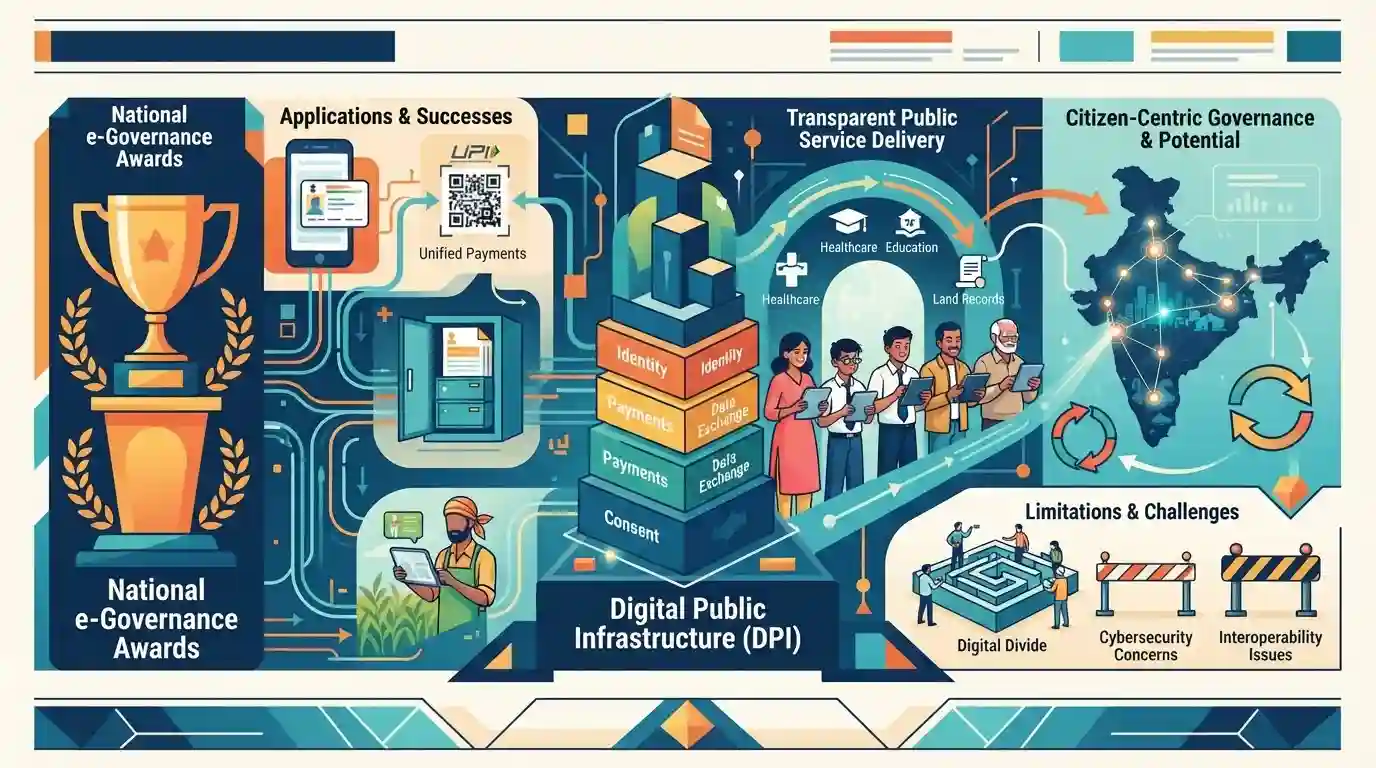
The article explores the significance of the National e-Governance Awards and the role of Digital Public Infrastructure (DPI) in transforming public service delivery, ensuring transparency, and promoting citizen-centric governance in India.
Key Points
- The National e-Governance Awards recognize excellence in implementing e-governance initiatives at national, state, and district levels.
- Digital Public Infrastructure (DPI) serves as the foundational backbone for inclusive digital service delivery and citizen empowerment.
- Effective e-governance enhances transparency, accountability, and citizen-centric governance by reducing bureaucratic red tape.
Important Terms
National e-Governance Awards

An annual scheme by the Department of Administrative Reforms and Public Grievances that recognizes and rewards excellence, innovation, and best practices in implementing e-governance initiatives across central, state, and local governments in India.
UPSC context
UPSC Mains Paper II / Governance: Tests knowledge of e-governance applications, models, successes, and digital public service delivery.
Digital Public Infrastructure (DPI)
Foundational digital systems like Aadhaar, UPI, and DigiLocker operating at population scale to provide interoperable identity, payment, and data exchange services for inclusive public and private service delivery.
UPSC context
UPSC Mains Paper III / Economy & Governance: Tests understanding of technology-driven inclusion, digital economy, and infrastructure development.
National e-Governance Division (NeGD)
An independent business division under Digital India Corporation (MeitY) that provides technical, project management, and advisory support for implementing e-governance projects and digital platforms nationwide.
UPSC context
UPSC Mains Paper II / Governance: Tests awareness of institutional frameworks driving e-governance initiatives in India.
Digital India Programme
A flagship initiative of the Government of India launched to transform the country into a digitally empowered society and knowledge economy through improved online infrastructure and governance.
UPSC context
UPSC Mains Paper III / Economy & Governance: Tests familiarity with national missions promoting digital inclusion and e-governance.
Prelims Trap
Digital Public Infrastructure (DPI) in India is a proprietary digital platform managed exclusively by private fintech corporations.
Aspirants often confuse DPI architecture as being proprietary software owned by private corporations, whereas India Stack layers are interoperable public goods built on open-API frameworks.
Static Concepts Connected
What are the core foundational layers of India's Digital Public Infrastructure (DPI)?
- Aadhaar (Identity):: Population-scale identity layer providing biometric and demographic verification for residents.
- UPI (Payments):: Interoperable real-time payment system enabling instant peer-to-peer and merchant transactions at zero marginal cost.
- DigiLocker (Data):: Cloud-based platform for issuance, storage, and verification of official documents and certificates securely.
Cross-Topic Patterns
DPI & Techno-Economic Diplomacy
India's export of India Stack components (UPI, Aadhaar) to Global South nations serves as a key pillar of India's soft power diplomacy and techno-economic outreach.
DPI & Fiscal Federalism (DBT)
The integration of DPI with flagship welfare schemes (DBT) has structurally transformed fiscal federalism and reduced leakage in public expenditure management.

DPI + G20 consensus on digital public infrastructure likely to feature as a multi-statement assertion in Prelims.
Linked PYQs · 3
Linked PYQs · 3
- 2024MainsGS2
e-governance is not just about the routine application of digital technology in service delivery process. It is as much about multifarious interactions for ensuring transparency and accountability. In this context evaluate the role of the 'Interactive Service Model' of e-governance.
- 2023MainsGS2
e-governance, as a critical tool of governance, has ushered in effectiveness, transparency and accountability in governments. What inadequacies hamper the enhancement of these features ?
- 2025MainsGS2
e-governance projects have a built-in bias towards technology and back-end integration than user-centric designs. Examine.
