Role of Digital Public Infrastructure in India E-Governance
Source:Indian Express ↗
কেন এটি গুরুত্বপূর্ণ
E-governance and Digital Public Infrastructure (DPI) are core components of India's administrative framework, frequently featured in GS Paper 2 questions focusing on transparency, accountability, and digital service delivery models.
সারসংক্ষেপ
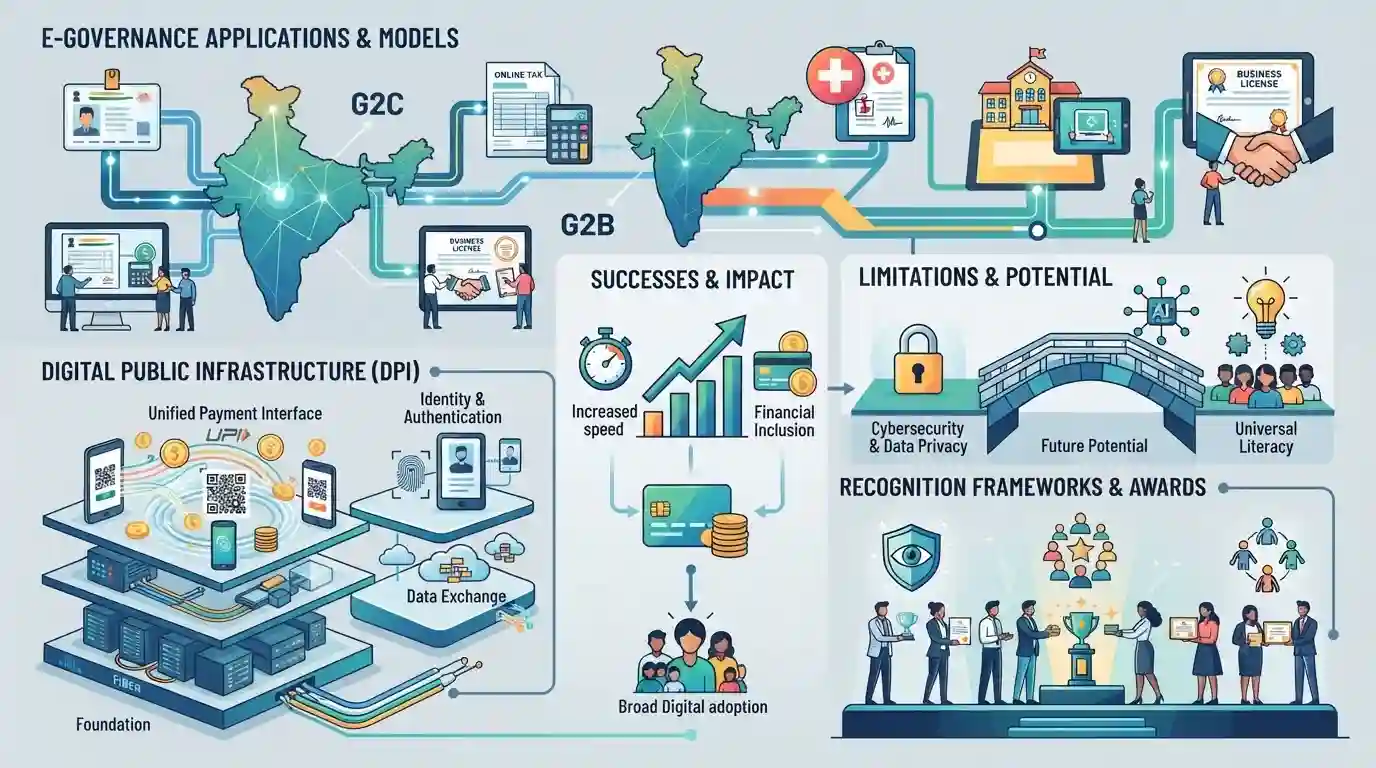
An overview of India's advancements in e-governance, digital public infrastructure (DPI), and recognition frameworks like national e-governance awards that promote transparency, citizen-centric service delivery, and digital inclusion.
মূল বিষয়
- E-governance awards recognize pioneering digital initiatives that improve service delivery, transparency, and accountability in governance.
- India's Digital Public Infrastructure (DPI)—encompassing identity (Aadhaar), payments (UPI), and open networks (ONDC)—serves as a global model for financial inclusion and digital democratization.
- Digital transformation initiatives aim to decentralize commercial and administrative processes, breaking information silos and empowering micro, small, and medium enterprises (MSMEs).
প্রিলিমস ফাঁদ
Government-operated networks like UPI and ONDC function as direct public sector undertakings under the Ministry of Electronics and IT.
Aspirants often assume ONDC and UPI are state-owned government departments, whereas UPI is developed by NPCI (an umbrella organization for retail payments) and ONDC is an initiative of DPIIT.
সংযুক্ত স্থির ধারণা
What are the core pillars and architectural layers of India's Digital Public Infrastructure (DPI)?
- Identity Layer: Foundational ID layer established via Aadhaar ensuring unique digital identity and legal verification.
- Payment Layer: Payment layer powered by UPI and Aadhaar Enabled Payment System (AePS) for instant interoperable transactions.
- Consent Layer: Data sharing consent layer via Account Aggregator framework empowering citizen data control.
আন্তঃবিষয় প্যাটার্ন
Digital Public Infrastructure & Inclusive Growth
The intersection of DPI (UPI, ONDC) and MSME market access directly links to inclusive economic growth and competition policy under GS-3.
DBT, JAM Trinity, and Fiscal Federalism
JAM trinity and DBT implementation mirror fiscal federalism challenges regarding direct welfare delivery and state-level fiscal space.

Expect a statement-based prelims question combining ONDC (open network) and NPCI (UPI) architecture with DPI ownership models.
সংযুক্ত PYQ · 3
সংযুক্ত PYQ · 3
- 2024MainsGS2
e-governance is not just about the routine application of digital technology in service delivery process. It is as much about multifarious interactions for ensuring transparency and accountability. In this context evaluate the role of the 'Interactive Service Model' of e-governance.
- 2023MainsGS2
e-governance, as a critical tool of governance, has ushered in effectiveness, transparency and accountability in governments. What inadequacies hamper the enhancement of these features ?
- 2026PrelimsGS1
Which one of the following best describes the key objective of India's 'Open Network for Digital Commerce' (ONDC) initiative ?
