COP Climate Summits Outcomes and India Stance
Source:Indian Express ↗
Why It Matters
Understanding the outcomes, institutional dynamics, and key contentions of UN climate change conferences (COP) is essential for aspirants tracking international environmental agreements and India's negotiating positions.
Summary
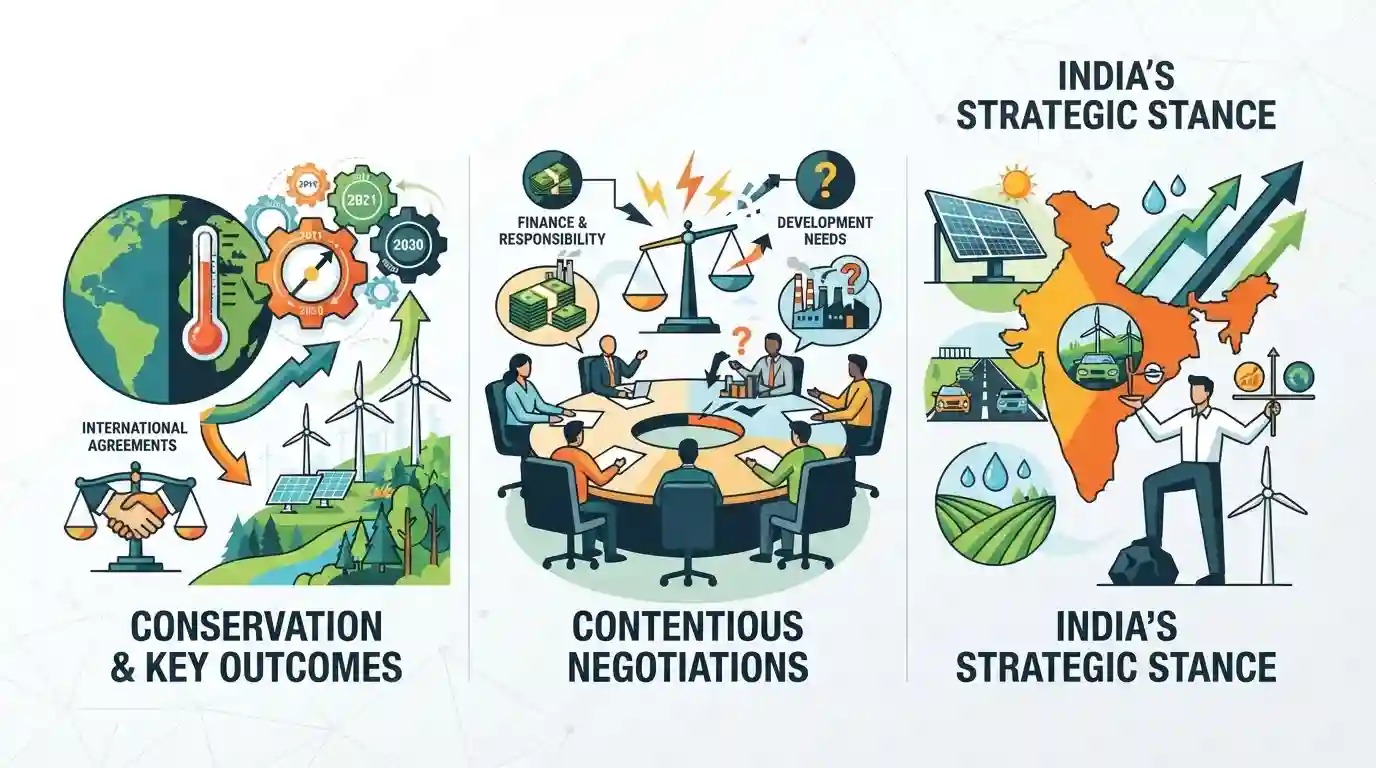
An overview of the UNFCCC Conference of the Parties (COP) framework, focusing on key outcomes, contentious negotiations, and India's strategic stance on global climate policy and commitments.
Key Points
- COP summits serve as the primary decision-making body of the UNFCCC, tackling global climate change mitigation, adaptation, and finance.
- India's stance at global climate negotiations revolves around equity, common but differentiated responsibilities and respective capabilities (CBDR-RC), and climate justice.
- Key contentions at climate summits often include climate finance, fossil fuel phase-down timelines, and technology transfer from developed to developing nations.
Important Terms
Paris Agreement

A legally binding international treaty adopted in 2015 at COP21, aiming to limit global temperature rise to well below 2°C while pursuing efforts for 1.5°C above pre-industrial levels.
UPSC context
GS Paper III (Environment and Ecology): Crucial for questions on international climate treaties, NDCs, mitigation strategies, and equity principles.
UNFCCC
The United Nations Framework Convention on Climate Change, a 1992 Rio Earth Summit treaty providing the foundational global legal framework for addressing climate change.
UPSC context
GS Paper III (Environment & Ecology): Tests understanding of global institutional architecture, international conventions, and historical responsibilities.
Conference of the Parties
The supreme decision-making body of the UNFCCC, comprising all ratifying member states, that meets annually to review implementation and negotiate climate commitments.
UPSC context
GS Paper III (Environment & Ecology): Essential for current affairs related to annual climate summits, contentious negotiations, and India's negotiating stance.
Prelims Trap
All emission reduction targets and timelines agreed upon under UNFCCC COP decisions are legally binding on member states.
Aspirants often confuse legally binding targets under the Paris Agreement (like NDC submissions) with legally binding economy-wide emission reduction targets, which are nationally determined and non-punitive.
Static Concepts Connected
What are the core principles underlying the UNFCCC and the Paris Agreement?
- Historical Responsibility: Acknowledges that developed countries bear a higher historical responsibility for greenhouse gas emissions.
- CBDR-RC Principle: Mandates global action while factoring in differing national capabilities and developmental needs of developing countries.
- Equitable Development: Ensures that climate action does not compromise the fundamental right of developing nations to eradicate poverty and pursue growth.
Cross-Topic Patterns
Climate Finance vs. Global Financial Architecture
Climate finance commitments made by developed nations intersect directly with multilateral development bank reforms and IMF Special Drawing Rights allocation debates.
Green Technology Transfer & IPR Flexibilities
India's push for green technology transfer parallels debates on TRIPS waiver flexibilities at the WTO for green and health technologies.

CBDR-RC vs net-zero targets and historical emissions share will likely feature in an analytical Prelims/Mains statement question.
Linked PYQs · 2
Linked PYQs · 2
- 2025MainsGS3
Write a review on India's climate commitments under the Paris Agreement (2015) and mention how these have been further strengthened in COP26 (2021). In this direction, how has the first Nationally Determined Contribution intended by India been updated in 2022?
- 2021MainsGS3
Describe the major outcomes of the 26th session of the Conference of the Parties (COP) to the United Nations Framework Convention on Climate Change (UNFCCC). What are the commitments made by India in this conference?
