COP31 Climate Summit Outcomes and India Stance
Source:Indian Express ↗
Why It Matters
Crucial for understanding evolving global climate architecture, climate finance disputes, and India's diplomatic negotiation posture on equity and CBDR-RC.
Summary
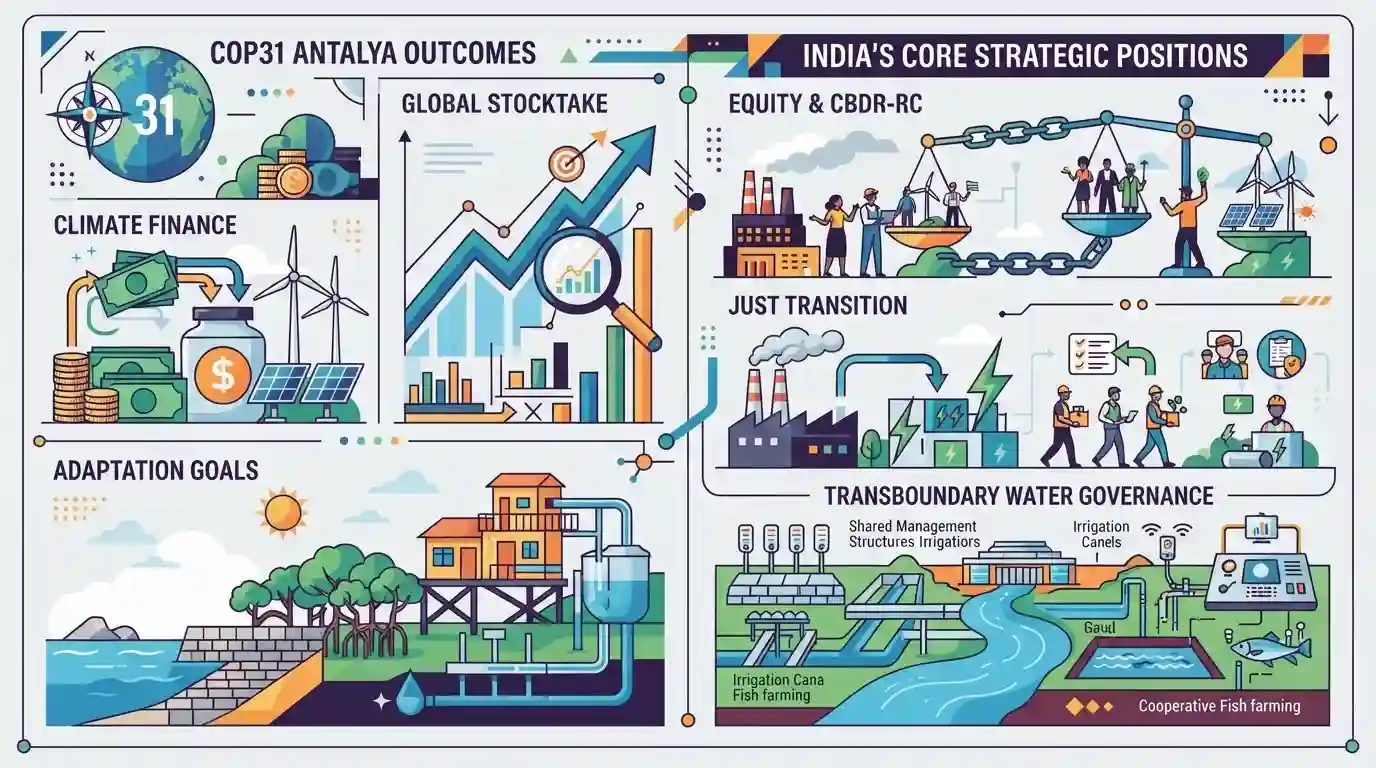
An overview of COP31 outcomes held in Antalya, Türkiye, detailing major developments in climate finance, global stocktake, adaptation goals, and India's core strategic positions on equity, CBDR-RC, just transition, and transboundary water governance.
Key Points
- COP31 held in Antalya, Türkiye under a unique Türkiye-Australia leadership framework focused on climate finance and implementation rather than a new treaty.
- Climate finance contentions centered around the New Collective Quantified Goal (NCQG) and the Baku-to-Belém Roadmap scaling funds to $1.3 trillion annually by 2035.
- India championed climate justice, equity, CBDR-RC, equitable access to the carbon budget, and opposed arbitrary global electrification targets while linking transboundary water cooperation to bilateral relations.
- The Second Global Stocktake (GST-2) was launched at COP31 to assess collective progress under the Paris Agreement toward COP33.
Static Concepts Connected
What are the foundational principles governing the UNFCCC and Paris Agreement architecture?
- CBDR-RC:: Equity-driven framework acknowledging that historical emitters bear greater responsibility for global warming.
- NDCs:: Mandate requiring all parties to prepare, communicate, and maintain successive nationally determined contributions.
- Global Stocktake:: Process conducted every five years to assess collective progress toward achieving the Paris Agreement goals.
Cross-Topic Patterns
Climate negotiations vs. WTO trade rules
India's resistance to carbon border taxes at UNFCCC connects directly to WTO rules on non-discrimination and unilateral environmental measures.
Hydro-diplomacy and transboundary water governance
India's linkage of transboundary water cooperation to bilateral treaties mirrors broader hydro-diplomacy challenges in the Brahmaputra and Indus basins.

Expect a statement-based question pairing CBDR-RC evolution with GST implementation timelines under the Paris Agreement.
Linked PYQs · 2
Linked PYQs · 2
- 2025MainsGS3
Write a review on India's climate commitments under the Paris Agreement (2015) and mention how these have been further strengthened in COP26 (2021). In this direction, how has the first Nationally Determined Contribution intended by India been updated in 2022?
- 2021MainsGS3
Describe the major outcomes of the 26th session of the Conference of the Parties (COP) to the United Nations Framework Convention on Climate Change (UNFCCC). What are the commitments made by India in this conference?
