BRICS Indore Declaration and Agricultural Cooperation
Source:Indian Express ↗
Why It Matters
Provides highly specific, citable examples of BRICS cooperation in non-traditional security domains (food, digital agriculture) for GS2 IR answers, while also offering crucial facts (BRICS AgriN, Indore Declaration) for Prelims and GS3 agriculture/technology answers.
Summary
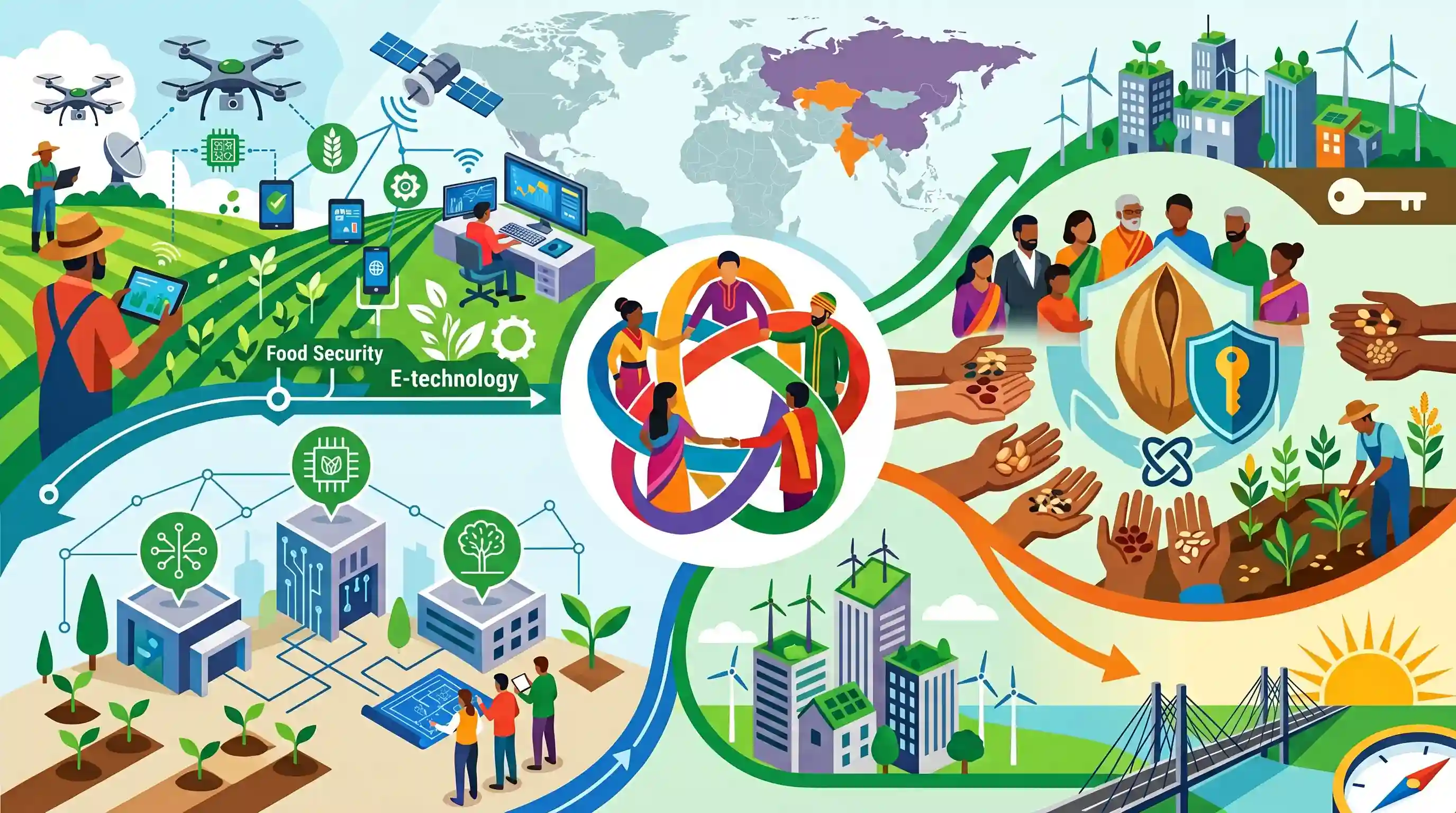
The BRICS Indore Declaration marks a significant pivot towards intra-group cooperation on food security, agricultural technology, and sustainable urban development. Major outcomes include the establishment of specialized networks for agro-ecology and digital agriculture, alongside the 'BRICS AgriN' initiative for agricultural startups. The declaration also prioritizes seed sovereignty through the Global Forum on Farmers' Rights in Seed Systems. With India set to chair BRICS in 2026, these developmental and non-traditional security initiatives will shape its multilateral diplomatic agenda.
Key Points
- The BRICS grouping adopted the Indore Declaration, prioritizing cooperation in agriculture, food security, and farmer welfare.
- Key initiatives launched include the BRICS Network of Centres of Excellence on Agro-Ecology and the BRICS Network on Digital Agriculture.
- The grouping established the Global Forum on Farmers' Rights in Seed Systems to protect genetic resources and seed sovereignty.
- The 'BRICS AgriN' platform was introduced to boost agricultural innovation and support agri-startups across member nations.
- India will hold the BRICS presidency in 2026, positioning it to steer these agricultural and urban sustainability agendas globally.
Important Terms
BRICS Indore Declaration

A 2026 joint agricultural charter adopted under India's BRICS chairship focusing on food security, climate-resilient farming, and farmer welfare through institutional cooperation.
UPSC context
GS II: Regional and Global groupings; tests India's leadership and multilateral diplomatic outcomes.
BRICS Network of Centres of Excellence on Agro-Ecology
A collaborative platform for joint research and capacity building in natural, organic, and regenerative farming, coordinated by ICAR-IIFSR, Modipuram.
UPSC context
GS III: Sustainable Agriculture; tests strategies for climate-resilient farming and soil health.
BRICS Network on Digital Agriculture
An initiative to integrate AI, geospatial technologies, and digital public infrastructure into agricultural systems, coordinated by IIT Delhi to benefit smallholder farmers.
UPSC context
GS III: E-technology for farmers; tests knowledge of digital public infrastructure in agriculture.
Global Forum on Farmers' Rights in Seed Systems
A platform for protecting seed sovereignty, conserving indigenous seed diversity, and safeguarding traditional knowledge, coordinated by India’s PPV&FRA.
UPSC context
GS III: Intellectual Property Rights; tests issues of biodiversity and traditional knowledge protection.
BRICS AgriN
The Agro Inputs, Genetic Resources and Information Network designed to facilitate structured exchange of high-yield varieties and technical expertise among BRICS members.
UPSC context
GS II/III: Food Security; tests international cooperation in agricultural inputs and genetic resources.
BRICS Urban Research and Knowledge Network
A virtual, chair-led platform for urban policy exchange and sustainable governance solutions among BRICS countries to foster resilient urban development.
UPSC context
GS I/II: Urbanization and Governance; tests knowledge of SDG 11 and sustainable city models.
Prelims Trap
"The BRICS Indore Declaration is an agreement focused primarily on urban sanitation and solid waste management."
Due to Indore's top ranking in Swachh Survekshan, aspirants reflexively associate the city with sanitation. This declaration actually prioritizes agriculture, agro-ecology, and seed sovereignty.
Static Concepts Connected
How does India legally protect farmers' rights in seed systems?
- PPV&FR Act, 2001: Grants intellectual property rights to plant breeders, researchers, and farmers to ensure seed sovereignty.
- Sui Generis System: India opted for a unique TRIPS-compliant model rather than the stricter UPOV convention.
- Seed Saving Rights: Farmers can legally save, use, exchange, and sell unbranded seeds of protected plant varieties.
What are the core principles of Agro-Ecology?
- Ecological Mimicry: Designs farming systems that mimic natural ecosystems, optimizing biodiversity, water conservation, and soil health.
- Reduced Inputs: Minimizes reliance on synthetic fertilizers and pesticides through biological pest control and nutrient cycling.
- Climate Resilience: Promotes practices like crop rotation and agroforestry, enhancing adaptation to climate change extremes.
Cross-Topic Patterns
BRICS + IPR in Agriculture
The BRICS Global Forum on Seed Systems links GS2 diplomacy with GS3 IPR, challenging restrictive Western regimes like UPOV to protect Global South farmers.
Agri-Tech as Soft Power
BRICS Network on Digital Agriculture and 'AgriN' align with India’s push to export its agricultural Digital Public Infrastructure (Agri-stack) to developing nations.

Expect a 2026 prelims pairing question matching recent BRICS declarations (Indore, Kazan, Johannesburg) to their core themes like agriculture.
Linked PYQs · 5
Linked PYQs · 5
- 2015PrelimsGS1
The 'Fortaleza Declaration', recently in the news, is related to the affairs of
- 2025PrelimsGS1
Consider the following statements with regard to BRICS : I. 16th BRICS Summit was held under the Chairship of Russia in Kazan. II. Indonesia has become a full member of BRICS. III. The theme of the 16th BRICS Summit was Strengthening Multiculturalism for Just Global Development and Security. Which of the statements given above is/are correct?
- 2012MainsGS2
Compare the significance of IBSA and BRICS in the context of India's multilateral diplomacy.
- 2023MainsGS3
How does e-Technology help farmers in production and marketing of agricultural produce? Explain it.
- 2019PrelimsGS1
Consider the following statements : 1. According to the Indian Patents Act, a biological process to create a seed can be patented in India. 2. In India, there is no Intellectual Property Appellate Board. 3. Plant varieties are not eligible to be patented in India. Which of the statements given above is/are correct?
